

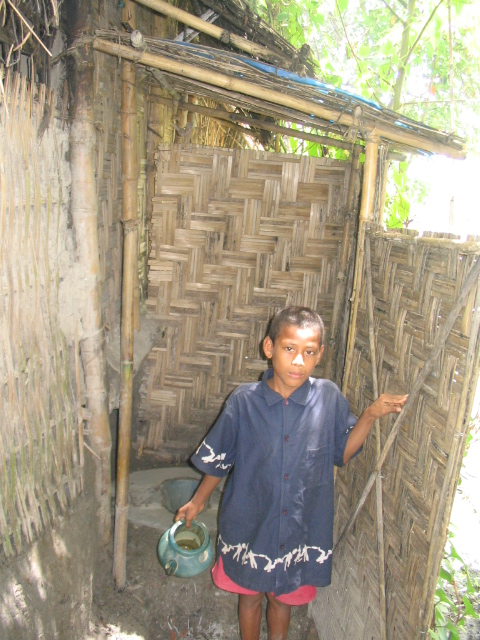
 According to the UN, 2.6 billion people around the world do not have access to what we take for granted, a clean and safe latrine. The UN General Assembly declared the year 2008 the International Year of Sanitation, the goal is to raise awareness and to accelerate progress towards the Millennium Development Goal (MDG) target to reduce by half the proportion of the 2.6 billion people without access to basic sanitation by 2015.
According to the WHO, about 2 million people die every year due to diarrheal diseases caused by poor sanitation and hygiene; most of them are children less than 5 years of age.To help combat this, Plan is pioneering new approach in Asia and East and Southern Africa – Community-Led Total Sanitation (CLTS), which educates communities about the importance of sanitation and helps them to construct and maintain their own latrines. Dr. Selina Amin brought to our attention the work of the Jaldhaka Program Unit of Plan Bangladesh.
The Jaldhaka Program Unit is situated at the northern part of Bangladesh. Their target population included 100,000 children and adults in rural communities where lack of appropriate facilities led to open defecation. CLTS was introduced, and a creative approach was added – active involvement of children. They call it the Child-to-Child (CtC) approach, where children became active participants in changing community behaviors. Armed with knowledge, flags and a whistle, children were empowered to participate by alerting the community with whistles when someone was caught not using a latrine. Continue reading “Stories from the Field: Blowing whistles for change.”

 IH CONNECT