It’s (UN) official: South Korea’s mandatory HIV testing for foreigners is racial discrimination

Note: This was cross-posted to my own blog.


South Korea has come under fire in recent years for its treatment of immigrants, migrant workers, and non-ethnic Koreans (and even their own working-class people). Last fall, Bitter Harvest, Amnesty International’s report on the country’s treatment of agricultural migrant laborers highlighted how Southeast Asian migrants went unpaid, were subjected to harsh treatment and squalid living conditions, and were either deprived of medical care or forced to pay for their own care out of pocket (from their own meager wages). In some cases, the migrants were forced to take (and pay for) an HIV test, with employers requiring a negative test result.

In the case of migrant workers, this is clearly illegal – currently, the only visa category for which the South Korean government requires an HIV test is E-2 (native-speaking English teachers from the US, Canada, the UK, Ireland, South Africa, Australia, and New Zealand). However, even this requirement – first implemented in 2007 in response to a racially-fueled moral panic – has been determined to be discriminatory and racially motivated, according to a ruling from the UN’s Committee to End all forms of Racial Discrimination (CERD) handed down last week. The ruling, issued in response to a case filed by a New Zealand woman who lost her job in 2009 after refusing to take an HIV test to renew her contract – has been long awaited by the expat ESL community in Korea. Whether the Korean government will remove the requirement remains to be seen.

The case was brought to CERD by Benjamin Wagner, an international human rights attorney who co-authored a legal paper on the issue of South Korea’s use of HIV testing as a proxy for racial discrimination with Matt van Volkenburg. The paper (PDF) provides an excellent background on the history, political and cultural climate, and xenophobic advocacy efforts that led to the implementation of the testing requirement, as well as how the requirement is a clear example of South Korea shirking its international human rights obligations:

The HIV and drug test requirements for foreign teachers were first established as emergency measures in 2007 by the Ministry of Justice
(“MOJ”), which claimed they were necessary in order to “ease the anxiety of the citizens.” Part II of this Article examines the background and
context of the implementation of these requirements and argues that they were introduced during a period of media hysteria and moral panic…a civil society group called the “Citizens’ Group for Upright English Education”…succeeded in courting public opinion against foreign English teachers by contributing to highly sensationalized media reportage replete with lurid tales of perversion, sex crimes, drug use and AIDS. This group was also successfully able to influence national policy by petitioning the government for measures against foreign teachers, including mandatory HIV and drug tests.

Part III examines the ROK’s international commitments to eliminate discrimination and stigma based on actual or presumed HIV status and
examines how and why the ROK has failed to honor these commitments.

Korea’s HIV restrictions for foreign teachers are among the most extreme form of HIV restrictions in the world…Of the forty-nine countries in the world that continue to have some form of HIV-related restrictions in place for foreigners only about six have restrictions so extreme as requiring in-country testing for foreign workers that must be repeated on a regular basis, and nowhere are teachers subject to such restrictions. Indeed, the ROK’s extreme position toward its foreign teacher population has attracted the attention of UN Secretary-General Ban Ki-moon who has urged the ROK to eliminate its HIV restrictions on foreign teachers.

Obviously, any foreigner who tests positive for HIV is immediately detained and deported; in 2008, the Korean CDC reported that it had deported 521 out of 647 HIV-positive foreigners. Non-nationals of Korean ethnicity have been able to successfully challenge such deportations, but the Korean judicial system explicitly differentiates between the legal rights of citizens versus foreign nationals.

Interestingly, South Korea has given CERD “the same authority as domestic law” regarding foreign nationals; however, this means next to nothing as Wagner explained in a different piece last week:

Professor Kyong-Whan Ahn…remarked that the constitutional analysis used by Korean courts to determine whether an incidence of discrimination has occurred is relatively underdeveloped. The method relied upon by courts is the “reasonableness test”. But, Ahn complains, decisions are all too often “a foregone conclusion” with little analysis or scrutiny.

[T]he status of the CERD is unique in that “it has the same authority of domestic law and does not necessitate additional legislation,” as the Republic of Korea has made clear to the Committee on several occasions. Nevertheless, the Committee has responded, “although the Convention forms part of the domestic law and is directly applicable in the courts of [South Korea], there are no court decisions which contain references to or confirm the direct applicability of its provisions.” The Committee has pointed out to the government that the situation may be the result of “a lack of awareness of the availability of legal remedies” and has recommended “information campaigns and education programmes on the Convention and its provisions.” Unfortunately, however, the treaty remains relatively unknown in Korea and neither the government nor the courts have done enough to change that.

van Volkenburg, who has been covering this issue (and its origins) since it all began in 2005 at the long-running Korean expat blog Gusts of Popular Feeling, has a great summary of the ruling and its implications (as well as the best collection of links to the news coverage of the ruling):

The summary makes public the justification the UMOE offered for the tests – something that many people taking these tests have known for years, but never admitted by the government:
[D]uring arbitration proceedings, L.G.’s employers, the Ulsan Metropolitan Office of Education (UMOE), said that HIV/AIDS tests were viewed as a means to check the values and morality of foreign English teachers.

One of the Committee’s recommendations isn’t very surprising:

The Committee recommends that the State party grant the petitioner adequate compensation for the moral and material damages caused by the above-mentioned violations of the Convention, including compensation for the lost wages during the one year she was prevented from working.

It continues with much more sweeping recommendations, however:

It also recommends that the State Party takes the appropriate means to review regulations and policies enacted at the State or local level related to employment of foreigners and abolish, both in law and practice, any piece of legislation, regulation, policy or measure which has the effect of creating or perpetuating racial discrimination. The Committee recommends the State party to counter any manifestations of xenophobia, through stereotyping or stigmatizing, of foreigners by public officials, the media and the public at large, including, as appropriate, public campaigns, official statements and codes of conduct for politicians and the media. The State party is also requested to give wide publicity to the Committee’s Opinion, including among prosecutors and judicial bodies, and to translate it into the official language of the State party.

This doesn’t just refer to English teachers, but to regulations for all foreign workers. And as I’ve covered here, the references to the conduct of the media and politicians is very pertinent, considering the ‘Citizens Group for Upright English Education’ (also known as Anti English Spectrum) worked closely with the media and had access to politicians when pushing for the creation of the HIV testing policy (among others) in the first place.

It will be interesting to see how the Korean government will respond to the CERD’s ruling – whether it will in fact change the law in accordance with its treaty obligations. Based on South Korea’s history of human rights protections, it does not look promising. Even when human rights principles are codified into law, employers (and often police officers) who violate workers’ legal rights do so with widespread impunity and are rarely prosecuted or held accountable – as demonstrated by the cases of the migrant workers in Bitter Harvest and the workers enslaved on salt farms on the islands of Jeollanam-do. The admission that HIV tests were seen as a way to “check the values and morality” of visa applicants is a slap in the face – doubly so considering that only foreigners are required to have “upright values” in order to get jobs.

Nonetheless, the CERD ruling is a major victory – a solid foundation on which to pressure the South Korean government, which has demonstrated that it wants to be taken seriously in the international community.

#Polio eradication in @CDCMMWR: Are we finally on the cusp of that elusive dream?

Note: This was cross-posted to my own blog.


I came across a very encouraging article in last week’s MMWR (the CDC’s Morbidity and Mortality Weekly Report) this morning about polio eradication. After several reappearances in 2013, cases are down again this year and, if things continue to go well, the end may be in sight:

Four of six WHO regions have been certified as free of indigenous WPV, and endemic transmission of WPV continued in only three countries in 2014. In 2013, the global polio eradication effort suffered setbacks with outbreaks in the Horn of Africa, Central Africa, and the Middle East; however, significant progress was made in 2014 in response to all three outbreaks. Nonetheless, the affected regions remain vulnerable to WPV re-importation from endemic areas and to low-level, undetected WPV circulation. Continued response activities are needed in these regions to further strengthen AFP surveillance and eliminate immunity gaps through high-quality SIAs and strong routine immunization programs.

Progress in Nigeria since 2012 has brought the goal of interrupting the last known chains of indigenous WPV transmission in Africa within reach. Elimination of all poliovirus transmission in Nigeria in the near term is feasible, through intensified efforts to 1) interrupt cVDPV2 transmission, 2) strengthen routine immunization services, and 3) increase access to children in insecure areas. Similar efforts should be implemented in all countries in Africa, where 9 months have passed without a reported WPV case, and 6 months have passed since the last reported cVDPV2 case.

"Number
Number of cases of wild poliovirus type 1 in countries with recent polio outbreaks, by territory* — January 1, 2013–March 30, 2015

*Central Africa (Cameroon and Equatorial Guinea), Horn of Africa (Ethiopia and Somalia), and Middle East (Iraq and Syria).

The eradication push has suffered major blows in the last two years. In 2013, after six years of being polio-free, a major outbreak in Somalia contributed more polio cases to the year’s tally than the rest of the world combined; meanwhile, the virus made its way back into Syria that same fall after a 14-year hiatus. Luckily, extraordinary efforts in the midst of conflict zones on the part of health workers were able to beat the virus back to the heart of the fight – the final three countries in which it remains endemic.

Number of cases of wild poliovirus type 1 among countries with endemic poliovirus transmission, by country — January 1, 2013–March 30, 2015

Most (86%) WPV cases in Afghanistan in 2014 resulted from importation from Pakistan; however, the detection of orphan viruses highlights the need to strengthen the quality of both polio vaccination and AFP surveillance (10). Efforts are also needed to increase population immunity by intensifying routine polio immunization activities to ensure high coverage among infants with at least 3 OPV doses.

Recent challenges to the secure operation and public acceptance of the polio eradication program in Pakistan are unprecedented (10). Although poliovirus transmission has been concentrated primarily in the FATA region of northwest Pakistan, transmission has continued in the greater Karachi area, and WPV cases have been reported from all major Pakistan provinces. Successful efforts to enhance security to protect health workers and increase public demand for vaccination are urgently needed.

The recent gains in control and elimination of poliovirus transmission globally must be maintained and built upon through innovative strategies to access populations during SIAs in areas with complex security and political challenges, improve AFP surveillance, and strengthen routine immunization. With the progress achieved in 2014 to interrupt endemic WPV transmission in Nigeria and polio outbreaks in Africa and the Middle East, permanent interruption of global poliovirus transmission appears possible in the near future, provided that similar progress can be made in Afghanistan and Pakistan; progress there would also reduce the risk for future importation-related outbreaks in polio-free countries.

While there have been several cases of circulating vaccine-derived poliovirus in northern Nigeria, the fact that no wild poliovirus has been seen in the country since last July is extremely encouraging – eradication in Africa may be in sight. The final stronghold will be Pakistan and Afghanistan (primarily its regions that border Pakistan) – where, as the global health community has discussed ad nauseum, militants take advantage of the lack of public trust in eradication owing to bad intelligence schemes, among other things.

Obviously, it is still too early to tell. Gaps in surveillance mean incomplete data; there are most likely more cases that have not been reported. Furthermore, ongoing conflict (not to mention the recent Ebola outbreak) has left the health systems of many countries devastated, so vulnerabilities are everywhere. Nevertheless, with continued dedication (and a little luck), we may very well get there. Here’s hoping.

World Human Right Cities Forum Advances Interdisciplinary Rights Dialogue

Gwangju, the “City of Light” and capitol of Jeollanam-do province in South Korea, is also the country’s historical epicenter of democratic activism and civil disobedience. In addition to being known for its flavorful food and spicy kimchi, the city has made a name of itself as a champion of human rights. Aung San Suu Kyi accepted an award for democracy there in 2013 (that had been awarded to her in 2004, while she was still under house arrest), and the city hosts an Annual World Human Rights Cities Forum. I am so proud of the fact that my own time in Korea was there, and that I became actively involved in the Gwangju International Center – a non-profit organization focused on cultural exchange that organizes and co-hosts the forum – while I was there. My husband and I both still have a strong affinity for Gwangju, which is why he chose to do his internship for his Master of Global Policy Studies program at the GIC. He had the good fortune of attending this year’s forum and even had the opportunity to speak with several panelists. He graciously agreed to share his experience and observations – even those that relate to public health – so that I could feature them here. What follows is his coverage (and photos!).

Note: This was cross-posted to my own blog.


Gwangju, South Korea – From May 15th to May 18th Gwangju, South Korea played host to the 5th Annual World Human Rights Cities Forum. Begun in 2011, the World Human Rights Cities Forum (WHRCF) has grown into a premier forum for human rights advocacy and policy with an emphasis on community-level programming. The foundational concept for the forum is that of the “human rights city,” which, according to the Gwangju Human Rights Charter, is a city built on “the historical assets and the infrastructure of democracy and human rights the city has, a democratic administration of participatory autonomy, and civic consciousness that functions as a catalyst in implementation of the human rights.” Gwangju’s interest in human rights stems from its history as the site of the May 18 Democratic Uprising, a popular revolt that played a key role in South Korea’s transition to democracy in the 1980s.

The WHRCF aims to draw activists, community organizers, and city government officials together in order to encourage the exchange of policies and ideas involving human rights advocacy and implementation. While acknowledging that city-level government is often unable to set a national tone for human rights policy, the role of municipal governments in implementation of human rights policies is key. Sessions at the 2015 WHRCF covered a variety of different themed sessions including topics of state violence and torture, gender, disability, education, and social economy. In total, over one hundred speakers from twenty-three countries presented or participated in panel sessions.

Public health interests were well represented among the panelists. The thematic session on disability placed a significant focus on self-determination in access to care, particularly for patients with mental disabilities. Discussions involved the rights of the disabled to humane treatment when institutionalized in long-term facilities, and how municipal and provincial policies can encourage proper oversight and legal protection for long-term patients at psychiatric facilities. Areas of additional concern were policies protecting the disabled from involuntary sterilization and strategies to advance public education capabilities for developmentally disabled children. Many of these are areas where local ordinances or regional organizations can have a major effect on at-risk populations, even in situations where national healthcare and education policies are lacking in their protections for the disabled.

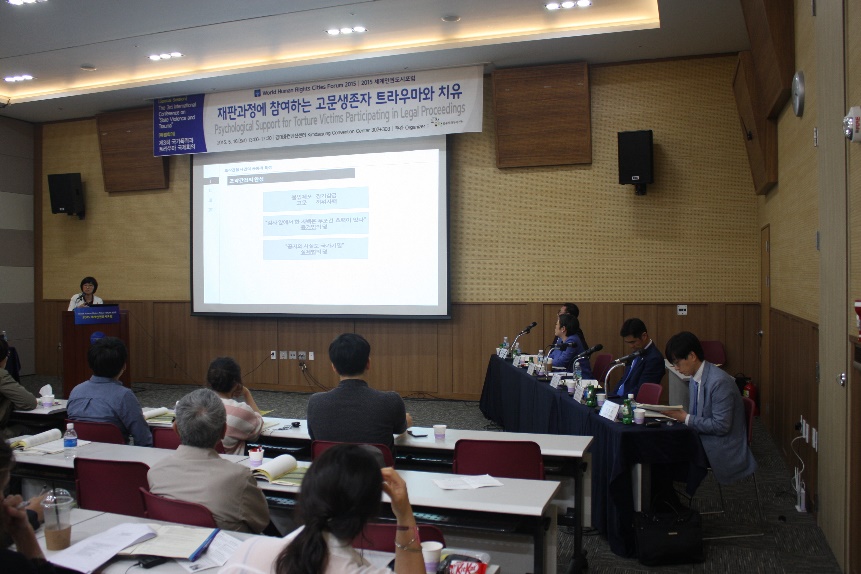
Panelists and audience members listen to a speaker at the special session on psychological support for torture victims participating in legal proceedings.

A topic of particular relevance in many countries, including even the United States given the ongoing racial tensions and unrest in places like Baltimore or Ferguson, was the thematic session on assisting victim of state violence and torture. In an interview following the session, panelist Pinar Onen, a clinical psychologist working with the Human Rights Foundation of Turkey, spoke about the need for psychological treatment for victims of state violence, and the difficulty of finding treatment for victims who distrust state authority and state-operated healthcare system due to their association between oppressive violence and state authority. Other speakers talked about the challenges facing legal activism in support of victims of state violence, particularly re-traumatization associated with the legal challenges needed to get redress for state violence or torture. An additional concern is the need to relax or eliminate statute of limitations laws for state violence and torture, as they prevent accountability of government figures and represent an inherent conflict of interests when the body instituting the statute of limitations stands to directly benefit from the inability to hear legal action involving state violence and oppression.

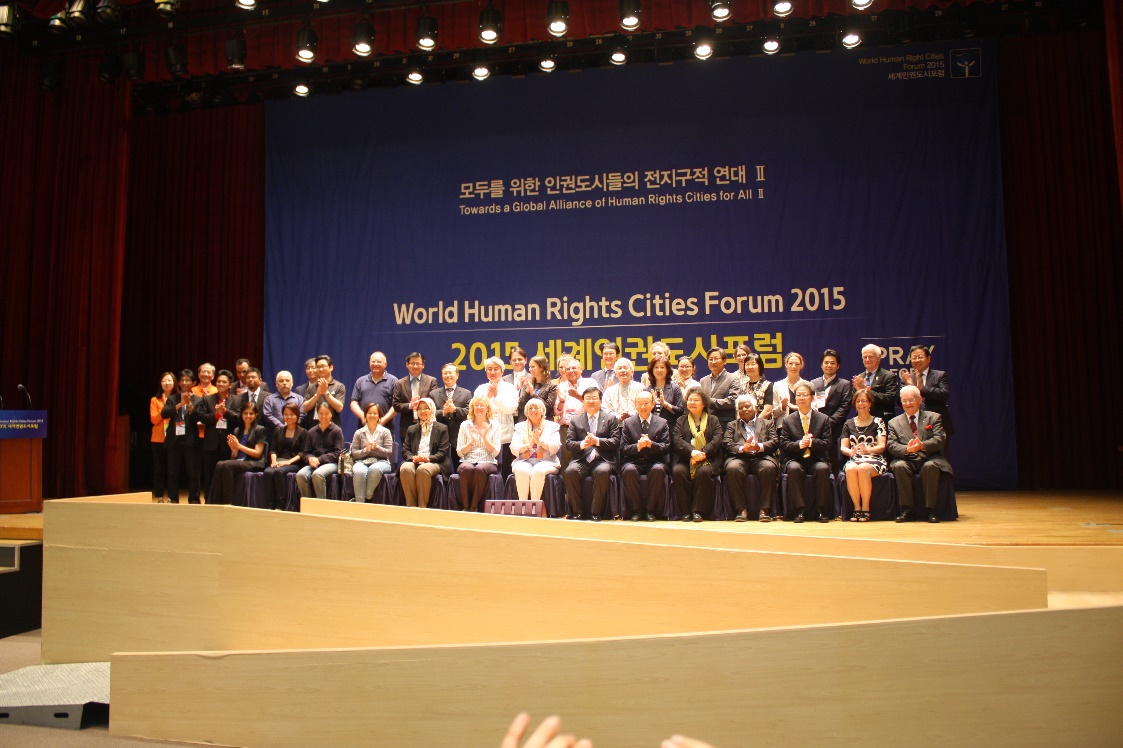
Assembled dignitaries and representatives at the closing of the 2015 World Human Rights Cities Forum on May 17th, 2015.

The WHRCF is particularly valuable as a platform for coordinating research and policies involving human rights across a variety of different fields and locations. The opportunity for dialogue and discussion helps activist gain insight on how to institute local government policies or to effectively run advocacy organizations working to increase access to human rights protections across the world. More recognition needs to be given to worker on the regional and municipal levels who are actually involved in policy implementation and development, as broad, national directives can make a statement about human rights but cannot actually benefit citizens without effective implementation on the ground. It is absolutely essential for those in need of assistance and expertise in implementing these policies to have platforms such as these to gain knowledge and information on managing and implementing the desired programs.

As the WHRCF continues in the future, there is great need for further participation of researchers, policy-makers, and professionals in related fields to continue this dialogue regarding methods for ensuring human rights protections. Public health plays a crucial role in this endeavor, as evidenced in the Universal Declaration of Human Rights Article 25, which establishes access to medical care and social services as a basic human right. When protections are needed for children, elderly, infirm, or disabled persons, public health professionals are best equipped to provide input on the needs and challenges of these at-risk populations, and their input is absolutely necessary for administrators and policy-makers to be able to craft the laws and regulations necessary to realize human rights protections for all.

Growth and challenges of health research in the WHO Africa Region: new analysis in the BMJ

I have always been devoted to the principle of evidence-based policy and decision making in public health, but I have taken a keen interest in the finer points of research and methodology since taking my current position as an epidemiologist (and contemplating the pursuit of a doctorate more seriously). Earlier this month, I spotted an article from BMJ examining the output of health research in the WHO Africa region from 2000 to 2014 (h/t to Dr. Ron LaPorte, professor of epidemiology at the WHO Collaborating Center at the University of Pittsburgh and co-founder of the Supercourse project). The article, entitled “Increasing the value of health research in the WHO African Region beyond 2015,” is a bibliometric analysis of the health research publications from the WHO Africa region indexed on PubMed; it analyzes the influence of various factors, including GDP, population, and health spending on the number and growth of published papers by country over the time period. The abstract reads:

Objective To assess the profile and determinants of health research productivity in Africa since the onset of the new millennium.

Design Bibliometric analysis.

Data collection and synthesis In November 2014, we searched PubMed for articles published between 2000 and 2014 from the WHO African Region, and obtained country-level indicators from World Bank data. We used Poisson regression to examine time trends in research publications and negative binomial regression to explore determinants of research publications.

Results We identified 107 662 publications, with a median of 727 per country (range 25–31 757). Three countries (South Africa, Nigeria and Kenya) contributed 52% of the publications. The number of publications increased from 3623 in 2000 to 12 709 in 2014 (relative growth 251%). Similarly, the per cent share of worldwide research publications per year increased from 0.7% in 2000 to 1.3% in 2014. The trend analysis was also significant to confirm a continuous increase in health research publications from Africa, with productivity increasing by 10.3% per year (95% CIs +10.1% to +10.5%). The only independent predictor of publication outputs was national gross domestic product. For every one log US$ billion increase in gross domestic product, research publications rose by 105%: incidence rate ratio (IRR=2.05, 95% CI 1.39 to 3.04). The association of private health expenditure with publications was only marginally significant (IRR=1.86, 95% CI 1.00 to 3.47).

Conclusions There has been a significant improvement in health research in the WHO African Region since 2000, with some individual countries already having strong research profiles. Countries of the region should implement the WHO Strategy on Research for Health: reinforcing the research culture (organisation); focusing research on key health challenges (priorities); strengthening national health research systems (capacity); encouraging good research practice (standards); and consolidating linkages between health research and action (translation).

In the discussion, there is some fascinating commentary on the challenges facing researchers in the research and the barriers to publication, as well as to making those publications available to other researchers in the field. Some of them are familiar and strike me as a common symptom of the complicated relationship between politics and (especially evidence-based) policy making:

Although there is clearly a need for improving the performance of health researchers on the continent, African health decision makers should use the available research evidence to guide policy, strengthen practice and maximise the use of resources in order to improve the welfare of their citizens. However, there appears to be a failure to apply available research evidence to improve the health of populations on the continent. This unfortunate situation may be related to the lack of sharing of research evidence for translation into policy and practice, a non-alignment of research conducted in African countries to national research policies and/or the non-existence of national health research policies with clearly defined priorities.

However, others are somewhat unique to Africa. Not of them are economic (though funding plays a major role), and the paper goes so far as to describe some of the challenges as “intractable”:

The difficulties in research, publication, editorial bias and information access facing Africa are profound and seem almost intractable. Another difficulty facing African researchers is dissemination of findings to other parts of the world. Most of the information published in African journals is largely not included in major databases. Access to technological tools, information access and other equipment and supplies to ease research work is not always possible.

I hope this will influence the wider debate on the future of aid and health spending in Africa. The call for a shift in funding and emphasis from technologically-focused solutions to health-systems strengthening and sustainability has gained momentum, and research and academic exchange is a crucial part of the latter.

After 30 years, @WHO finally begins pushing single-use syringes

Yesterday, the WHO officially updated its injection safety recommendations to call for the widespread adoption of single-use syringes, as well as a reduction in unnecessary injections (e.g., administering medications orally if they do not need to be injected):

A 2014 study sponsored by WHO, which focused on the most recent available data, estimated that in 2010, up to 1.7 million people were infected with hepatitis B virus, up to 315 000 with hepatitis C virus and as many as 33 800 with HIV through an unsafe injection. New WHO injection safety guidelines and policy released today provide detailed recommendations highlighting the value of safety features for syringes, including devices that protect health workers against accidental needle injury and consequent exposure to infection.

Transmission of infection through an unsafe injection occurs all over the world. For example, a 2007 hepatitis C outbreak in the state of Nevada, United States of America, was traced to the practices of a single physician who injected an anaesthetic to a patient who had hepatitis C. The doctor then used the same syringe to withdraw additional doses of the anaesthetic from the same vial – which had become contaminated with hepatitis C virus – and gave injections to a number of other patients. In Cambodia, a group of more than 200 children and adults living near the country’s second largest city, Battambang, tested positive for HIV in December 2014. The outbreak has been since been attributed to unsafe injection practices.

WHO is urging countries to transition, by 2020, to the exclusive use of the new “smart” syringes, except in a few circumstances in which a syringe that blocks after a single use would interfere with the procedure. One example is when a person is on an intravenous pump that uses a syringe.

Setting aside my horror that repeat use of non-sterile needles in still a thing in healthcare facilities here in the US, I saw this as a positive move on WHO’s part and assumed that the “smart” syringe referred to in the press release and several headlines was something only recently developed. After all, injection drug use has been the primary driver of HIV and hepatitis infections in Eastern Europe and Central Asia for years, and it is a significant component of the epidemics in southeast Asia and China’s Yunnan province as well.

Imagine my chagrin when I came across this piece from the Guardian‘s Global development professionals network. It tells the story of Marc Koska, the British inventor of the K1 single-use syringe, who has apparently been trying – unsuccessfully – to get the global health community to jump on this bandwagon…for 30 years.

Using existing technology Koska came up with a syringe that falls apart after one use, and sold his first one in 1997. Even though he’s sold more than 4 billion auto-disable syringes since, he has been repeatedly frustrated in his attempts to make the world aware of the problem caused by reusable syringes. “It’s been a very frustrating journey. Thirty years to get WHO turned around. Thirty years to get the manufacturers turned around. You’ve got too many parts to expect it to be a three year journey.”

“There is a very basic reason why it hasn’t happened and that is because the manufacturers haven’t had a market,” he argues. “If the manufacturers could sell a product and it was identified where they were going to sell it and who was going to pay for it, they would make it.

“Today, [WHO Director Margaret] Chan is a hero, but I think the next chapter might be just as challenging as the first bit,” he says.

“My gut feeling is that the ministries of health will be most resistant, because they’ve been saying for so long that they don’t have a problem of reuse in their countries. They’re never going to say that ‘we’ve got a terrible problem with hepatitis C because I can’t be bothered to buy enough syringes’. So now ministers have got to change their position and say, from Tuesday, we’re only going to buy auto-disable syringes.”

The frustrations of market forces blocking the development or widespread adoption of critically-needed global health resources is an old hat to most in the field, but this seems particularly egregious…WHO really should have caught on much sooner.