APHA Mid-Year Meeting, Day 3: Advocacy and Closing Remarks

Day three of the mid-year meeting started off with one last break-out, then moved to the closing general session and a break-out luncheon for the section representatives and state public health affiliates. I attended the “Assuring Population Health: Advocating for Prevention and Wellness” session, which left me wondering how the presentations in this session related to the topic. While I appreciate learning about how different communities are using their Prevention and Public Health Fund grants, I found myself asking where the advocacy was in some of the slide presentations.

One presentation which I did find interesting was one on “The Employer’s Perspective on Health and Health Care Reform” by Larry Boress, President and CEO of the Midwest Business Group on Health. Mr. Boress brought some very good points on the role of businesses in providing and advocating for health coverage (“We pay for everything, so we are advocating for how our money is spent”), as well as the incentive for employers to provide coverage for their employees – “It’s not because we’re altruistic. We do it for business reasons.” I was disappointed, however, when my question about a graph on one of his slides was completely sidestepped. It looked at the breakdown for how businesses answered the question, “How likely is it that drop health insurance coverage and let employees buy individual insurance from the new health insurance exchanges?” Twenty-six percent answered “Unlikely” while 27 percent said “Not likely” – what is the difference between these two? Are they not the same response? Unfortunately, Mr. Boress responded by explaining to me why employers would choose to provide health coverage to their workers.

On a more positive note, I was very impressed with the closing speech given by Dr. Lawrence Wallack, Dean of the College of Urban and Public Affairs at Portland State University. Not only did he spare us from a script on slides, he drove home some very important points about why health care and health reform are important, how we need to be framing the debate, and how we should engage the opposition when advocating for it. He said that there are two prevailing mentalities among Americans: the “yo-yos” (You are On Your Own) and the “wits” (We are In this Together). While the yo-yos stress personal responsibility and the idea that a person will do whatever it takes to get what he or she wants, wits believe that communities have to stick together to improve the common good, and that one person’s well-being is intimately connected to that of his or her neighbor. Most of us strike a balance between these two, and we need to appeal to the wit philosophy when framing the need for reform.

“If they can get you asking the wrong questions, they don’t have to provide the answers.” Dr. Wallack reminded the audience that we need to stop being distracted by questions that cannot be adequately answered and focus on framing the debate in terms of values that all Americans hold in common. He cited Lakoff’s three levels of analysis:

  1. Big ideas and universal values like fairness, equality, justice, family, community
  2. Issue types such as housing, education, etc.
  3. Specific issues such as beer taxes, toxic waste sites, and health care coverage

During debates, progressives tend to argue from level three down, while conservatives argue at level one. Wallack argues that if we frame the health care issue at level one, we will have success at level three.
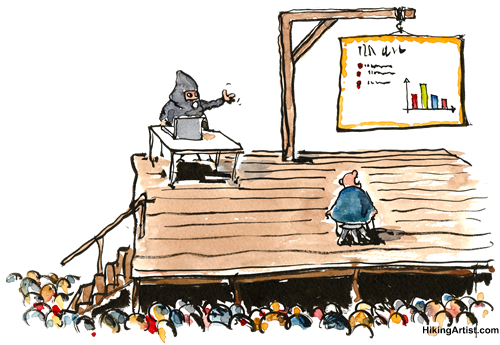
Addendum: The Circle of Death (by PowerPoint)

As I mentioned in my first day post, I was delighted when I received a flash drive along with my registration materials that contained speaker bios, PowerPoint slides for each panelist’s talk, and background materials for some presentations. One advantage was that I was able to follow each panelist’s presentation on my laptop instead of furiously taking notes and annoying the attendee sitting next to me with my rapid 80 wpm typing. I can also now look over the slides from the sessions I could not attend.

The second advantage was the ability to blog during the sessions – because I was able to tune out the moderator as (s)he read the text from panelist bios, or the speakers themselves as they read from their slides. Alas, this meant that I still annoyed the attendees unfortunate enough to sit next to me…while they were surfing Facebook on their smart phones and iPads because they had zoned out, too.

I wonder if it ever occurs to speakers that no one will listen to them talk if they can just read the slides on the screen. Granted, many speakers did a great job by elaborating on the content of their slides by discussing programs or activities that related to the text; however, we were most likely not listening to that, either – because we were reading their slides. Most PowerPoint presentations are designed as stand-alone pieces and are written to be read rather than as presentation tools, which is what they are supposed to be. This leads to a high concentration of bulky jargon and large words, which in turn causes the speaker to stumble over some words and mumble others as they wade through their slides. If you have had training in public speaking, you understand that people read differently than they listen. Anyone listening to these presentations would be absolutely lost, as they would be unable to process the barrage of bureaucracy-speak that is clumsily read aloud by each speaker as quickly as possible to leave time for other panelists to read their slides just as quickly so that we can get to questions.

Luckily, we all know what is going on because we are reading their slides rather than listening to anything.

Flickr, HikingArtist.com

This is the circle of death – by PowerPoint. We all go to sessions and panel presentations, read slides, yawn, get bored, and then give the same types of presentations to pay it forward and bore the audience listening to us. It is a disservice to everyone: it numbs the minds of audiences everywhere and allows presenters to escape a true public speaking experience.

The only way to break the circle of death is to build your presentations differently. Use as few words on your slides as possible. Use pictures and data so that your audience is forced to listen to you explain them – you know it better than they do, so you should not have to read it off your slides. Additionally, if we are actually listening to you, we will get your jokes when you actually crack them, thus bypassing the awkward silence as we emerge from our stupor with the realization that you strayed from your “script.” Better still if you do not need any slides at all! It is a truly intimidating and earth-shattering prospect, but I promise that it is possible – orators did it for thousands of years before computers and teleprompters were invented.

Break the circle of death. Save us from having to read your slides while we ignore you reading from your slides. I may not be able to blog as much, but hey – I am much happier to be listening to you instead.

APHA Mid-Year Meeting, Day 2: Public Health Jobs, Prevention, and Wellness (and why the heck does APHA serve sodas at lunch?)

I get frustrated sometimes with the academic nature of policy presentations. I have spent enough time in masters classes and government work to be used to lofty language and bureaucracy-speak, but I wonder at its utility at a conference that is focusing on how the public health rubber is meeting the road in this climate of health reform. The breakout session I attended this morning was on the public health workforce. I scratched my head while trying to understand the connection between the session topic and the Brian Smedley’s (from the Joint Center for Political and Economic Studies) presentation on the disparities between white-dominated and minority neighborhoods (the moderator had to make the connection for the audience). Cynthia Lamberth from the University of Kentucky raised some good points on planning for changes in the number of public health workers that will be driven by reform. She said that while many universities and states are in a “wait and see” mode, we cannot afford to wait – hospitals and clinical establishments and planning now, and the field of public health should be following suit. (She also pointed out the convoluted and outdated hiring practices that make it so difficult for public health graduates to get jobs in academia or with the government, which I definitely appreciated).

The presentation that got me up to the microphone, however, was one by John Lisco of the CDC on their various fellowship programs. Any students or recent graduates reading this blog are most likely familiar with at least a few of these programs – Public Health Prevention Service, Epidemic Intelligence Service, Presidential Management Fellows, etc. – and are also familiar with how incredibly competitive they are. The competitiveness of a program is not a bad thing in and of itself, but in an economic climate (and corresponding job market) like ours, finding work is extremely difficult no matter where the vacancy is. On top of that, many of these fellowship programs have highly specific rubrics and ranking criteria – while the essays have very vague prompts. You have to know someone on the inside to know what the selection panel is looking for in your essay, and how to make yourself stand out among thousands of qualified applicants.

On the other hand, it was great to hear about the experiences of communities implementing prevention and wellness program during the afternoon sessions. Major areas of focus included obesity, smoking cessation, and working to make health foods available in low socioeconomic neighborhoods. I was particularly impressed by the results of tobacco-cessation program in Indiana presented by Carla Sneegas, Executive Director of the Indiana Tobacco Prevention and Cessation Program. The program used a fax-referral system that targeted employers, allowing them to fax in a form to enroll in the program to help their employees quit smoking. The program utilized various approaches, including “quitting competitions” and monetary incentives, and some employers had cessation rates of 50% or more. Kudos to Ryan Kellog from Seattle and King County for calling out APHA on having soft drinks at lunch. He added a slide at the end of his presentation on the Communities Putting Prevention to Work program in King County with the picture of the spread with Coke, Sprite, and Diet Coke. “Why the heck were there sugar-sweetened beverages at lunch today?” Good question, indeed.

APHA Mid-Year Meeting, Day 1: Technology and Socializing

Greetings from APHA’s Mid-Year meeting in Chicago!  This year’s meeting is on healthcare reform, which is fortunate for me – with so much focus on international health news and topics, I unfortunately do not know much about the intricacies of the new healthcare reform legislation, or how it is being implemented on the ground.  I think many Americans are in the same position, however, so hopefully I will gain a better understanding of reform and be able to pass it on to you, the reader!

Upon checking in, I was given a flash drive in addition to a program and a badge holder.  This is such a great resource – it contains speaker bios and (most of) the PowerPoint presentations from each session.  After I arrived this afternoon, I attended one of the first break-out sessions of the conference, “Technology Implications of Health Reform.”  The panel was made up of a representative from CDC, the Kentucky state health commissioner, and the CEO of the Cabarrus Health Alliance (which, believe it or not, is actually a county health department!).  Each one gave his perspective on implementing electronic medical records and building a health information exchange on the federal, state, and county level, respectively.  While I appreciate the excitement surrounding the possibilities of electronic health records (EHRs), I pointed out that even clinicians and health institutions that have them are not able to use them beyond searching for records by patient name or consultation date, plus whatever queries have been pre-programmed into the software by the vendor so that the practice can get the “Meaningful Use” dollars from the government.  I have experienced this in my public health surveillance work – providers have no idea how to pull the information that we are looking for from their records.  We have a long way to go before EHRs are useful on a large scale to public health surveillance and research.

Later in the evening, I had a chance to meet some of the APHA section representatives that were given the same opportunity as I was to attend the meeting.  This is apparently the first year that APHA has been able to bring section representatives to the mid-year meeting, so it is exciting to be a part of it.  The challenge will be thinking about how the information at this meeting can be applied to the activities of the IH section.  What do you think?

There is No Silver Bullet

There is no silver bullet and frankly you probably don’t need one. It is far more important to be able to find the right kind of gun, be able to load the gun, be able to aim the gun, and perhaps most importantly, be able to figure out where the werewolf is.Matthew Oliphant

Vampire Selene uses bullets with silver nitrate to fight off werewolves in "Underworld." Unfortunately, we do not have "silver nitrate bullets" for global health problems.

I always scratch my head a bit when the global health community is dismayed at the revelation that one of its previously hailed “silver bullets” is revealed to not be the miracle cure it was thought to be. The latest disappointment making its way across the blogosphere right now is microfinance: after shady lending practices and harassment of borrowers (driving some to suicide) were uncovered on the part of commercial microlenders in India, the development community began wringing its hands at the unfolding political scandal. The forced retirement of Muhammad Yunus, founder of the Grameen Bank, Nobel laureate, and pioneer of the microfinance institution, looks like the proverbial nail in the coffin of microfinance’s status as the one-stop solution for ending poverty. Now experts are holding panel discussions to debate whether or not microfinance “works.”

This is not the first time we have found ourselves crestfallen at the failure of a silver bullet. When evaluating the results of his “Grand Challenges in Global Health,” Bill Gates admitted that the organization had been “naïve” in its expectations of breakthroughs in vaccine development. He underestimated the time it takes to move new products from the lab through clinical trials and manufacturing. “I thought some would be saving lives by now,” he said, “and it’ll be more like in 10 years from now.” Tell me about it: I worked for a biotechnology start-up in college, and the time it took to get approval for phase I clinical trials allowed bad management to completely unravel the company – it took less than five years. By the time we got the green light from the FDA, the company was being bought out, and we never got to test the product.

Many are also astounded at the current descent from grace of Greg Mortenson, of Three Cups of Tea fame. Details of his inspiring Quixote-esque story of building schools for girls in rural Pakistan and Afghanistan are now being questioned, and donors are appalled at reports of mismanaged funds and schools being used as storage sheds. But don’t we already know that graft happens, and rookies make (sometimes colossal) mistakes? How reasonable was it to expect the Central Asia Institute, Mortenson’s charity, to “fix” Afghanistan by building schools? On the other hand, why are countries and large-scale donors pulling funding and creating a fuss over the graft that the Global Fund revealed through its own investigations?

Why are we continually disillusioned when the simple solutions to the complex problems of global health and poverty turn out to not be so simple? Part of the problem is marketing. Saundra Schimmelpfennig, who has made it her mission to point out and tackle issues surrounding charity (mis)representation and shady fundraising practices, points out that

Whether it’s TOMS A Day Without Shoes or CAI’s Pennies for Peace, schools and teachers are using what are essentially commercials for a charitable product to teach children about the larger world and philanthropy. As is the case with most commercials, these “awareness raising activities” often distort or over-simplify the problems faced in ways that benefit their own organization.

This is extremely worrying as the children brought up on these myths and misconceptions are going to turn into businessmen, philanthropists, and lawmakers. How will the decisions they make be impacted by a distorted view of what the world is like and how to really help?

Another part seems to be that despite each revelation, we are constantly drawn to the prospect that we will somehow still find that magic “something,” that the next innovation or big idea will be the much-sought-after silver bullet. Despite coming to terms with his naiveté, Gates is now saying that energy innovation is the key to beating climate change. Programmers are busily developing cell phone apps in the hope that cell phones can help end poverty.

The problems that we devote our careers to tackling are nowhere near simple, and it is unreasonable to expect to find simple solutions to them. Heck, we don’t even adequately fund the silver bullets we already have. As professionals more knowledgeable than me continually point out, our best bet is to strengthen health systems, focus on measurable improvements, admit and learn from failure, and – perhaps most importantly – have a little patience.