The Year of the Girl

The United Nations declared October 11th the International Day of the Girl Child.  Everywhere I looked for this post’s inspiration, I saw story after story of the daily violence perpetrated against girls worldwide. I had to ask myself, why just a day?  Aren’t girls – roughly half of the world’s population – deserving of much more consideration? I say that we declare 2017 the YEAR of the Girl and devote our efforts to address the following issues.

Female Genital Mutilation

Female genital mutilation, or FGM, is a global concern. Some 200 million girls and women in 30 countries have undergone FGM, usually between infancy and 15 years of age. In many countries, FGM is a deeply entrenched cultural practice that has seen little decrease in the decades since foreign aid workers have been campaigning for is abolition. The risks might be high – infection, infertility, and complications of childbirth – but the perceived social benefits outweigh the physical costs. Bettina Shell-Duncan, an anthropology professor working as part of a five-year research project by the Population Council, has witnessed this conflict firsthand among the Rendille people of Northern Kenya:

One of the things that is important to understand about it is that people see the costs and benefits. It is certainly a cost, but the benefits are immediate. For a Rendille woman, are you going to be able to give legitimate birth? Or elsewhere, are you going to be a proper Muslim? Are you going to have your sexual desire attenuated and be a virgin until marriage? These are huge considerations, and so when you tip the balance and think about that, the benefits outweigh the costs.

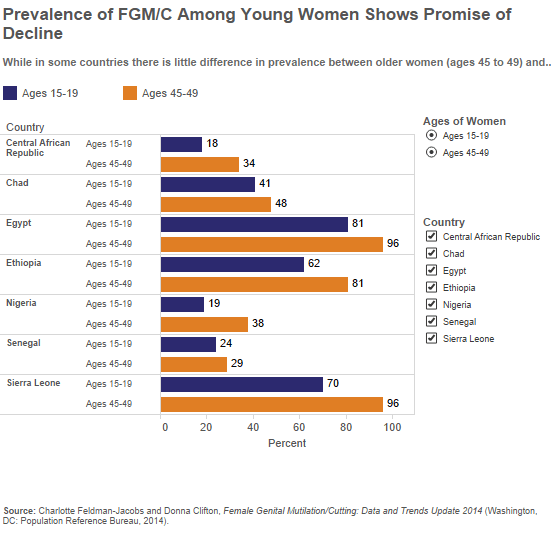
Despite cultural ties, FGM is decreasing in some African countries as evidenced by rates from the prior generation.  However, with prevalence as high as 81% (Egypt), 79% (Sierra Leone), and 62% (Ethiopia), there is still much work to be done.
prevalence

For example, with prevalence at 60-70%, FGM in Iraqi Kurdistan is a “hidden” epidemic.  Prevalence of this practice elsewhere in Iraq is 8%.  Outlawed in 2011 by the Kurdistan Regional Government under the Family Violence Law, FGM has continued largely unabated due to poor implementation and push-back from religious leaders.  You can read the Human Rights Watch harrowing report about FGM in Iraqi Kurdistan here.

Rape and Child Marriage

Last Friday, the BBC reported on a bill under consideration by the Turkish Parliament that would clear a man of statutory rape if he married his victim.  This bill is evidence of increasing violence against Turkish women.  Between 2003 and 2010, the murder rate of women increased by 1,400%.  Of course, the bill isn’t couched in terms of legalizing rape, but as a loophole for those offenders who know not the errors of their ways:

The aim, says the government, is not to excuse rape but to rehabilitate those who may not have realised their sexual relations were unlawful – or to prevent girls who have sex under the age of 18 from feeling ostracised by their community.

If passed, the bill would release 3,000 men from prison as well as legitimize child rape and marriage. Per Girls Not Brides, Turkey has one of the highest child marriage rates in Europe with 15% of girls married before the age of 18. Globally 34% of women are married before the age of 18 and every day 39,000 girls join their ranks. According to a study recently published in the International Journal of Epidemiology, child marriage comes with health and social consequences. Along with unintended pregnancies, infant and maternal mortality, and HIV, girls who are married suffer from social isolation, power imbalance, and experience higher lifetime rates of physical and sexual intimate partner violence.

Coming-of-age “Cleansing” Rituals

Practiced in parts of Africa, girls as young as 12 are forced to have sex as part of a sexual cleansing ritual.  The men, known as “hyenas,” are paid by parents to usher girls through the transition between girlhood and womanhood.  Girls are coerced into this practice through familial and societal pressure.  It is believed that great tragedy will befall the family and community should she not comply.  The use of a condom is prohibited.

A BBC radio broadcast found that communities believe the spread of HIV to be a minimal risk since they can pick men they know are not infected. One Malawian hyena, Eric Aniva, has been charged with exposing hundreds of girls and women to HIV. Aniva knew of his HIV status but did not disclose to his customers.

Forty percent of the global burden of HIV infections are in Southern Africa. Thirty percent of new infections in this area are in girls and women aged 15-24. Young women contract HIV at rates four times greater than male peers and 5-7 years earlier, linked to sexual debut or sexual cleansing rituals.

Let’s face it: Girls around the globe are being short-changed. Though progress has been made, there is still much work to be done. The Sustainable Development Goals have promised to “end all forms of discrimination against all women and girls everywhere” by 2030. Others attest that it will take at least another century for women to reach wage equity in the United States.  However it happens, rest assured it will take more than a day.
Female sterilization not an answer to global contraception

The last week of September marks two days dedicated to improving reproductive health: World Contraception Day  (September 26) and Global Day of Action for Access to Safe and Legal Abortions  (September 28).  Both days are committed to improving the reproductive health and choices of women worldwide. With the vision of making every pregnancy a wanted pregnancy, World Contraception Day aims to help the estimated 225 million women in developing countries who have an unmet need for contraception.

Reports such as the UN’s 2015 Trends in Contraceptive Use Worldwide include somewhat promising data, such as 64% of married or in-union women use a modern contraceptive method. This figure is lower in developing countries, including 17 countries in Africa where modern contraceptive use is below 20%.

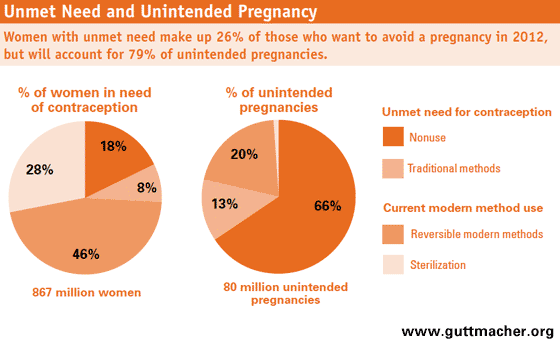
Sterilization is the most widely used form of birth control, accounting for a third of modern contraceptive use. Sterilization is heavily weighted toward female sterilization, 18.9% versus 2.4% male sterilization globally.  In certain countries, the prevalence of female sterilization as modern contraception is much higher.  Female sterilization of sexually active women aged 15 to 49 is most prevalent in Latin America.  The Dominican Republic leads the pack at 47%  followed closely by Colombia, Costa Rica, El Salvador, and Puerto Rico.  China (29%) and India (36%) are also front runners.

unmetneedandunintendedpregnancy

Sterilization is a popular choice in the developed countries of Europe and North America, though male sterilization tends to be more prevalent than in the developing world. When practiced safely, sterilization offers many benefits because it is a one-time procedure with no follow-up or maintenance.  While sterilization might be the best choice for some individuals or couples, unsafe, involuntary, or otherwise coercive female sterilizations are altogether too common and an affront to human rights.

China’s “one child” policy  – perhaps one of the more infamous anecdotes in mandated family planning – has relied on sterilization to meet its goals.  In the heyday of the 1980s, neighbors became informants on so-called “out-of-plan” pregnancies.  Offending families were fined and possessions stolen, and local bureaucrats oversaw countless forced abortions and sterilization. 1983 alone saw over 20 million sterilizations. China’s Communist Party has recently relaxed its one-child policy  to allow each couple two children, but many in China, including activist Chen Guangcheng don’t see the difference as stated in this tweet:

This is nothing to be happy about. First the #CCP would kill any baby after one. Now they will kill any baby after two. #ChinaOneChildPolicy

Lesser known is an Uzbekistan policy that assigns gynecologists a sterilization quota of up to 4 per month.  In a report by the BBC, rural women who have had two or more children are the main target of this campaign.  It is estimated in 2011 alone that 70,000 Uzbek women were sterilized, some voluntarily and some involuntarily.  Unlike China’s policy to slow population growth, Uzbekistan’s goal is to manipulate its once abysmal infant mortality ratings.  Fewer infants means fewer infant deaths, and Uzbekistan’s infant mortality rate in 2012 is half of what it was in 1990.

India has received much attention for its sterilization camps.  The name alone conjures images of the Nazi eugenics movement.  In 1951, with Malthusian ideology in mind, an Indian demographer set out across rural India to complete a census.  His prediction – that India’s population would reach 520 million people by 1981 – was both incorrect (India’s population in 1981 was 683 million ) and the catalyst for a mass sterilization program.  This led to compulsory sterilization in 1976  that lasted for 21 months and effectively sterilized 12 million men and women, often rural, poor, and of low caste.  Employment, wages, and even running water were withheld from individuals and whole villages until 100% compliance was met.

Today, while technically voluntary, sterilization in India is incentivized. In the past, men were promised transistor radios in exchange for a vasectomy.   Male sterilization is now considered culturally unacceptable.  Women are the target of sterilization campaigns and can receive up to $23 US – a month’s income – to submit to a tubal ligation.

sterilization
Women undergo sterilization operations at the Cheria Bariarpur Primary Health Centre in the Begusarai District of Bihar. A few dozen women were sterilized in one day. Although India officially abandoned sterilization targets years ago, unofficial targets remain in place, according to people working on the ground. One Primary Health Centre doctor says the targets in themselves are not necessarily the problem, arguing instead that itÕs the lack of a good healthcare infrastructure in some places that makes it difficult to safely meet those targets. SARAH WEISER

Indian women arrive at sterilization camps by the jeep load.  In makeshift operating theaters –  with no electricity and running water – neither gloves nor equipment are changed between the five-minute operations.  Expired antibiotics given to some women are found laced with rat poison.  In 2014, Dr. R.J. Gupta, self-described as performing 300 tubal ligation in one day, was arrested after women he and an assistant sterilized either died or were hospitalized.  The current government regulation is that no one doctor should perform more than 30 sterilizations a day.  On the day in question, Gupta’s six-hour spree resulted in 83 tubal ligation.  It is believed that Gupta was trying to reach a government-set target of 220,000 sterilizations in one year.

On September 14th of this year, India’s Supreme Court ordered a close of all sterilization camps within three years.  That is an unsettling time span in which over a half a million more women could be sterilized and many more deaths and hospitalizations could occur.  Even after the dissolution of government-sanctioned sterilizations camps, women will continue to be subject to this dangerous procedure.

What are low cost, accessible, and humane forms of birth control for the developing world?  A promising alternative might be Sayana® Press, a lower-dose presentation of the three-month injectable contraceptive Depo-Provera® in the Uniject™ injection system.

sayana_press
A village health worker counsels a client in family planning and administers Sayana Press. Phiona Nakabuye (left), village health worker trained by PATH’s Sayana Press pilot introduction program, with Carol Nabisere (right), age 18, who chose to receive Sayana Press after being counseled in the various forms of contraception, Kibyayi village, Mubende district.

Original trials of the injectable contraceptive were successful in Florida, New York, and Scotland, and the same seems to be holding true in Uganda.  Most women were able to self-administer the drug after just one training session and again at the next dose, three months later.  Designed for single use, Sayana® Press reduces reliance on needles and needle sharing  which is essential in the fight against HIV/AIDS and women only need to travel to a clinic once to get a year’s supply.

There is so much to consider when it comes to global family planning.  It would be remiss not to mention the impact that the HIV/AIDS epidemic has on sterilization rates in some regions of the world and you can read more here, here, and here.  Organizations such as USAID have been implicated  for funding so-called fertility reduction programs that include mass sterilization.  What can be done to ensure all women have access to contraception?

More HIV discrimination from the ROK government: Korea disqualifies students with HIV from receiving scholarships

A few regular readers might be familiar with the Korean government’s ongoing misrepresentation of its HIV-related immigration restrictions: while it continues to receive undeserved recognition from the UN for being a country free of HIV-related travel restrictions, it mandates HIV tests for native-speaking English teachers, EPS workers (manual laborers), and entertainment workers. Despite claims from KCDC and Korea’s ministry of foreign affairs that immigration restrictions have been lifted, one English teacher won a discrimination case with the UN CERD earlier this year, and another case is pending with the ICCPR. Our Section was even successful in pushing through a resolution on immigration restrictions tied to HIV status at this year’s APHA Annual Meeting that called Korea out specifically for its double-talk.

Now there more evidence of discrimination to add to the list. The Korean Government Scholarship Program, which provides funding and airfare for non-Koreans interested in pursuing post-graduate degrees at a Korean university, is open to a small number of foreign nationals each year and is actively advertised on Korean embassy websites and even featured on several university websites for current undergraduates who might be interested. The program “is designed to provide higher education in Korea for international students, with the aim of promoting international exchange in education, as well as mutual friendship amongst the participating countries,” and the payment includes tuition, airfare, a monthly allowance, a research allowance, relocation (settlement) allowance, a language training fee, dissertation printing costs, and medical insurance. Which sounds lovely, except:

Applicants must submit the Personal Medical Assessment (included in the application form) when he/she apply for this program, and when it’s orientation, an Official Medical Examination will be done by NIIED. A serious illness (For example, HIV, Drug, etc) will be the main cause of disqualification from the scholarship.

It is also worth noting that pregnancy can disqualify candidates as well.

The best part is that this information is not even hidden: a Google search on the above line pulls up dozens of results, and the restrictions on prominently featured on the websites of Korean embassies to the US, the UK, Australia, Malaysia, plus the Korean Education Center in New York, GWU’s Sigur Center for Asian Studies, and even Seoul National University (DOC), the most prestigious university in the country.

@MSF Video for World #AIDS Day: People with #HIV still face major hurdles

Note: This was cross-posted to my own blog.


Another year and another December mark the passage of another World AIDS Day. This has been an exciting year for HIV research and policy, with the WHO updating guidelines to recommend that anyone diagnosed with HIV get on ARVs, PrEP gaining traction in the US (even in my own Lone Star State!) and approval in France, new optimism in the effort to development a vaccine, and talk of ending AIDS by 2030. Aw, yeah.

Alas, we are not there yet – and World AIDS Day is an important day to remember that. While many countries have turned the tide of their HIV epidemics, it is getting worse in several others and, in South Korea’s case, presents the potential for a fast-approaching crisis. MSF is always a good resource for bringing optimists back to reality. In this video, they remind us that in order to keep up the progress we have made against AIDS by treating HIV, we need to make sure that those who are infected stay in care – which will take sustained efforts in treatment, policy, and funding.

After 30 years, @WHO finally begins pushing single-use syringes

Yesterday, the WHO officially updated its injection safety recommendations to call for the widespread adoption of single-use syringes, as well as a reduction in unnecessary injections (e.g., administering medications orally if they do not need to be injected):

A 2014 study sponsored by WHO, which focused on the most recent available data, estimated that in 2010, up to 1.7 million people were infected with hepatitis B virus, up to 315 000 with hepatitis C virus and as many as 33 800 with HIV through an unsafe injection. New WHO injection safety guidelines and policy released today provide detailed recommendations highlighting the value of safety features for syringes, including devices that protect health workers against accidental needle injury and consequent exposure to infection.

Transmission of infection through an unsafe injection occurs all over the world. For example, a 2007 hepatitis C outbreak in the state of Nevada, United States of America, was traced to the practices of a single physician who injected an anaesthetic to a patient who had hepatitis C. The doctor then used the same syringe to withdraw additional doses of the anaesthetic from the same vial – which had become contaminated with hepatitis C virus – and gave injections to a number of other patients. In Cambodia, a group of more than 200 children and adults living near the country’s second largest city, Battambang, tested positive for HIV in December 2014. The outbreak has been since been attributed to unsafe injection practices.

WHO is urging countries to transition, by 2020, to the exclusive use of the new “smart” syringes, except in a few circumstances in which a syringe that blocks after a single use would interfere with the procedure. One example is when a person is on an intravenous pump that uses a syringe.

Setting aside my horror that repeat use of non-sterile needles in still a thing in healthcare facilities here in the US, I saw this as a positive move on WHO’s part and assumed that the “smart” syringe referred to in the press release and several headlines was something only recently developed. After all, injection drug use has been the primary driver of HIV and hepatitis infections in Eastern Europe and Central Asia for years, and it is a significant component of the epidemics in southeast Asia and China’s Yunnan province as well.

Imagine my chagrin when I came across this piece from the Guardian‘s Global development professionals network. It tells the story of Marc Koska, the British inventor of the K1 single-use syringe, who has apparently been trying – unsuccessfully – to get the global health community to jump on this bandwagon…for 30 years.

Using existing technology Koska came up with a syringe that falls apart after one use, and sold his first one in 1997. Even though he’s sold more than 4 billion auto-disable syringes since, he has been repeatedly frustrated in his attempts to make the world aware of the problem caused by reusable syringes. “It’s been a very frustrating journey. Thirty years to get WHO turned around. Thirty years to get the manufacturers turned around. You’ve got too many parts to expect it to be a three year journey.”

“There is a very basic reason why it hasn’t happened and that is because the manufacturers haven’t had a market,” he argues. “If the manufacturers could sell a product and it was identified where they were going to sell it and who was going to pay for it, they would make it.

“Today, [WHO Director Margaret] Chan is a hero, but I think the next chapter might be just as challenging as the first bit,” he says.

“My gut feeling is that the ministries of health will be most resistant, because they’ve been saying for so long that they don’t have a problem of reuse in their countries. They’re never going to say that ‘we’ve got a terrible problem with hepatitis C because I can’t be bothered to buy enough syringes’. So now ministers have got to change their position and say, from Tuesday, we’re only going to buy auto-disable syringes.”

The frustrations of market forces blocking the development or widespread adoption of critically-needed global health resources is an old hat to most in the field, but this seems particularly egregious…WHO really should have caught on much sooner.