Food for thought: can Meatless Monday save the planet?

World-renowned researchers, physicians, government officials, and industry leaders are meeting today in Berlin to discuss the state of global health.  Amidst presentations and discussions about non-communicable diseases, global health security, and priority issues in conflict zones, the attendees of the World Health Summit will gather together to break bread.  The menu might look a little different this year, as the Summit will jump on the Meatless Monday bandwagon.

The brainchild of Sid Learner, in partnership with Johns Hopkins Bloomberg School of Public Health, Meatless Monday was established in 2003 to reduce reliance on red meat, improve chronic disease, and protect the environment.  Meatless Monday is now active in 44 countries – from Bhutan to Togo.

Could wider adoption of Meatless Monday or less reliance on meat as a diet staple prove a boon for food scarcity, health, and reduction of green house gases?  When so much of the world suffers from malnutrition, is this fad a luxury or a necessity?

The ills of large-scale factory farming are well established.  These facilities, known in the US as concentrated animal feeding operations (CAFO), can each produce up to 1.6 million tons of manure a year, more waste than a U.S. city.  Unlike human waste infrastructure, there is no mandated system for the storage or sanitization of animal waste which can be rife with E. coli, antibiotics and other hormones, animal blood, and organic and inorganic compounds dangerous to human health.  Improper or overextended systems for storing untreated manure can cause run off or leaching into ground water.  Degrading animal waste can also affect local air quality and attract insects.

It isn’t just the immediate health effects of factory farming – such as increased incidence of childhood asthma in communities near CAFOs – but the cumulative effects that contribute to global warming.  A 2006 report of the Food and Agricultural Organization of the United Nations found that CAFOs deleterious outputs could account for 18% of global emissions.  The list is literally and figuratively exhaustive: from the methane gas emitted from the aforementioned manure, the oil used to transport carcasses to processing plants and on to stores, the electricity used to keep the meat cool, and the emissions and energy needed to harvest the crops that feed the livestock and pumps for water.  Dig a little deeper and consider, as suggested by two World Bank Scientists, the following:

Should you include all the knock-on emissions from clearing forests? What about the fertiliser used to grow the crops to feed to the animals, or the emissions from the steel needed to build the boats that transport the cattle; or the “default” emissions – the greenhouse gases that would be released by substitute activities to grow food if we were to give up meat? And is it fair to count animals used for multiple purposes, as they mostly are in developing countries, from providing draught power to shoe leather or transport, and which only become meat once they reach the end of their economic lives?

All told, these activities add up to 32.6 billion tons of carbon dioxide annually, or 51% of global greenhouse gas emissions.  Even at its lowest estimate of 15%, greenhouse gas emissions from livestock are equal to exhaust emissions from every vehicle – plane, train, and automobile – in operation today.

How much less meat would we need to eat to keep rising temperatures below the 2-degree Celsius mark that could spell big trouble for life as we know it?  Industrialized countries currently consume more than twice the amount of meat considered healthy.  Americans eat three times as much.  While meat consumption in developing countries is a fraction of those listed above, an increased call for meat has been seen as countries become more urban.   Meat consumption in developing countries has tripled compared to developed nations in recent decades.

While the simple solution is to eat less meat, the type of meat might also be important.  Raising beef requires nearly 30 times more land and 11 times more water than pork, chicken, dairy or eggs.  Three staple crops – potatoes, wheat, and rice – require up to six times fewer resources than pork, chicken, dairy or eggs.

If industrialized countries were to consume less red meat, global malnutrition could be addressed. Only 55% of the world’s crops feed people, the rest are reserved to feed livestock or to make biofuel.  The conversion of calories from grain to meat leaves much to be desired.  One hundred calories of grain produce a mere 3 calories of beef.  Just switching from grain-fed beef to pasture-raised beef, chicken, pork, eggs, and dairy products could free up much more food to feed the world.

It may be that time is running out to make smarter food choice before climate change makes the decision for us.  Currently, 4% of global croplands experience drought each year but could reach as high as 18% by the year 2100.  Even at the current rate, droughts have the capacity to devastate regions and industries.  A recent study found that an extra 500,000 deaths will be attributable to a decrease in nutrient-rich food in 155 world regions by the year 2050.  Rather than malnutrition related to caloric intake, these deaths will be due to lack of vitamins from fruit and vegetables. The majority of these deaths will likely occur in already impoverished countries of Asia and Africa.

If you are reading this blog, you can probably afford to have some lentils or a nice vegetarian burrito for dinner.  While you sup, feel free to check out these great articles by Maryn McKenna.  The first imagines a world without antibiotics – a huge issue especially as it pertains to the food industries over-use. The second examines a Dutch company that is mass producing antibiotic-free boiler hens.
Female sterilization not an answer to global contraception

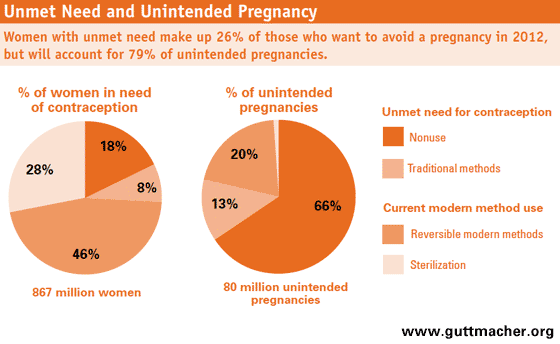
The last week of September marks two days dedicated to improving reproductive health: World Contraception Day  (September 26) and Global Day of Action for Access to Safe and Legal Abortions  (September 28).  Both days are committed to improving the reproductive health and choices of women worldwide. With the vision of making every pregnancy a wanted pregnancy, World Contraception Day aims to help the estimated 225 million women in developing countries who have an unmet need for contraception.

Reports such as the UN’s 2015 Trends in Contraceptive Use Worldwide include somewhat promising data, such as 64% of married or in-union women use a modern contraceptive method. This figure is lower in developing countries, including 17 countries in Africa where modern contraceptive use is below 20%.

Sterilization is the most widely used form of birth control, accounting for a third of modern contraceptive use. Sterilization is heavily weighted toward female sterilization, 18.9% versus 2.4% male sterilization globally.  In certain countries, the prevalence of female sterilization as modern contraception is much higher.  Female sterilization of sexually active women aged 15 to 49 is most prevalent in Latin America.  The Dominican Republic leads the pack at 47%  followed closely by Colombia, Costa Rica, El Salvador, and Puerto Rico.  China (29%) and India (36%) are also front runners.

unmetneedandunintendedpregnancy

Sterilization is a popular choice in the developed countries of Europe and North America, though male sterilization tends to be more prevalent than in the developing world. When practiced safely, sterilization offers many benefits because it is a one-time procedure with no follow-up or maintenance.  While sterilization might be the best choice for some individuals or couples, unsafe, involuntary, or otherwise coercive female sterilizations are altogether too common and an affront to human rights.

China’s “one child” policy  – perhaps one of the more infamous anecdotes in mandated family planning – has relied on sterilization to meet its goals.  In the heyday of the 1980s, neighbors became informants on so-called “out-of-plan” pregnancies.  Offending families were fined and possessions stolen, and local bureaucrats oversaw countless forced abortions and sterilization. 1983 alone saw over 20 million sterilizations. China’s Communist Party has recently relaxed its one-child policy  to allow each couple two children, but many in China, including activist Chen Guangcheng don’t see the difference as stated in this tweet:

This is nothing to be happy about. First the #CCP would kill any baby after one. Now they will kill any baby after two. #ChinaOneChildPolicy

Lesser known is an Uzbekistan policy that assigns gynecologists a sterilization quota of up to 4 per month.  In a report by the BBC, rural women who have had two or more children are the main target of this campaign.  It is estimated in 2011 alone that 70,000 Uzbek women were sterilized, some voluntarily and some involuntarily.  Unlike China’s policy to slow population growth, Uzbekistan’s goal is to manipulate its once abysmal infant mortality ratings.  Fewer infants means fewer infant deaths, and Uzbekistan’s infant mortality rate in 2012 is half of what it was in 1990.

India has received much attention for its sterilization camps.  The name alone conjures images of the Nazi eugenics movement.  In 1951, with Malthusian ideology in mind, an Indian demographer set out across rural India to complete a census.  His prediction – that India’s population would reach 520 million people by 1981 – was both incorrect (India’s population in 1981 was 683 million ) and the catalyst for a mass sterilization program.  This led to compulsory sterilization in 1976  that lasted for 21 months and effectively sterilized 12 million men and women, often rural, poor, and of low caste.  Employment, wages, and even running water were withheld from individuals and whole villages until 100% compliance was met.

Today, while technically voluntary, sterilization in India is incentivized. In the past, men were promised transistor radios in exchange for a vasectomy.   Male sterilization is now considered culturally unacceptable.  Women are the target of sterilization campaigns and can receive up to $23 US – a month’s income – to submit to a tubal ligation.

sterilization
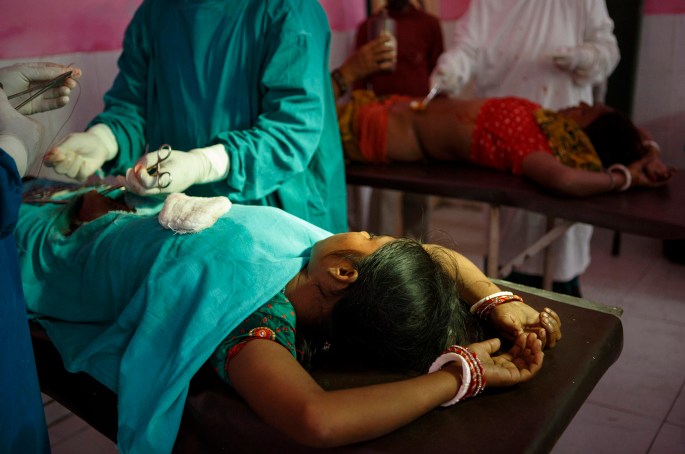
Women undergo sterilization operations at the Cheria Bariarpur Primary Health Centre in the Begusarai District of Bihar. A few dozen women were sterilized in one day. Although India officially abandoned sterilization targets years ago, unofficial targets remain in place, according to people working on the ground. One Primary Health Centre doctor says the targets in themselves are not necessarily the problem, arguing instead that itÕs the lack of a good healthcare infrastructure in some places that makes it difficult to safely meet those targets. SARAH WEISER

Indian women arrive at sterilization camps by the jeep load.  In makeshift operating theaters –  with no electricity and running water – neither gloves nor equipment are changed between the five-minute operations.  Expired antibiotics given to some women are found laced with rat poison.  In 2014, Dr. R.J. Gupta, self-described as performing 300 tubal ligation in one day, was arrested after women he and an assistant sterilized either died or were hospitalized.  The current government regulation is that no one doctor should perform more than 30 sterilizations a day.  On the day in question, Gupta’s six-hour spree resulted in 83 tubal ligation.  It is believed that Gupta was trying to reach a government-set target of 220,000 sterilizations in one year.

On September 14th of this year, India’s Supreme Court ordered a close of all sterilization camps within three years.  That is an unsettling time span in which over a half a million more women could be sterilized and many more deaths and hospitalizations could occur.  Even after the dissolution of government-sanctioned sterilizations camps, women will continue to be subject to this dangerous procedure.

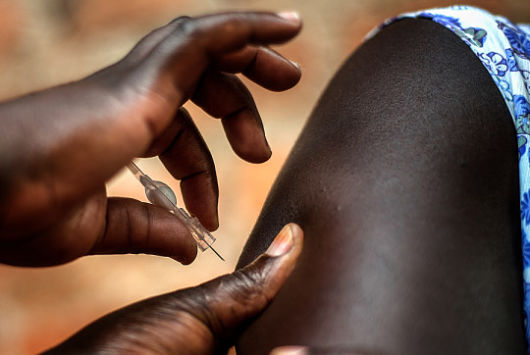
What are low cost, accessible, and humane forms of birth control for the developing world?  A promising alternative might be Sayana® Press, a lower-dose presentation of the three-month injectable contraceptive Depo-Provera® in the Uniject™ injection system.

sayana_press
A village health worker counsels a client in family planning and administers Sayana Press. Phiona Nakabuye (left), village health worker trained by PATH’s Sayana Press pilot introduction program, with Carol Nabisere (right), age 18, who chose to receive Sayana Press after being counseled in the various forms of contraception, Kibyayi village, Mubende district.

Original trials of the injectable contraceptive were successful in Florida, New York, and Scotland, and the same seems to be holding true in Uganda.  Most women were able to self-administer the drug after just one training session and again at the next dose, three months later.  Designed for single use, Sayana® Press reduces reliance on needles and needle sharing  which is essential in the fight against HIV/AIDS and women only need to travel to a clinic once to get a year’s supply.

There is so much to consider when it comes to global family planning.  It would be remiss not to mention the impact that the HIV/AIDS epidemic has on sterilization rates in some regions of the world and you can read more here, here, and here.  Organizations such as USAID have been implicated  for funding so-called fertility reduction programs that include mass sterilization.  What can be done to ensure all women have access to contraception?