Lancet reminds us to include health in #humanrights analysis

This should go without saying, but it is always nice when a respected, high-impact journal reminds us that health should be a central consideration in every human rights discussion and “necessary component of resilient human security.” In its most recent issue, British health journal Lancet published an editorial on HRW’s World Report 2015, lauding it for drawing attention to health-related human rights failures around the world while expressing disappointment that it “did not identify health as a core element in its analysis”:

In his opening essay, HRW’s Executive Director, Kenneth Roth, writes, “The world has not seen this much tumult in a generation…it can seem as if the world is unravelling”. Indeed, this 656-page report is a grim read in a year marked by extensive conflict and extreme violence. But when one delves deeper, there is a hidden story that often does not make the headlines. That story is the health dimension of human rights. Viewed through the lens of health, the report contains several compelling and disturbing themes.

The editorial noted numerous examples in the report of attacks on healthcare facilities, both in conflict zones and in the areas of West Africa struck by the Ebola outbreak, as well as spotlights on gender-based violence, a dearth of mental health services, targeted killings and persecution of health workers, and inadequate access to palliative care. While the report contains valuable analysis, the editorial contends that it does not go far enough in incorporating health as a human rights foundation:

This latest HRW report is an important call to arms to protect health as a fundamental human right. It is a pity that HRW did not identify health as a core element in its analysis, not only as part of a comprehensive package of human rights protections but also as a necessary component of resilient human security. Their analysis should prompt all governments and international health organisations to reflect carefully on their actions to make health a core responsibility and right of all citizens.

Agreed.


Note: This was cross-posted to my own professional blog.

Media Wars: #Ferguson, American Hypocrisy and a Hint of Spring

This was originally posted on my professional blog.

America has experienced an ugly spotlight reversal with the eruption of popular discontent into violence in its own backyard. Just a few weeks ago, international media was buzzing with reports of ISIS steamrolling the Iraqi military and Russian-supported separatists in Ukraine shooting down passenger airlines. Now, the US squirms uncomfortably under international scrutiny of Ferguson, Missouri, where the shooting of a young black man by a white police officer has once again raised the specter of racism and police brutality.

Obviously, the incident itself is complicated. Eyewitnesses – who have given conflicting testimonies – are the only window into what happened, since there was no dashboard camera. The initial description of Michael Brown, the victim of the shooting, as a “gentle giant” about to start college clashed with video footage of him stealing a box of cigarillos from a convenience store. Commentators have drawn parallels with the case of Trayvon Martin, whose mother has now reached out to Brown’s mother. Peaceful protests have given way to violence and looting, reporters have been arrested, and witnesses have complained of excessive use of force by the police.

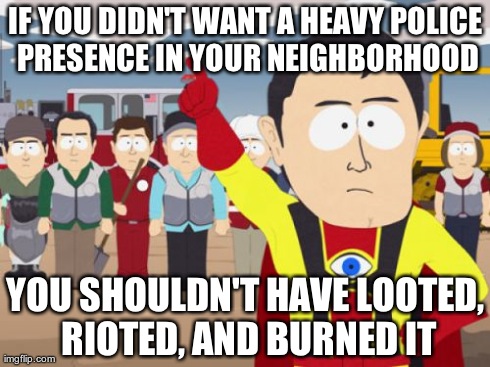
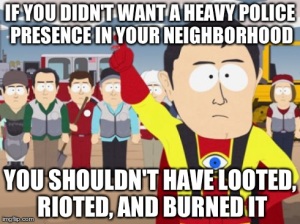
Social media, which played a major role in bringing media attention to Ferguson in the first place, has played host to the battleground of ideological responses to the incident. The primary complaint from conservatives is that the uprising in Ferguson, and the underlying racial tensions it has exposed, don’t deserve our consideration because some of the protesters have been looting and vandalizing stores…


epdara9

ql184ox

…including a few gems that actually blame the community for the excessive force used against it.
RRAKSio

b58p7

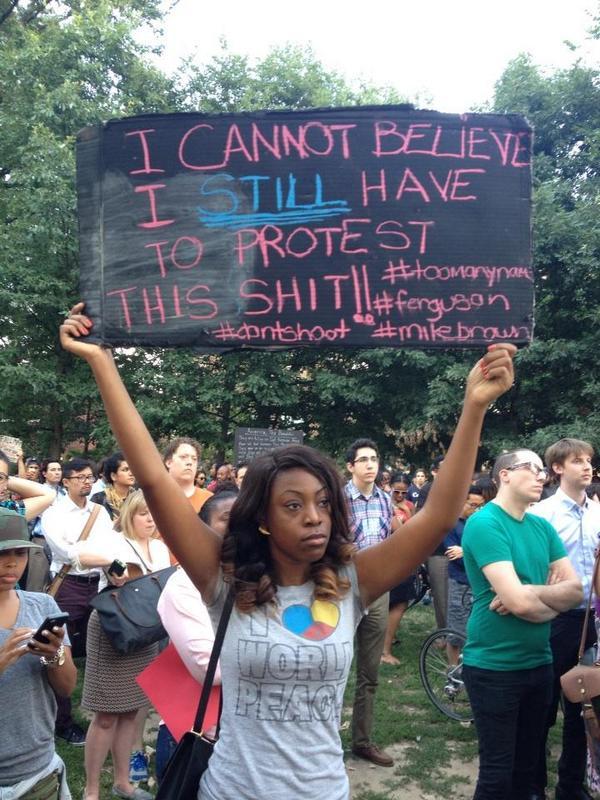
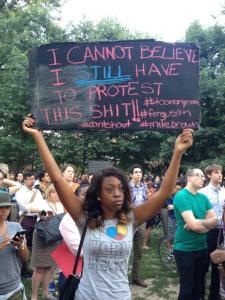
Meanwhile, people used the Twitter hastag #IfTheyGunnedMeDown to spar over which photos of Brown were used by traditional media (wearing a cap and gown vs. striking a “thug” pose) and post their own side-by-side pictures. Still others are expressing frustration at the fact that the vandalism and looting has been used as a straw man to distract from ongoing widespread racial profiling and policy brutality against blacks, including one refreshingly blunt protester at a rally in DC:
BvCci4DIMAEXAIz

What has been the most interesting to me is the global shock and horror at the incident and resulting fallout. The international community sees what many Americans are apparently missing: that the protests and unrest in Ferguson are the manifestation of a minority group sick of being oppressed and ignored. The UN High Commissioner for Human Rights drew parallels to South African apartheid, while several countries have been using the situation to take shots at America’s own human rights record when we so often criticize other countries. One might expect Iran and Russia troll the US over civil unrest, but as one friend of mine pointed out on Facebook, “When Egypt calls you out for human rights abuses, YOU’RE DOING IT WRONG.”

American police brutality, and the unwillingness of many police departments to be held accountable for their actions, have also been focal points. What happened to Michael Brown will unfortunately always be shrouded in mystery, since the Ferguson police department apparently prioritizes riot gear and tear gas over cameras for officers or police cruisers. They also seemed to have forgotten the meaning of “free press,” as they arrested and harassed several reporters who were trying to cover the protests. Interestingly, Obama was quick to condemn the bullying of journalists “here in the United States of America,” despite his own administration’s secrecy and aggression toward the press, including prosecuting a journalist who refused to identify the source of an intelligence leak.

Indeed, many observers have been quick to point out America’s hypocrisy at fingering human rights abuses outside our own borders when we have threads of discontent, similar to those found in the Arab Spring and other global protest movements, woven throughout our own society. A lovely little piece of satire from Vox portrays how American media might describe the events in Ferguson if they happened in another country.

When everything is said and done, America doesn’t look so much like a shining beacon of democracy and human rights – we just kinda look like everybody else.

Annual Meeting, Day 2: A Visit to the Hill, Refugees, and the Awards Dinner

This morning I got a preview of what those of you who are signed up for Thursday’s Advocacy Day will experience.  Since I will not be able to stay in DC until Thursday, I decided to take some time while I was here to visit the office of my own Congressman, Representative Michael McCaul.  While the Congressman was not able to meet me himself, I spoke with DoD fellow Christian Lyons (who manages his foreign affairs portfolio) and made my case for global health funding.  While he was very polite and expressed support for my concerns, he was just as eager to raise some issues of his own, so be prepared to answer questions and be on your toes!

After a long walk back from Capitol Hill, I took my “passport” to the Public Health Expo, determined to put my name in for the drawing (go free registration for APHA12!).  Walking around the expo is a great way to scope out job opportunities, pick up stress balls, and get free smoothies.  For me, it is also a great way to get comfortable with meeting and talking to people.  If networking does not come naturally to you (it has always been awkward for me), the best way to get good at it is to practice.

In the afternoon, I attended a session on refugee health.  Those presentations were particularly interesting to me, as I have done some research and writing on the side related to displacement and refugee health issues.  We heard from researchers who work with refugee populations, as well as a very interesting presentation from a representative from Physicians for Human Rights.

At the IH Social this evening, members got together to chat, make connections, and reminisce as we honored this year’s section awardees.  Congratulations to all of this year’s award winners.  Pictures will follow soon!

Annual Meeting, Day 1: Meetings and Opening General Session

The APHA Annual Meeting kicked off today with the Opening General Session, which featured Pamela Hyde, administrator of the Substance Abuse and Mental Health Services Association; Jonathan Jarvis, director of the National Parks Service; and former Senate Majority Leader Tom Daschle.  The session began with some very inspiring words from current APHA President Linda Rae Murray; however, I have to confess that I was less than impressed by the speeches – and somewhat baffled by the choices of Jarvis (not quite sure why national parks are relevant to public health) and Daschle (Obama’s first failed choice for Secretary of HHS).  That is just my personal opinion, though – many at the IH section’s first business meeting enjoyed the talks.

For some of us, however, the meeting began before the opening session.  Section members greeted and helped orient international attendees at our International Welcome Booth, which the Global Health Connections Committee is hosting for the third year in the a row.  The GHCC also held its annual meeting in the hour before the opening session.  We discussed our progress on the Global Health Expertise Directory and discussed ways to get involved in the section and make connections with other members.  After the opening session, the section held its first business meeting, where longtime members reconnected and new members learned about opportunities to get involved.

For many of us, one of the main highlights of the Annual Meeting is the wide array of scientific sections, which begin tomorrow – so get excited!  I have my own reason to be excited as well – although I cannot stay for the section’s very first Advocacy Day, I am going to my Congressman’s office to advocate for international aid funding!

Addendum: What does health reform have to do with IH?

While I am sure that most of you have been riveted by my recaps of APHA’s Mid-Year Meeting on health reform, many readers are probably asking what the heck I, your friendly neighborhood Communications Chair, was doing there, and why the IH section was asked to send a representative to this meeting. The whole purpose of inviting section representatives and state affiliate leaders was to stimulate discussion about health care reform as it related to each section or affiliate’s work, and how the sections and affiliates could get more involved in the effort. Upon discovering this, my mind drew a blank.

How does health reform relate to the work of our members?

After some thought, I can see two major areas in which our membership would be interested in health reform. The first is in border health: despite the increased coverage that came with the new law, it does not cover undocumented immigrants and even some classes of migrant workers with temporary work visas (for example, those who come to work during the harvest season).

The other area is in sharing information. Our health reform battle has received much global attention, and the international health community is interested in the way the new health legislation will finally take shape and how individual communities will implement it. Also, a lot of the population health and wellness challenges that are being targeted by the Public Health and Prevention Fund grants (e.g. obesity, diabetes, tobacco use) are receiving increasing amounts of attention in developing nations as professionals are realizing that these countries share a disproportionate burden of chronic conditions. IH members who work in communities outside the U.S. may be interested in seeing how communities here address these issues, and they could apply some successful programs to their own communities facing similar issues.

The section representatives and affiliate leaders attended a luncheon that served as a breakout session to discuss these very issues. We were divided into geographic regions by table (which did not seem to make a lot of sense for section members, but it was productive nonetheless) and hashed out our impressions from the meeting and how the sessions related to the work of the sections and/or affiliates. APHA plans to use the notes from these discussions to compile a report for the sections and affiliates to use in their work as it relates to the mid-year meeting.