Transdisciplinarity: global health workers breaking down walls

Message from Miriam (Section Chair)

As a lifelong international MCH professional, as a faculty member, and as citizen of the world, I am so excited about chairing IH Section this year. To me, what is so special about international health is that it is a transdisciplinary field. The term “transdisciplinary” may be new to some of you, so here’s the definition, developed by Piaget (yes, the same Piaget), translated by yours truly: “concerning interdisciplinary discourse, we hope to see a higher level emerge, “transdisciplinarity,” which would not settle for interactions or reciprocities between specializations, but which would internalize such interaction within an overall construct, and break down the walls between disciplines.” Continue reading “Transdisciplinarity: global health workers breaking down walls”
Best of the Best

There was much to appreciate about the APHA 2008 meeting in San Diego, but two sessions that started off the meeting will stand out in my mind for a long time.

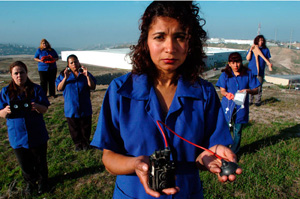
On Saturday we were supposed to have a Trade and Health tour of Tijuana, but because of increased violence there the trip was called off.  Instead, Tijuana came to us.  Over the course of three hours we heard from some inspiring environmental health efforts (a successful community effort to clean up a disgusting toxic waste dump) and occupational health work (a maquila worker-turned-activist).  The last hour was a fantastic film that I highly recommend to anyone interested in either or these topics:

Maquilopolis

Continue reading “Best of the Best”

How effective is our work towards reaching the MDGs?

By Elvira Beracochea, MIDEGO

Are we really making a difference? Should we account for our work and present transparent results, good and bad to our peers, host country partners and funding agencies?

This year the IH section hosted the second panel on “Aid Effectiveness and Accountability.” This panel is a follow on to the one we had last year. I am happy that the topic of Aid Effectiveness is raising more attention. I want to thank two guest presenters: Michael Hammer, Executive Director of the One World Trust, who came from the UK for this panel and Elisabeth Sandor of the OECD, who came from Paris for this panel.

One World Trus (www.oneworldtrust.org) is a fifty-year old non-profit organization in the UK evaluating and holding accountable organizations such as DfID, Aga Khan Foundation, etc. Their accountability report is a must for those working in IH. Last year the OECD decided to include health as its tracer sector and is monitoring progress towards the MDGs and the commitments made in Paris Declaration.   Continue reading “How effective is our work towards reaching the MDGs?”

Health Care as a Means to Peace

By Courtney Cawthon

Attending the Community-Based Primary Health Care (CBPHC) workshop on Saturday, October 25 at the 136th annual APHA conference, I was reminded of how there truly can be “power in numbers”.

Having worked in domestically in tertiary care at a well-funded institution (basically the opposite of CBPHC) for almost a year now, I searched for common ground with the international community-based primary care group, relying on my relatively brief but highly educative experiences in international public health. I of course am still interested in community health and primary care, but as others noted in an earlier blog entry from this conference, the funding for positions in that field is minimal.
 
At the workshop on Saturday, I realized just how many dedicated people there are focused on this area, and that our strength is in combining efforts to accomplish our goals. I often witnessed how a group’s synergy can greatly improve its effectiveness and creativity. At the workshop, we split into 3 groups, each one discussing the major actions needed to further the field of CBPHC, including, documentation and dissemination, raising awareness, and finding funding. My group was charged with discussing how to create or find more resources to implement programs in CBPHC. Continue reading “Health Care as a Means to Peace”

Failed Leadership of the Health Sector in Addressing the 2008 World Food Crisis

By Charles Teller

Where have international nutrition and health sector leaders been during this serious 2008 crisis of spiraling food crises that are worsening food and nutrition insecurity among the most vulnerable in the world?

At a lively, standing room only session (#3302) on the 2008 Global Food Crisis Monday at the APHA meetings, the 4 panelists and moderator agreed that it was much more than a crisis. It reflected a longer term structural and systems issue related to food poverty, international trade, climate change, energy and environment. Case studies on India and Ethiopia helped to contextualize the intra-country discrepancies in undernourishment, stunting and wasting.

On my Ethiopian case, I contrasted the apocalyptic press statements in September 2008 of the UN ( FAO, WFP,Humanitarian Affairs) with my Oct. 20th interview with the well-informed Minister of Health of Ethiopia who felt that overall high inflation and energy costs, as well as drought, were more serious shocks  to health and nutrition of his people.  In presenting the long and short-term trends in food access and malnutrition in Ethiopia, I found that this discrepancy in information reflects the lack of representative and reliable data on the evolution of the situation, causes and immediate effects. Continue reading “Failed Leadership of the Health Sector in Addressing the 2008 World Food Crisis”