Global Health Connect

In addressing health disparities globally, the WHO Pandemic Agreement aims to center equity-rooted principles in pandemic prevention, preparedness, and response through the collective efforts of global leaders.

Let’s hear from you about the Revised Draft of the WHO pandemic agreement negotiating text. Learn more here: https://apps.who.int/gb/inb/pdf_files/inb9/A_inb9_3-en.pdf

#APHA #internationalhealth #HealthEquityMatters #pandemicpreparedness

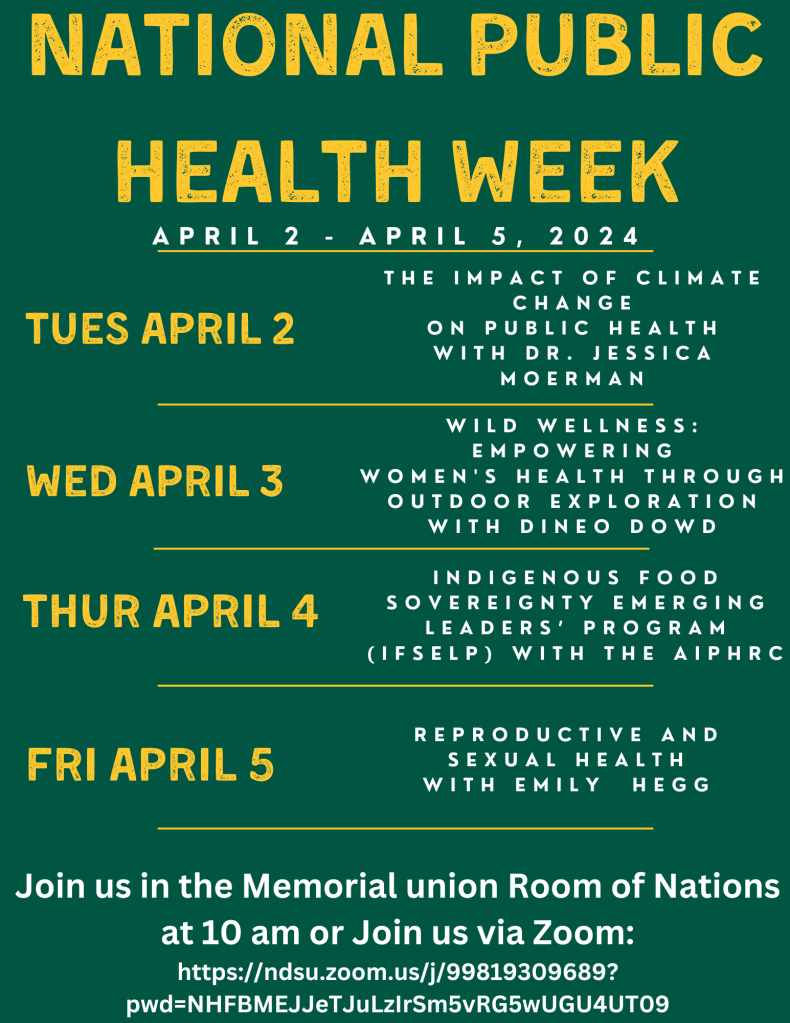
North Dakota State University National Public Health Week

The PHA student leaders at North Dakota State University are hosting a series of NPHW events (10 am central time each day, April 2-5, 2024). Attached is a flyer of events, and here is a QR code for the Zoom link. All are welcome.

Congratulations to our 2023 Award Winners

Congratulations to our colleagues whose outstanding accomplishments in international health are being recognized by our Section this year!

Carl Taylor Lifetime Achievement Award in International Health
Sarah Shannon

Mid-Career Award in International Health
Mona Bormet

Gordon-Wyon Award for Community-Oriented Public Health, Epidemiology and Practice
Judy Lewis

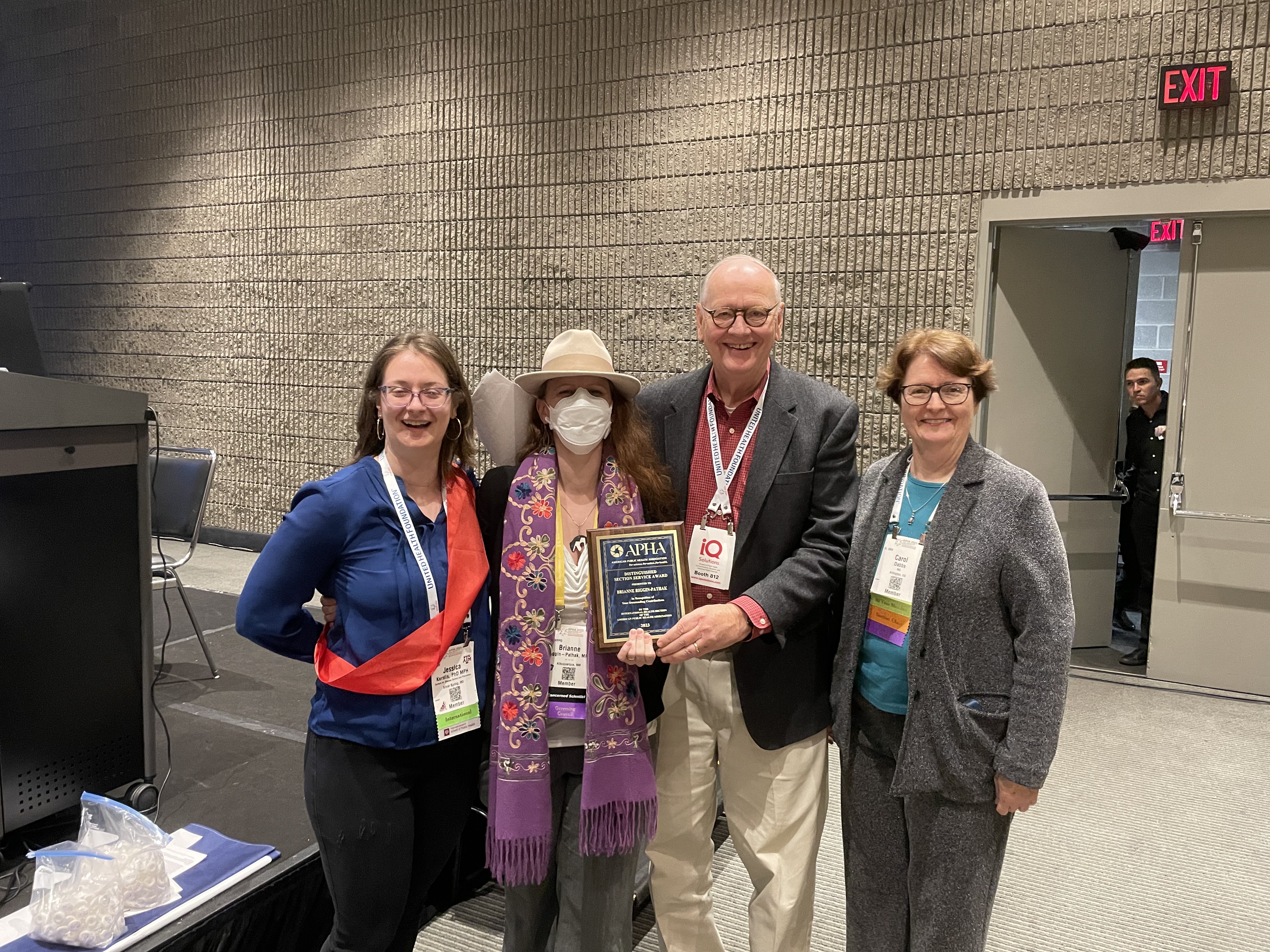
Distinguished Section Service Award
Brianne Riggin-Pathak

Welcome message from our IH Section Chair, Carol Dabbs

Dear IH Section Members,

As we enter the final preparations for the 2023 APHA Annual Meeting, it is gradually becoming clear that we are almost back to the full-bore Annual Meetings of pre-pandemic times. But we’ve added the power of remote access by having several pre-meetings, like the COA/ISC Candidates Forum, the policy hearings, and a vibrant virtual program in the weeks preceding the in-person meeting in Atlanta, including the workshop offered by the IH Section Working Group on Community-based Primary Health Care. The latter was sold out almost two weeks in advance!


This year at the Annual Meeting, our approximately 1800-member section will have a full program of oral and poster scientific sessions presenting the 248 accepted abstracts. Our hearty thanks to Jamie Zigterman and Liz Healey, our Program Chairs for this excellent program—it was a feat of endurance and strength to create it!


In addition, we will have several IH Section meetings, as follow:
– an Open House on Sunday morning starting at 9 am, 
– a Luncheon at 12:30 pm on Monday. A few tickets are still available through your registration for the AM at $62; sales close on 11/6. Those without a ticket may sit in the back to listen to the speech, scheduled to start about 1 pm. 
– several IH committees and working groups are holding open meetings –some at 6:30 pm on Monday, and others at 12:30 pm on Tuesday, all listed in the program. 
– our Awards Reception will be on Tuesday evening starting at 6:30 pm. 
We hope to see you at one or more of these IH events as well as at our scientific sessions.

As this program year draws to a close, I want to acknowledge and thank the leadership of the IH Section, without whose initiative and support we would not have an IH Section which is active year round, and which supports our strong Annual Meeting program.
– Our elected leaders include the Immediate Past Chair, Chair-Elect, Treasurer, Secretary, Secretary-Elect, Student Assembly Liaison, 6 Section Councillors, and 6 Governing
Councillors.
– We have 8 IH Committees (Awards, Communications, Membership, Mentorship, Nominations, Policy and Advocacy, Program, and Students) and 6 IH Working Groups Climate Change, Community-based Primary Health Care, Global MCH Network, Health Systems Strengthening, International Abortion, and Palestine Health Justice), each of which is supported by dedicated and creative volunteer international public health professional members and Chairs or Co-Chairs.
Committees and Working Groups are open to all IH members—let me know which group you’d like an introduction to!

I’d like to give a shout out to our APHA staff liaison to the IH Section, Vina Hulaam, who has provided substantial support which moved our programming forward, and to our Section Historian. And to our incoming elected officers: Section Councillors Jessica Keralis and Jamie Zigterman, Governing Councillors Jean Armas and Emily Maistrellis, and Secretary-Elect Mark Strand. (NB we will have a special election this fall for Student Assembly Liaison.)

Our thanks go also to our outgoing Secretary Jessica Keralis, outgoing Section Councillors Jean Armas and Rhoda Gordon, and outgoing Governing Councillors Kevin Sykes and Samer Jabbour. In addition, I want to thank the several IH members in APHA leadership positions for their ready advice and counsel to the section throughout this past year. These include a member of the Executive Board, Vice-Chair of the Science Board, incoming Chairs of the Student Assembly and of the Intersectional Council, 2 members of the AJPH Editorial Board, and a member of the Advisory Board to APHA’s Center for Climate, Health, and Equity.

I look forward to another fruitful year in the IH Section.

Sincerely,
Carol J. Dabbs, MPH
Chair, APHA IH Section
Email me at: ih.chair@apha.org

Blog IV- Universal Health Coverage and COVID-19 in the United States

According to Galvani et al. (2022), here in the U.S. “…the COVID-19 pandemic has underscored the public health, economic, and moral repercussions of widespread dependence on employer-sponsored insurance.” The majority of U.S. adults under age 65 access health insurance through their employer. From December 2019 to April 2020, there was a 14.5 million decrease in employer-sponsored health insurance enrollments, largely driven by the millions of Americans who became unemployed during this time. On the flip side, Medicaid enrollments increased by almost 10 million between March and December 2020, in no small part due to the Families First Coronavirus Response Act (FFCRA) which allowed state Medicaid programs to keep individuals continuously enrolled throughout the pandemic. Soon we may be seeing another drop in insurance coverage, though, as this provision ended on March 31st, 2023. It is expected that millions of people will lose coverage or experience a lapse in coverage, but the full impacts are yet to be seen. 

The uniquely American dependence on employer-sponsored health insurance no doubt contributed to the COVID-19 outcomes we experienced as a country. Workers may fear losing their job and therefore health insurance, so they decide to go into work even if they are sick and contribute to transmission. If a person did lose their job and insurance, fear of high costs and delayal of care results in increased case fatality rates. It was found that essential workers in Pennsylvania were 55% more likely to contract COVID in the early stages of the pandemic compared to Pennsylvanians who were able to work from home. Family members and roommates of these workers were 17% and 38% more likely to test positive, respectively. In this study, “essential workers” were more likely to live in communities of predominantly Black or Latino residents and individuals below the poverty line. Thinking back to early 2020, one of the memories that stands out most is society’s collective glorification of essential workers. While this rhetoric of heroism was being propagated, the material conditions that these individuals were working under, and the policies that allowed these conditions, displayed blatant disregard for the health and safety of Americans who literally kept our communities running. Our drained workforce, and more importantly the families who have an empty seat at the dinner table, signify the lasting effects of the U.S.’s COVID-19 response. 

While we can’t go back in time and fix all of the many problems associated with our COVID-19 response, we can use policy changes to become more resilient in preparation for future health emergencies. UHC is one piece of this puzzle. One study estimated that 26.4% of lives lost due to COVID-19 in 2020 could have been saved if the U.S. had UHC. This amounts to 131,438 COVID-related deaths in 2020 alone. UHC would have provided greater access to critical healthcare services and programs. Access to primary care and management of chronic conditions are two of the main mechanisms through which UHC could have been lifesaving in 2020. Hypertension increases the risk of COVID-19 mortality by 188%. Similar risk increases exist with other comorbidities such as diabetes and obesity. Adults who are uninsured are less likely to be diagnosed and receive treatment for chronic conditions, making them more vulnerable to severe COVID-19 infection. Access to primary care also contributes to the prevention of COVID-19 prevention, as it is associated with increased vaccine uptake. This relationship may account for vaccine uptake disparities between Black and Hispanic Americans and White Americans.

COVID-19 may have jeopardized the great strides made towards UHC in the 21st century, hopefully this collective trauma illuminated the need for change and sparked renewed energy across the world. COVID-19 showed both leaders and ordinary people the importance of health, and the impacts of its absence. It puts on full display how a threat to health can impact all corners of society: physical health, mental health, the economy, school systems, availability of goods and services, and the list goes on. We are still feeling these impacts years later. As for myself [Martha Smee], I value my health now more than ever. As a future public health professional and healthcare provider, I will continue to advocate until those in power value my health and the health of all peoples as much as they should. 

Martha Smee MPH (c) MMS (c) 

Martha Smee is a current student in Arcadia University’s Dual Master of Public Health/Master of Medical Science in Physician Assistant Program. As an MPH student, her capstone research explored the relationship between state Medicaid policy and mental health outcomes. She completed an internship at the Free Library of Philadelphia’s Culinary Literacy Center where she assisted with curriculum development and program facilitation to promote literacy through food, cooking, and community-building. Her public health interests include health policy, access to mental health services, and environmental health. After graduating, she plans to continue practicing evidence-based public health as a primary care provider in the Philadelphia area.

Dr. Heather F. McClintock PhD MSPH MSW

Dr. McClintock is an IH Section Member and Associate Professor in the Department of Public Health, College of Health Sciences at Arcadia University. She earned her Master of Science in Public Health from the Department of Global Health and Population at the Harvard School of Public Health. Dr. McClintock received her PhD in Epidemiology from the University of Pennsylvania with a focus on health behavior and promotion. Her research broadly focuses on the prevention, treatment, and management of chronic disease and disability globally. Recent research aims to understand and reduce the burden of intimate partner violence in Sub-Saharan Africa. Prior to completing her doctorate she served as a Program Officer at the United States Committee for Refugees and Immigrants and a Senior Project Manager in the Center for Clinical Epidemiology and Biostatistics, University of Pennsylvania. At the University of Pennsylvania she led several research initiatives that involved improving patient compliance and access to quality healthcare services including the Spectrum of Depression in Later Life Study and Integrating Management for Depression and Type 2 Diabetes Mellitus Study.