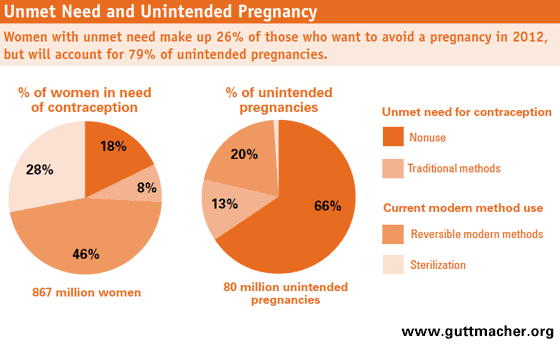
The last week of September marks two days dedicated to improving reproductive health: World Contraception Day (September 26) and Global Day of Action for Access to Safe and Legal Abortions (September 28). Both days are committed to improving the reproductive health and choices of women worldwide. With the vision of making every pregnancy a wanted pregnancy, World Contraception Day aims to help the estimated 225 million women in developing countries who have an unmet need for contraception.
Reports such as the UN’s 2015 Trends in Contraceptive Use Worldwide include somewhat promising data, such as 64% of married or in-union women use a modern contraceptive method. This figure is lower in developing countries, including 17 countries in Africa where modern contraceptive use is below 20%.
Sterilization is the most widely used form of birth control, accounting for a third of modern contraceptive use. Sterilization is heavily weighted toward female sterilization, 18.9% versus 2.4% male sterilization globally. In certain countries, the prevalence of female sterilization as modern contraception is much higher. Female sterilization of sexually active women aged 15 to 49 is most prevalent in Latin America. The Dominican Republic leads the pack at 47% followed closely by Colombia, Costa Rica, El Salvador, and Puerto Rico. China (29%) and India (36%) are also front runners.
Sterilization is a popular choice in the developed countries of Europe and North America, though male sterilization tends to be more prevalent than in the developing world. When practiced safely, sterilization offers many benefits because it is a one-time procedure with no follow-up or maintenance. While sterilization might be the best choice for some individuals or couples, unsafe, involuntary, or otherwise coercive female sterilizations are altogether too common and an affront to human rights.
This is nothing to be happy about. First the #CCP would kill any baby after one. Now they will kill any baby after two. #ChinaOneChildPolicy
Lesser known is an Uzbekistan policy that assigns gynecologists a sterilization quota of up to 4 per month. In a report by the BBC, rural women who have had two or more children are the main target of this campaign. It is estimated in 2011 alone that 70,000 Uzbek women were sterilized, some voluntarily and some involuntarily. Unlike China’s policy to slow population growth, Uzbekistan’s goal is to manipulate its once abysmal infant mortality ratings. Fewer infants means fewer infant deaths, and Uzbekistan’s infant mortality rate in 2012 is half of what it was in 1990.
India has received much attention for its sterilization camps. The name alone conjures images of the Nazi eugenics movement. In 1951, with Malthusian ideology in mind, an Indian demographer set out across rural India to complete a census. His prediction – that India’s population would reach 520 million people by 1981 – was both incorrect (India’s population in 1981 was 683 million ) and the catalyst for a mass sterilization program. This led to compulsory sterilization in 1976 that lasted for 21 months and effectively sterilized 12 million men and women, often rural, poor, and of low caste. Employment, wages, and even running water were withheld from individuals and whole villages until 100% compliance was met.
Today, while technically voluntary, sterilization in India is incentivized. In the past, men were promised transistor radios in exchange for a vasectomy. Male sterilization is now considered culturally unacceptable. Women are the target of sterilization campaigns and can receive up to $23 US – a month’s income – to submit to a tubal ligation.
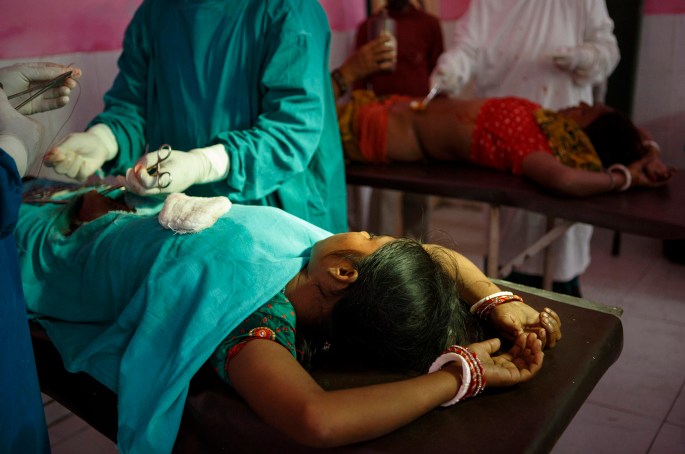
Women undergo sterilization operations at the Cheria Bariarpur Primary Health Centre in the Begusarai District of Bihar. A few dozen women were sterilized in one day. Although India officially abandoned sterilization targets years ago, unofficial targets remain in place, according to people working on the ground. One Primary Health Centre doctor says the targets in themselves are not necessarily the problem, arguing instead that itÕs the lack of a good healthcare infrastructure in some places that makes it difficult to safely meet those targets. SARAH WEISER
Indian women arrive at sterilization camps by the jeep load. In makeshift operating theaters – with no electricity and running water – neither gloves nor equipment are changed between the five-minute operations. Expired antibiotics given to some women are found laced with rat poison. In 2014, Dr. R.J. Gupta, self-described as performing 300 tubal ligation in one day, was arrested after women he and an assistant sterilized either died or were hospitalized. The current government regulation is that no one doctor should perform more than 30 sterilizations a day. On the day in question, Gupta’s six-hour spree resulted in 83 tubal ligation. It is believed that Gupta was trying to reach a government-set target of 220,000 sterilizations in one year.
On September 14th of this year, India’s Supreme Court ordered a close of all sterilization camps within three years. That is an unsettling time span in which over a half a million more women could be sterilized and many more deaths and hospitalizations could occur. Even after the dissolution of government-sanctioned sterilizations camps, women will continue to be subject to this dangerous procedure.
What are low cost, accessible, and humane forms of birth control for the developing world? A promising alternative might be Sayana® Press, a lower-dose presentation of the three-month injectable contraceptive Depo-Provera® in the Uniject™ injection system.
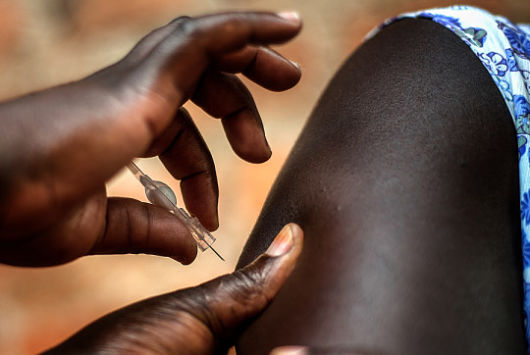
A village health worker counsels a client in family planning and administers Sayana Press. Phiona Nakabuye (left), village health worker trained by PATH’s Sayana Press pilot introduction program, with Carol Nabisere (right), age 18, who chose to receive Sayana Press after being counseled in the various forms of contraception, Kibyayi village, Mubende district.
There is so much to consider when it comes to global family planning. It would be remiss not to mention the impact that the HIV/AIDS epidemic has on sterilization rates in some regions of the world and you can read more here, here, and here. Organizations such as USAID have been implicated for funding so-called fertility reduction programs that include mass sterilization. What can be done to ensure all women have access to contraception?
In today’s video, USAID shares a message of hope amidst the horrors experienced by 2.4 million Syrian refugee children. Along with displacement from home, Syrian children experience an interruption in education from which they might never recover. Ms. Maha, a principal for a girls’ school in Jordan, answered the desperate pleas of Syrian parents as she welcomes us and their children into her school with the sentiment: “Just Bring a Chair.”
Video Description:
“In Jordan, where the Syrian crisis has led to around 635,000 additional people taxing already overburdened schools, hospitals and social services, some people still find reasons to open their arms and make it work. Ms. Maha is one of those people.”
Without access to education, the future is bleak for many of the youngest Syrian refugees. A recent report by Human Rights’ Watch found that nearly one-third of refugees in Jordan are between the ages of 5 and 17. Of these children, 56% are not enrolled in school. Lebanon is also struggling to accommodate the inundation of refugee students. Soon, school-aged Syrian children could outnumber their Lebanese peers.
Unfortunately, the problems do not end once children are in school. A reportby UNICEF highlights the unique educational concerns of refugee children, citing violence while traveling to and from school, abusive teachers and classmates, and separation anxiety while at school. The same report finds that even when the school is located within the refugee camp, 75% of children do not attend.
So what’s the solution? I think an inclusive environment like Ms. Maha creates in her school is key. Money for teachers, educational materials, and space are paramount for educating this generation of Syrian youth. 2015 saw fundraising efforts by members of the UN fall short of the $8.4 billiongoal. Will 2016 see more Syrian children returning to classrooms?
The World Humanitarian Day is today August 19th, 2016 and the theme for this year is “One Humanity”. The day was designated in 2003 to honor the lives of 22 humanitarian workers who were killed in a terrorist attack in Baghdad, Iraq.
Currently, there are 130 million people who are living in crisis and face impossible choices. All wars, conflicts and internal displacements disrupt the strong social, economic and cultural support systems that people have built and cultivated over the years. This decimation of all forms of support has a direct impact on people’s mental and physical health. The consequences also extend to our colleagues who put their lives in danger to serve people in many conflict zones. You will recall the loss of lives from the many acts of violence against hospitals and clinics.
As global/public health professionals, it is our duty to take a stand and commit today to move the needle on the 7 core commitments that were identified at the World Humanitarian Summit that happened in May 2016.
APHA Executive Director Georges Benjamin has written a letter to the members of the UN Security Council to enforce a resolution to end attacks targeting health care workers in Syria. You can read the text below.
Dear United Nations Security Council members:
On behalf of the American Public Health Association, a diverse community of public health professionals who champion the health of all people and communities, I write to call on the United Nations Security Council to enforce resolution 2139 to put an end to the attacks on health workers and facilities in Syria.
In over four and a half years of conflict in Syria, nearly 700 health workers have been killed and more than 300 medical facilities have been attacked. According to well-documented reports, the Syrian government is responsible for over 90 percent of these assaults. The disruption of health services is being used as a weapon of war. This year, by the end of October, attacks on medical facilities in Syria had already surpassed the number of attacks for any other year since the conflict began in 2011.
The attacks have decimated the country’s health system. In Aleppo, only 10 hospitals remain of the 33 hospitals that were functioning in 2010. About 95 percent of doctors have been detained, killed or have fled leaving one doctor for every 7,000 residents. There are shortages of medicine and necessities such as clean water and electricity. Hospitals are overwhelmed with patients needing emergency care for conflict-related injuries and patients are dying from treatable conditions.
In February 2014, the United Nations Security Council unanimously passed resolution 2139 demanding that all parties immediately end all forms of violence. The resolution strongly condemned attacks on hospitals and demanded that all parties respect the principle of medical neutrality, and that medical personnel, facilities and transport must be respected and protected. Passing the resolution was a critical first step, but now almost two years have passed since it was adopted and the attacks have continued. We urge the Security Council to take immediate steps to ensure that the resolution translates into meaningful progress to protect health workers and their patients in Syria.
A few regular readers might be familiar with the Korean government’s ongoing misrepresentation of its HIV-related immigration restrictions: while it continues to receive undeserved recognition from the UN for being a country free of HIV-related travel restrictions, it mandates HIV tests for native-speaking English teachers, EPS workers (manual laborers), and entertainment workers. Despite claims from KCDC and Korea’s ministry of foreign affairs that immigration restrictions have been lifted, one English teacher won a discrimination case with the UN CERD earlier this year, and another case is pending with the ICCPR. Our Section was even successful in pushing through a resolution on immigration restrictions tied to HIV status at this year’s APHA Annual Meeting that called Korea out specifically for its double-talk.
Now there more evidence of discrimination to add to the list. The Korean Government Scholarship Program, which provides funding and airfare for non-Koreans interested in pursuing post-graduate degrees at a Korean university, is open to a small number of foreign nationals each year and is actively advertised on Korean embassy websites and even featured on several university websites for current undergraduates who might be interested. The program “is designed to provide higher education in Korea for international students, with the aim of promoting international exchange in education, as well as mutual friendship amongst the participating countries,” and the payment includes tuition, airfare, a monthly allowance, a research allowance, relocation (settlement) allowance, a language training fee, dissertation printing costs, and medical insurance. Which sounds lovely, except:
Applicants must submit the Personal Medical Assessment (included in the application form) when he/she apply for this program, and when it’s orientation, an Official Medical Examination will be done by NIIED. A serious illness (For example, HIV, Drug, etc) will be the main cause of disqualification from the scholarship.
It is also worth noting that pregnancy can disqualify candidates as well.




 IH CONNECT