
World Pneumonia Day

November 2, 2009 is the first annual World Pneumonia Day, recognizing the world’s leading child killer as a global public health issue. A network of nearly 100 IGO, NGO, research and academic institutions, foundations, and community-based organizations have joined forces to raise awareness and urge governments and policymakers to combat this preventable illness. Each year, over 2 million children under the age of five die from pneumonia and pneumonia-related complications.

Although this is a great venture, it is surprising to see that this is the first campaign of its kind. Being the leading killer of children, it is outrageous to know this disease is not only treatable, but preventable. It leads me to wonder: “Why hasn’t more been done?” Mary Beth Powers, Campaign Chief of Save the Children said in an interview about pneumonia, “The sad thing is this is a disease that is largely preventable, and highly treatable.” This is not a disease that requires decades of scientific research to find a cure. Watch the movie.

According to leading public health organizations such as the World Health Organization (WHO) and UNICEF, many deaths can be prevented through early vaccination, proper medication (antibiotics) and nutrition, and vitamin supplements, such as zinc that is not typically found in a lower-income diet. Read more about the cause, prevention and treatment of pneumonia at the World Pneumonia Day website.

I would encourage everyone to spread the word about World Pneumonia Day, so greater awareness is made. The coalition firmly believes these deaths can be avoided, and encourages others to join the fight against pneumonia by:

1. Signing the pledge to fight pneumonia
2. Joining the coalition
3. Donating to the cause
4. Educating others about pneumonia prevention, diagnosis and treatment
5. Participating in a World Pneumonia Day event
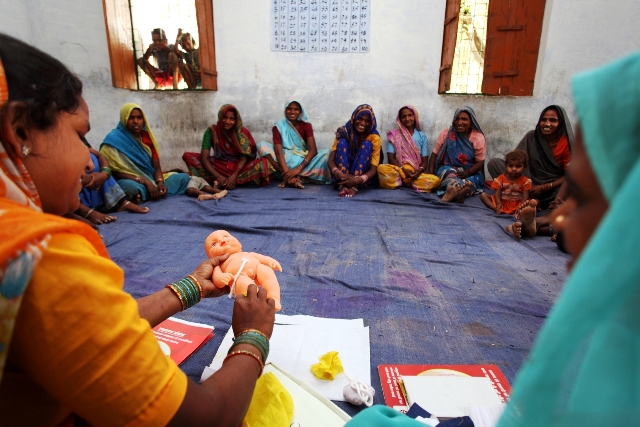
‘Sure Start’ in India Mobilises Communities for Maternal and Neonatal Health

Expecting mothers and their mother-in-laws learn about how to safely sever the umbilical cord of a newborn at a Sure Start facilitated Mothers’ Group Meeting in Sabji Village, Rae Bareilly District, Uttar Pradesh, India

By Tania Lal

A report by UNICEF India in January 2009 found that about a million neonatal deaths occur in the country each year. Uttar Pradesh (U.P.) has the largest population of any state in India and continuing problems with neonatal mortality. In an effort to tackle this problem PATH India with funding from the Bill and Melinda Gates Foundation has initiated Sure Start, a five year project that works with a population of roughly 25 million. The program is described on our website at http://www.path.org/projects/sure-start.php.

A major contributor to these death rates is the lack of literacy and awareness that exists in the rural areas of the country. For example, the benefits of immediate and exclusive breastfeeding are not well understood. For this purpose Sure Start in U.P. works with  community health workers and facilitates the functioning of village health and sanitation committees. Continue reading “‘Sure Start’ in India Mobilises Communities for Maternal and Neonatal Health”

Transdisciplinarity: global health workers breaking down walls

Message from Miriam (Section Chair)

As a lifelong international MCH professional, as a faculty member, and as citizen of the world, I am so excited about chairing IH Section this year. To me, what is so special about international health is that it is a transdisciplinary field. The term “transdisciplinary” may be new to some of you, so here’s the definition, developed by Piaget (yes, the same Piaget), translated by yours truly: “concerning interdisciplinary discourse, we hope to see a higher level emerge, “transdisciplinarity,” which would not settle for interactions or reciprocities between specializations, but which would internalize such interaction within an overall construct, and break down the walls between disciplines.” Continue reading “Transdisciplinarity: global health workers breaking down walls”