Global News Round Up

Politics & Policies

Rear Adm. Tim Ziemer, the head of global health security on the White House’s National Security Council, left the Trump administration on Tuesday.  The news was announced one day after an Ebola outbreak was declared in the Democratic Republic of the Congo.

A judge in Riverside County on Tuesday overturned California’s controversial assisted death nearly two years after it took effect, ruling that the Legislature improperly passed the measure during a special session on health care funding.

When global health leaders convene in Geneva next week for the 71st World Health Assembly, they’ll gather under one banner: universal health coverage.  

The World Health Organization (WHO) announced on Tuesday that a new Ebola outbreak has emerged in the Democratic Republic of Congo — and thanks to the Trump administration, we are woefully under-equipped to deal with it.

Research

Migrant children have specific health needs, and may face difficulties in accessing health care, but enough is known about their health service use. This study aims to describe patterns of use of health services of international migrant children and differences to respective native populations.

Although uncomplicated urinary tract infections (UTIs) are often self-limiting, most patients will be prescribed antibiotic treatment.  We assessed whether treatment with ibuprofen was non-inferior to pivmecillinam in achieving symptomatic resolution by day 4, with a non-inferiority margin of 10%.

Scientists have successfully reconstructed genomes from Stone Age and Medieval European strains of the hepatitis B virus.  This unprecedented recovery of ancient virus DNA indicates that hepatitis B was circulating in Europe at least 7,000 years ago.

Diseases & Disasters

The World Health Organization announced Friday that it hopes to deploy an experimental vaccine against the developing Ebola outbreak in the Democratic Republic of the Congo, even as the agency plans for the “worst case scenario.”

Healthy diet is not just about how many calories you consume, it’s also about how many calories you consume, it’s also about what kind of calories you consume.  A paper published this week in Obesity Reviews, Pathways and Mechanisms Linking Dietary Components to Cardiometabolic Disease: Thinking Beyond Calories, examined how calories from different foods affect the body.

The WHO and not-for-profit organization Resolve to Save Lives have teamed up to build a scheme for governments to use to tackle industrially-produced trans fats.

People who have their body clock disrupted by being awake at night risk developing mood disorders and depression.
People who ate diets full of vegetables, fruits, nuts and fish had bigger brais than their less well-nourished counterparts the large study from the Netherlands found.

Heart failure is a global health problem, affecting about 26 million people worldwide.  The disease presents a major and growing health-economic burden that currently costs the world economy 108 billion dollars every year, which accounts for both direct and indirect costs.

The Ebola virus has reared its head again, this time in the Democratic Republic of Congo. While it is impossible to predict exactly where and when the next outbreak will occur, we now know much more about how to prevent a crisis.

Dr. H.D.B Herath, Director, Anti Malaria Campaign speaks at the World Malaria Day Press event in Colombo, Sri Lanka.
In the jungle-rich landscape of Sri Lanka, mosquitoes are everywhere. But, thanks to a decades-long eradication campaign, the country hasn’t seen a single native case of malaria since 2012.

Sudan is a fragile developing country, with a low expenditure on health. It has been subjected to ongoing conflicts ever since 1956, with the Darfur crisis peaking in 2004. The conflict, in combination with the weak infrastructure, can lead to poor access to healthcare.  Hence, this can cause an increased risk of infection, greater morbidity and mortality from tuberculosis (TB).

Technology

Tools to diagnose and monitor HIV, hepatitis B and C, and tuberculosis, as well as resistance to first-line TB treatment are among the tests included in World Health Organizations’s first List of Essential In Vitro Diagnostics, released Tuesday.

Environmental Health

More than 80% of people living in urban areas that monitor air pollution are exposed to air quality levels that exceed WHO limits.  While all regions of the world are affected, populations in low-income cities are the most impacted.

Equity & Disparities

WHO recommends that every child should receive at least three doses of hepatitis B virus (HBV) vaccine, with the first dose being given ideally within 24 h of birth (referred to as HBV birth dose vaccine), regardless of burden of disease in the country.  However, despite this recommendation, only 101 (52%) of the 194 WHO member states provide universal HBV birth dose vaccination, with nine (19%) of 47 countries in the African region providing the vaccine.

A class-action lawsuit has been filed against the Canadian government on behalf of a group of Indigenous people who say they were subjected to medical experiments in residential schools and sanatoriums without their consent.

Global News Round Up

Politics & Policies

A Government Accountability Office report has found that USDA has taken steps to establish pathogen standards for only some meat and poultry products. Commonly consumed products such as turkey breasts and pork chops don’t have any standards.

The United Nations is being criticized for failing to help cholera victims in Haiti. The U.N. Haiti Cholera Response Multi-Partner Trust Fund has raised only about 2.2.% of total amount needed and has spent only less than half thus far.

There are potentially two options as we risk entering a post-antibiotic era: one is to discover new antibiotics and the other is to manage our current antibiotics better so that they remain effective for as long as possible.

Doctors and other specialists in Bangladesh are working under a One Health Initiative to prevent the development of antibiotic resistance.

Programs, Grants & Awards

Bill Gates and Larry Page have pledged $12 million to support the development of a universal flu vaccine.

Women-led movements in France and South Africa exposed damaging environmental policies – and won the prestigious Goldman Environmental Prize for 2018.

Research

Fiber gets well-deserved credit for keeping the digestive system in good working order — but it does plenty more. In fact, it’s a major player in so many of your body’s systems that getting enough can actually help keep you youthful.

More Americans are living in wooded suburbs near dear, which carry the ticks that spread Lyme disease, anaplasmosis, Rocky Mountain spotted fever, babesiosis, rabbit fever and Powassan virus.

Handgrip strength, a measure of muscular fitness, is associated with cardiovascular (CV) events and CV mortality but its association with cardiac structure and function is unknown.  The goal of this study was to determine if handgrip strength is associated with changes in cardiac structure and function in UK adults.

Diseases & Disasters

The HIV and AIDS epidemic could become uncontained if current funding trends continue, warned one of the founding architects of the US President’s Emergency Plan for AIDS Relief.

Three African countries will soon start rolling out the world’s first malaria vaccine.  Last year, more than 200 million people around the world were affected by the disease.  Most of those cases were reported in Africa.

Chronic wasting disease (CWD) did not cross the species barrier to infect cynomologus macaque monkeys during a lengthy investigation by National Institutes of Health scientists exploring risks to humans.

Technology

“Si-Low”, a low-cost alternative to the sterile silicone bags could help treat babies who are born with portions of intestines outside the body due to incomplete closure of the abdominal wall.

Purdue University researchers are developing an app and wearable technology to enable pregnant women to use a smart phone to detect whether they have or are susceptible to a condition that could lead to serious health complications for them or their unborn child.

Environmental Health

An experimental “reinvented toilet”, a system designed to reuse water, has been installed at a textile mill in the city of Coimbatore in India.

A new study found that China’s future emissions trajectory has the potential to measurably impact methylmercury levels in the rice being consumed by people in parts of China.

Equity & Disparities

A new report confirms what many residents suspected: living conditions in the city’s ‘resettlement’ blocks are little better than the slums they replaced.

For millions of displaced people around the world – many of them refugees, living in often overcrowded, temporary shelters – an outbreak of disease can be devastating. Each year, the measles virus kills more than 134,000 people globally, and another 100,000 children are born with the medical effects of congenital rubella syndrome. Both diseases are preventable by vaccination.

Women, Maternal, Neonatal & Children’s Health

Results from the Mordor trial conducted in 3 African countries, reveal 14% fewer deaths among children under the age of 5 getting azithromycin doses every 6 months for a 2 year period.

According to a new study, preterm babies should be given freshly expressed breast milk in order to allow slow degradation of hydrogen peroxide to preserve its bactericidal action.

Global News Round Up

Politics & Policies

An affordable hepatitis C treatment has been shown to be safe and effective, with very high cure rates for patients including hard-to-treat cases, in interim clinical trial results that offer hope to the 71 million people living with the disease worldwide.

The Trump administration is releasing the first of its kind interagency review of US overseas involvement that creates a framework for how the State Department, US Agency for International Development, and Department of Defense can coordinate efforts to streamline diplomacy, aid, and military operations around the world and maximize resources and results.

Programs, Grants & Awards

As part of its efforts to improve maternal healthcare in the country, Serene Health will kick off a campaign dubbed “Dollar4life”.

Four Duke doctoral students have been selected to join the Global Health Doctoral Scholars program at the Duke Health Institute (DGHI), bringing the current cohort total to 13 scholars.

Research

Evolve BioSystems, Inc. and the icddr,b (International Centre for Diarrhoeal Disease Research, Bangladesh) today announced their collaboration, funded by the Bill & Melinda Gates Foundation, to study the use of Evivo® in infants to aid in recovery from severe acute malnutrition (SAM).

A far-reaching study conducted by scientists at Cincinnati Children’s reports that the Epstein-Barr virus (EBV)—best known for causing mononucleosis—also increases the risks for some people of developing seven other major diseases.

A natural variation of the gene KLF14 causes some women to store fat on their bellies and hips and outs them at significantly increased risk of type 2 diabetes, new research reveals.

Falls are a leading cause of injury and death among older adults.  In 2014, about 1 in 3 adults aged 65 and older reported falling, and falls were linked to 33,000 deaths.

Diseases & Disasters

The first known epidemic of extensively drug-resistant typhoid is spreading through Pakistan, infecting at least 850 people in 14 districts since 2016, according to the National Institute of Health Islamabad.

There have been recent spikes in Buruli ulcer cases in Australia, a chronic infection that leads to erosion of flesh. This condition once considered rare, is caused by Mycobacterium ulcerans.

Technology

A group of scientists from VCU Massey Cancer Center and UCLA Jonsson Comprehensive Cancer Center have developed new, high-speed microscopy platform that can measure a cancer cell’s resistance to drugs up to 10 times faster than existing technology, potentially informing more effective treatment selection for cancer patients. The technology is being presented in abstract form today at the American Association for Cancer Research’s Annual Meeting in Chicago.

A new e-health system designed to be a whole-home sensor aims to allow the elderly to live in their own homes with a higher degree of independence.

Environmental Health

A University of Montana researcher and her collaborators have published a new study that reveals increased risks for Alzheimer’s and suicide among children and young adults living in polluted megacities.

According to the World Poverty Clock, more than 73,000 people have escaped poverty – today.  The flip side of that coin is that more than 15,000 people have, today, fallen into poverty.  The sum total of people living in extreme poverty as of March 23, 2018, is about 619,800 people. By the time you read this, many more people will make the escape.

Two of the most elite waste treatment systems available today on farms do not fully remove antibiotics from manure, research finds.

Equity & Disparities

In two suburbs of the American city of St. Louis, separated by fewer than 30 miles, the odds of living a long and healthy life could not be more different.  If you reside in the mostly white, wealthy suburb of Wildwood, your life expectancy is 91.4 years. But if you live in the mostly black, poorer suburb of Kinloch, your life expectancy is only 55.9 years.

One in five older adults is socially isolated from family or friends, increasing their risks for poor mental and physical health, as well as higher rates of mortality, a new study shows.

Nearly nine months after Myanmar’s military was accused of widespread sexual violence in a crackdown against Rohingya communities, aid groups in Bangladesh’s Rohingya refugee camps are scrambling to identify women and girls now pregnant by rape.

Women, Maternal, Neonatal & Children’s Health

Taking painkillers during pregnancy could affect the fertility of the unborn child in later life, research suggests.

Maternal anemia is an important global health problem that affects about 500 million women of reproductive age.  Much is known about the consequences of anemia during pregnancy, including the increased risks of low birth weight, preterm birth, perinatal mortality, and neonatal mortality.

Many moms-to-be know that their health even before they become pregnant- known as pre-conception health – can affect the health of their babies. Now, research is continuing to show that the pre-conception health of fathers also can influence a pregnancy and the baby.

Infants in some of the world’s poorest regions are vulnerable to a common worm parasite infection and their treatment should become a priority, according to a study.

Despite a global decline in childhood infectious diseases, the prevalence of mental illness among youth has remained the same. That makes mental disorders one of the main origins of illness in children aged 4-15 years around the world, according to a new study published in the journal Child and Adolescent Psychiatry and Mental Health.

Global News Round Up

Politics & Policies

A review of US-funded Ebola recovery projects in Guinea, Liberia, and Sierra Leone by the US Government Accountability Office (GAO) released this week found that, of $1.6 billion appropriated by Congress in 2014 for US Agency for International Development (USAID) in the hard-hit region, $411.6 million has been targeted to 131 specific projects.

Programs, Grants & Awards

Each year we commemorate World TB Day on March 24 to raise public awareness about the devastating health, social and economic consequences of tuberculosis (TB) and to step efforts to end the global TB epidemic. The date marks the day in 1882 when Dr. Robert Koch announced that he had discovered the bacterium that causes TB, which opened the way towards diagnosing and curing this disease.

Research

In most health systems, Community Health Workers (CHWs) identify and screen for severe acute malnutrition (SAM) in the community. This study aimed to investigate the potential of integrating SAM identification and treatment delivered by CHWs, in order to improve the coverage of SAM treatment services.

Researchers with the National Institutes of Health (NIH) recently made a breakthrough on the link between iron supplements and worsening malaria infections, as well as curious mutation in African populations.

States that have approved medical cannabis laws saw a dramatic reduction in opioid use, according to a new study by researchers at the University of Georgia.

It seems the multi-billion dollar cannabis industry is having some problems with its employees showing up to work stoned. A recent study published in the American Journal of Industrial Medicine finds that a large percentage of those employed in the businesses of growing and selling weed are getting high either before work at some point during business hours — risking both their safety and that of their co-workers.

Diseases & Disasters

In West and Central Africa, nearly 170 young people are infected with HIV everyday and a disparity in funding has left the youth at risk.

Public Health England has reported a gonorrhea case resistant to the pair of antibiotics (ceftriaxone and azithromycin) that have been typically effective in treating gonorrhea.

For decades now, global health organizations and deep-pocketed philanthropies like the Gates Foundation have worked to eradicate wild poliovirus – and the achievement of that goal often seems tantalizingly close at hand.

The United Nations emergency food relief agency has airlifted over 80 metric tons of vital nutritional supplements to Papua New Guinea – enough to feed approximately 60,000 people in the earthquake-hit country.

Technology

Antibiotics were heralded as life-savers when they became widely available in the 1940s.  Today, they are fast becoming killers themselves. The more any given antibiotic is used, the greater the chances that bacteria will develop antimicrobial resistance (AMR) that renders the drug ineffective.

Environmental Health

The world is facing one of the largest food crises in more than 79 years, and climate change is only making it worse.  Between 2030 and 2050, climate change could kill an additional 250,000 people every year, from malnutrition, malaria, diarrhea and heat stress.

Lebanon’s waste crisis began in 2015 when a huge landfill site closed and government authorities failed to implement a contingency plan in time to replace it; dumping and burning waste on the streets became widespread. The campaign group Human Rights Watch calls it “a national health crisis”.

New research reveals shortening of telomeres due to air pollution in newborn. The researchers analyzed telomeres in the umbilical cord blood of 255 newborns, half of whom were born prior to the coal plant closure and the other half were conceived and born after the plant closure in Tongliang, China.

Equity & Disparities

One of the biggest issues at the intersection of sanitation, poverty and global health, open defecation has also long been one of the hardest to represent visually.

While globally men report a 25% higher cancer incidence than women, a new study reveals the opposite trend in India with more women being diagnosed with cancer than men.

Women, Maternal, Neonatal & Children’s Health

A United Nations employee who says she was sexually assaulted by a top UN official has spoken publicly for the first time, alleging she was offered a promotion if she accepted an apology from the man and claiming that the organization failed to take her complaint seriously.

An international health organization has suspended its partnership with the Heineken beer company because of the controversial use of so-called “beer girls” to promote its products.

Teenage pregnancy – the biggest killer of girls and women aged 15 to 19 in the world – is growing in the east Asia-Pacific region, the only place where the rate is climbing.

Human Rights

UN Security Council members condemned the killing of civilians in Gaza after a peaceful protest turned violent.

World TB Day 2018

5149398656_ebd66669fa_z

Tuberculosis is caused by Mycobacterium (seen in the image), a genus postulated  to have originated some 150 million years ago! The first written records about TB from India and China, date back to 3300 and 2300 years ago respectively.

Hippocrates accurately defined symptoms of “Pthisis” (Greek for TB) and described it as a fatal disease. There is also plenty of historical evidence about tuberculosis and its impact on human culture. From being identified as a “romantic disease” to being associated with poetic and artistic qualities, TB has had its fair share of time in the limelight.

All this history aside, the fact is, if untreated, TB can be fatal.  Effective treatment became available about 50 years after Robert Koch showed that TB was caused by an infectious agent in 1882Soldier TB 2. Isolation in sanitariums and surgical interventions were all part of treatment until the advent of streptomycin in 1944. BCG vaccine has also been in use since 1921. Several public health campaigns (such as the one seen here) were also conducted to raise awareness once TB was established as a contagious disease.

Unfortunately even to this day, TB is still a major public health concern in many parts of the world and is among the top 10 leading causes of death worldwide.  Seven countries account for two-thirds of total TB cases with India leading the count.

The disease typically affects the lungs and is spread in the air when a person infected with TB coughs or sneezes. Sadly the cost of having TB goes beyond the damage it does to one’s health. Recent studies show that economic impact TB can have people; TB can lead to a downward spiral into poverty and for the poor a TB diagnosis can prolong the cycle of poverty they already live in.

TB3March 24th is World TB Day. The theme for World TB Day 2018 is “Wanted: Leaders for a TB-free World”.

TB rate spike due to the humanitarian crisis in Venezuela, poor TB infection control in South African clinics and jail time for doctors who fail to report TB cases in India, have all been in the news leading up to World TB day. Clearly these news reports show the need for stepping up global action, if we hope to end TB by 2030.

The message about greater commitment and better leadership comes ahead of the UN General Assembly High Level Meeting on TB in September 2018. Given the surge in multiple drug-resistant TB, it is imperative that leaders at all levels work together to end TB. End TB strategy adopted in 2014 outlines interventions that fall under three key pillars that include integrated, patient-centered care and prevention, policies and supportive systems and research and innovation.

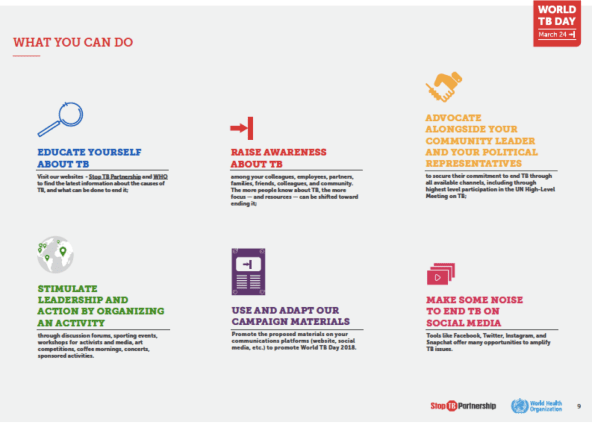
But as public health professionals, community leaders and residents, we all can take small steps to make sure we put an end to TB. The path to ending TB will hopefully improve the lives of most vulnerable people world-wide.

TB4.png