Malaria-2015 and beyond

One of the mosquito-borne illness (we have been hearing about these a lot lately in the news, heard of Zika virus anyone?) that the global community has been trying to eradicate for a long time now is malaria. Malaria is caused by Plasmodium, a parasitic protozoan, that is transmitted from the bites of infected female anopheles mosquitoes.

Early this month, the WHO released a video describing the progress that has been made toward reducing/eradicating malaria globally and the challenges that exist in the fight against malaria. The disease is widespread in Sub-Saharan Africa, Asia and Latin America. 214 million cases were reported in 2015. A multi-pronged approach of coordinated responses that include timely diagnosis through Rapid Diagnostic Testing (RDT), treatment using artemisinin-based combination therapy (ACT), distribution of long-lasting insecticide-treated bed nets (LLIN) and targeted insecticide spraying, the global mortality rates have decreased by 60% between 2000-2015. The malaria incidence rates also fell by 37% between 2000 and 2015.

Childhood mortality due to malaria fell by 65% worldwide and by 71% in Africa. This is particularly impressive and an important win since children under five years of age are highly susceptible to malaria infection and death.

In 2015, the global burden of malaria is highly concentrated in 17 countries, mostly in Africa and progress in reducing malaria incidence in these high burden countries has lagged behind other countries.
These data thus far are dramatic and encouraging but given the many challenges including poorly functioning health systems, climate change and global economy, a coordinated, multi-pronged global response with continued investment is needed. The Global Technical Strategy for Malaria was approved by the WHO in 2015. This strategy follows the timeline of the sustainable development goals and aims to reduce both malaria incidence and mortality by 90%. The framework provided in the technical strategy consists of 3 pillars, that could be used as a foundation for anti-malaria strategies and programs. The three pillars are a) ensure universal access to malaria prevention, diagnosis and treatment; b) accelerate efforts towards elimination and attainment of malaria-free status; and c) transform malaria surveillance into a core intervention. The framework aims to provide clear defined paths to achieve the lofty goals of malaria reduction and elimination.

Now is the time for consistent financial support from national governments and other donors to keep the momentum going in our fight against malaria. Together we can end malaria!

Global News Round Up

Politics & Policies

The American Public Health Association (APHA) supports the President’s request for funding to combat the spread of the Zika virus, both domestically and abroad.  The request to Congress includes more than $1.8 billion in emergency funds.

Programs

Malaria results in more than 400,000 deaths each year.  The President’s Malaria Initiative (PMI) is working hard to eliminate the devastating effects of the disease.  The program’s expansion means more people in endemic areas will benefit from the program.

Research

A paper presented at the Conference on Retroviruses and Opportunistic Infections by the Centers for Disease Control and Prevention (CDC) scientists has shown promising results in the global response to AIDS.  Malawi, for example, through its 2011 policy and Option B+ implementation, is showing success on the path towards the UNAIDS goal of less than 5% mother-to-child transmission rate.

A recent review published in Epidemiology Reviews by Santaella-Tenorio et al examines evidence on gun laws and gun violence from 130 studies that had been conducted in 10 countries. The authors found that new restrictions on gun purchasing and ownership was associated with reduction in gun-related deaths. But, they did point out that their study does not conclusively prove that gun restrictions reduce gun-related deaths.

In a new study published in The Lancet Global Health, Tarsicio Uribe-Leitz and colleagues report great discrepancies in surgical outcomes across different regions in the world. They examined the three surgical procedures, for which reporting should be uniform, since the procedures have been standardized (caesarean delivery, appendectomy, and groin hernia repair). Their systematic review shows that quality of surgical outcome data from LMICs is poor, and in most cases, LMICs are not even reporting the surgical data.

Diseases & Disasters

Researchers at the University of California, San Diego have published a paper in Nature describing how rock formations under the sea may have played a role in the 2011 Tohoku-oki magnitude 9 mega earthquake in Japan, which resulted in almost 16,000 deaths.

Technology

An effective experimental vaginal ring that can help prevent HIV transmission has been tested by the International Partnership for Microbicides (IPM), according to USAID.  The ring slowly releases an antiretroviral drug reducing the chances of infection by some women, who are at an increased risk of getting infected.

The Paul G. Allen Foundation, the largest private donor in the response of the Ebola outbreak in West Africa, and the US Department of State have teamed up to create a better and cost-effective airborne medical evacuation system to deal with a future outbreak.  The solution is the Containerized Bio-Containment System (CBCS).

Environmental Health

Many regions in northeast Mongolia have been severely affected by a phenomenon called dzud, whereby large numbers of livestock die due to extremely harsh winter conditions. This phenomenon that used to occur about once every 10 years, has now been occurring more frequently. This devastating trend seems to be the result of overgrazing in combination with climate change.

Five Epidemics to Watch for

As the World Health Organization executive board met in January 2016, Médecins Sans Frontières (MSF) highlighted five diseases that had the potential to become epidemics this year.

The 5 epidemics to watch for this year are:

Cholera is the infection of the intestine caused due to the rod-shaped Vibrio cholerae. It spreads through water and food that has been contaminated by human feces. While in the US and other developed countries, it is deemed as a rare disease, but it is a huge issue in many parts of the developing world. In 2014 the WHO reported a 47% increase in the number of cholera cases compared to 2013. Cholera can be prevented by improving sanitation, especially by the provision of clean drinking water.

L0032154 Unhygienic practices which lead to death from cholera. Colou
L0032154 Unhygienic practices which lead to death from cholera. Colou Credit: Wellcome Library, London. Wellcome Images images@wellcome.ac.uk http://wellcomeimages.org Unhygienic practices which lead to death from cholera. Colour lithograph by S. Pogorelskii, 192-. 1920-1929 By: S. PogorelskiiPublished: [ca. 1920?] Copyrighted work available under Creative Commons Attribution only licence CC BY 4.0 http://creativecommons.org/licenses/by/4.0/
Image Source: Unhygenic practices which lead to death from cholera,  Wellcome Images

Measles, yet another infection that is considered rare in the US, is among the leading causes of death among children worldwide. It is a highly contagious disease caused by the measles virus. Measles vaccination is the most effective prevention method. There has been a 75% decrease in deaths due to measles between 2000 and 2013.

Measles

                            Image Source: A global partnership to stop measles and rubella, CDC

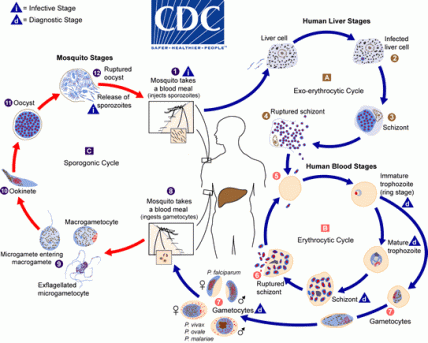
Malaria is caused by the plasmodium parasite and is transmitted from person to person by the female anopheles mosquito. Of more than 100 species of the malarial parasite, the most deadly is Plasmodium falciparum, which is also the most common in Africa. About 3.2 billion people are at risk for malaria, with young children and pregnant mothers being particularly vulnerable. There have been increased efforts in curbing this life-threatening disease. Malaria incidence fell by 37% globally between 2000 and 2015.

malaria_lifecycle

                                                                Image Source:Malaria Biology, CDC

Meningitis, an inflammation of the protective linings (meninges) around the brain and spinal cord, is often caused by infection. Bacterial meningitis caused by Meningococcal meningitis affects more than 400 million people each year in the African meningitis belt that runs east-west from Senegal to Ethiopia. While the number of cases has been decreasing steadily (24,000 in 2010 to 11,500 in 2014), the most recent outbreak occurred in 2009 with over 80,000 cases in Nigeria and Niger.

extra-meningitisbelt-map-0216

                                           Image Source: Map of Africa’s meningitis belt,  PATH

Emerging and Re-emerging viruses and parasites have already been causing some serious worry among the health professionals. Who could forget the Ebola outbreak in 2015, and we are all already well aware of the Zika virus. But a few other infectious diseases that did not receive too much of a media coverage in the US this past year were outbreaks of dengue, Chikungunya, Middle Eastern Respiratory Syndrome. Visceral leishmaniasis,a parasitic infection that has been under control for so long, is also on the rise.

In addition to prevention measures and rapid emergency alert systems, MSF has emphasized the necessity of broadening efforts to help countries strengthen their national health care systems (infrastructure and capabilities). MSF said that individual health security, including health security for vulnerable populations is the first step to achieve global health security.

Dr. Rull said that “Current outbreak response strategies are failing the very people they are designed to help”. “If we don’t make significant changes, we will be doomed to repeat past mistakes, and must take responsibility for the consequences.”

Global Health News Round-Up

The Communications Committee is working to revive the global health news round-up, which has been a popular feature in the past. Stay tuned!


WHO has released its latest situation report on Zika virus. The Director-General has announced that the cluster of microcephaly and other neurologic disorders in Brazil is a Public Health Emergency of International Concern. Experts also agreed that there is an urgent need for coordinated international efforts to understand the relationship between Zika virus and such neurologic disorders.

Nearly 25% of the South Sudanese population face food insecurity and in need of food assistance. This is particularly worrisome because this increase in hunger has occurred during the post-harvest season, a time when the country has traditionally been food secure.

A recent article in Health Affairs assessed the return on investment from childhood immunization programs to prevent diseases associated with 10 antigens in low- and middle- income countries. Their study shows that net gains were greater than costs across all 10 antigens.

Dr. Paul Farmer and 16 others who comprise the Commission on a Global Health Risk Framework for the Future have said in their 130-page report that pandemics are inevitable and that a key solution is investing in the countries’ health systems.

An analysis of the data from the Global Burden of Disease 2013 Study published in JAMA Pediatrics showed that “road injuries were the leading cause of death among adolescents globally.” Road traffic injuries killed nearly 115,000 young people, compared with ~76,000 deaths due to HIV/AIDS.

Zika virus: An emerging threat

by Abbhirami Rajagopal

Zika virus was originally reported in 1952 in the Transactions of Royal Society of Tropical Medicine and Hygiene. The original study involved placing a Rhesus monkey in a cage in the ZIka forest in Uganda. The monkey subsequently developed a fever and the researchers were identified a transmissible agent from its serum, and called it the ZIka virus. The virus belongs to the Flaviviridae virus family, related to dengue, yellow fever and West Nile virus, and it is transmitted by the day-time active mosquitoes, such as those of the genus Aedes.

CDC estimates that “about 1 in 5 people infected with Zika will get sick and for those who get sick, the illness is usually mild. The most common symptoms of Zika virus disease are fever, rash, joint pain, or conjunctivitis (red eyes). Symptoms typically begin 2 to 7 days after being bitten by an infected mosquito.”

Currently, the virus has spread to nearly 23 countries, with countries like Colombia reporting that they have about 20,000 confirmed cases that include ~2000 pregnant women. Pregnant women are the focus of this epidemic, as recent studies showed a link between Zika virus infection and microcephaly, a devastating birth defect that results in smaller brain size. CDC has issued travel warnings for nearly 25 countries, and several South American countries are strongly urging women to not get pregnant.

WHO recently declared Zika virus a global health emergency with the potential for infecting nearly 4 million people. In the US there have been 36 cases including 4 pregnant women and in Houston, where I live and work, thus far seven cases have been reported. All cases in the US are travel-related and not due to local transmission.

There is real concern at the alarming rise in the number of infected individuals. The other potential cause for worry might be the summer Olympics in Rio De Janeiro in a few months. Brazil has stepped up its surveillance program and the hope is that the cooler, drier climate will control the mosquito population.

President Obama has called on U.S. health officials and scientists to examine the link with microcephaly and rapid development and testing of vaccines for Zika virus.

While we wait, protect yourself from mosquito bites and if you are traveling make sure to check the CDC ZIka Virus page.