Mahila Mandals: Case Studies from Mumbai, India

The following post was written by Sarah Simpson, MPH-Epidemiology Candidate at the University of Medicine and Dentistry New Jersey. Sarah is an IH section member who has contributed to the blog previously. The following post is about her winter internship in Mumbai, India.
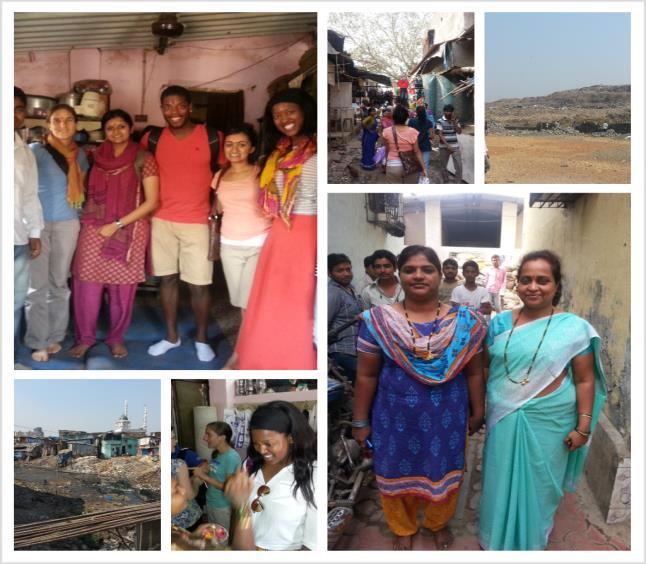

ssimpson_mumbaiHome to more than 18 million people, India’s most populous city, Mumbai, continues to be an attraction for millions looking for a better life for themselves and their families. Migrants from different parts of India, religions and cultures end up in the crowded slum communities around Mumbai. This past winter I had the opportunity to learn about urban health issues in these slum communities along with 20 other students from around the US and the world for three weeks at the Tata Institute of Social Sciences (TISS) in Mumbai.

My project group and I sped around town in rickshaws, trudged through sludge, and dust to study urban health issues in the slum areas of Shivaji Nagar. Located in the M Ward and home to some of the largest slums in India, about 600,000 people live in this area, which is located near the Deonar dumping ground, a man-made mountain of debris and trash. The health of the urban poor is complicated by many issues ranging from waterborne illnesses to infectious and communicable diseases, and when compounded by inadequate nutrition and overcrowded and poorly constructed living conditions makes for a dire situation for millions of people.

During our first day, we were introduced to the “Mahila Mandals” or women’s groups there are instrumental to addressing these public health issues. Parts of Shivaji Nagar are plotted slum areas recognized by the government; however they have minimal access to facilities and services provided by the Brihanmumbai Municipal Corporation (BMC). Imagine sharing 28 bathroom stalls (14 for men, 14 for women) with 1,000 other people and as you can imagine they quickly become unsanitary. The breakdown of government services has lead to the organization of community based organizations such as Mahila Mandals.

Instead of using a needs-based or problems-focused approach which would highlight only the worst aspects of a community, we decided to highlight the community’s assets by writing a case study using SWOT (Strengths, Weakness, Opportunities and Threats) Analysis to help us investigate how to best utilize these important community assets. We interviewed 6 Mahila Mandal groups consisting of some registered and unregistered groups and varying in size and number of members. We concluded that not only do the Mahila Mandals work to solve issues with sanitation, but they also promote immunization of children, maternal and child health education and resolve domestic violence issues. However, their impact is limited mostly due to funding and support from the local community.

At the end of our study, we recommended that the government provide more funding and implement community-based participatory research programs which would allow the communities to identify, support, and mobilize existing resources to create a shared vision of change and encourage greater creativity in solving community issues. Two community organizations like these groups and community engagement are important for continued public health and social change. Further research is needed on how to best utilize these valuable community assets.

Our internship presentation can be found at: http://prezi.com/i0lbgveimbyc/copy-of-indian-urban-slums/

References:

  1. Mili, D. Migration and Healthcare Access to Healthcare Services by Migrants Settled in Shivaji Nagar Slum of Mumbai, India. TheHealth 2011; 2(3): 82-85
  2. P A Sharpe, M L Greaney, P R Lee, S W Royce. Assets-oriented community assessment. Public Health Rep. 2000 Mar-Jun; 115(2-3): 205–211.

Stories from the Field: Clínica Tzanabaj (San Pablo, Guatemala)

by Deborah Flores, RN, Ed.D, MBA E-mail

Lake Atitlan is a large lake approximately 340 meters deep, situated in the Guatemalan highlands. It is flanked by several volcanoes and surrounded by towns and villages inhabited by descendents of Mayan people. They are proud and strong people. The lake itself is one of the most beautiful in the world.

This lake supports coffee and farm crops. Most of the indigenous population survives on very little money as they make a living from the land. The lake is a major life force in their lives. There is cyclical contamination from fertilizer run off, etc. which leads to bouts of cyanobacteria in the lake.

Although the weather is temperate, the rainy season brings mudslides and flooding, which has been known to destroy homes, commercial property and lives.

There are several small hospitals around the lake; one is public, and the others are private. There are also many clinics which provide basic medical and dental care. These are supported by churches and/or by locals, and some of these are private as well. Providers are predominately volunteers who either come in to the area from Guatemala City or are on short assignments from US, Europe or other parts of Central or South America. Much of the equipment is donated either through medical companies or churches. This in itself can be a challenge.

In December 2010, my husband, a general surgeon practicing in the US, decided to retire from medicine. He is from Guatemala, and for many years has desired to return there. He has always been drawn to the lake area, as so many people are. He decided we could contribute if we opened a health center to care for the people, because basic healthcare needs are difficult to meet. For example, basic dental care is in great need, infants suffer from dehydration and the women suffer from early respiratory disease due to cooking over an open fire that often is not vented properly.

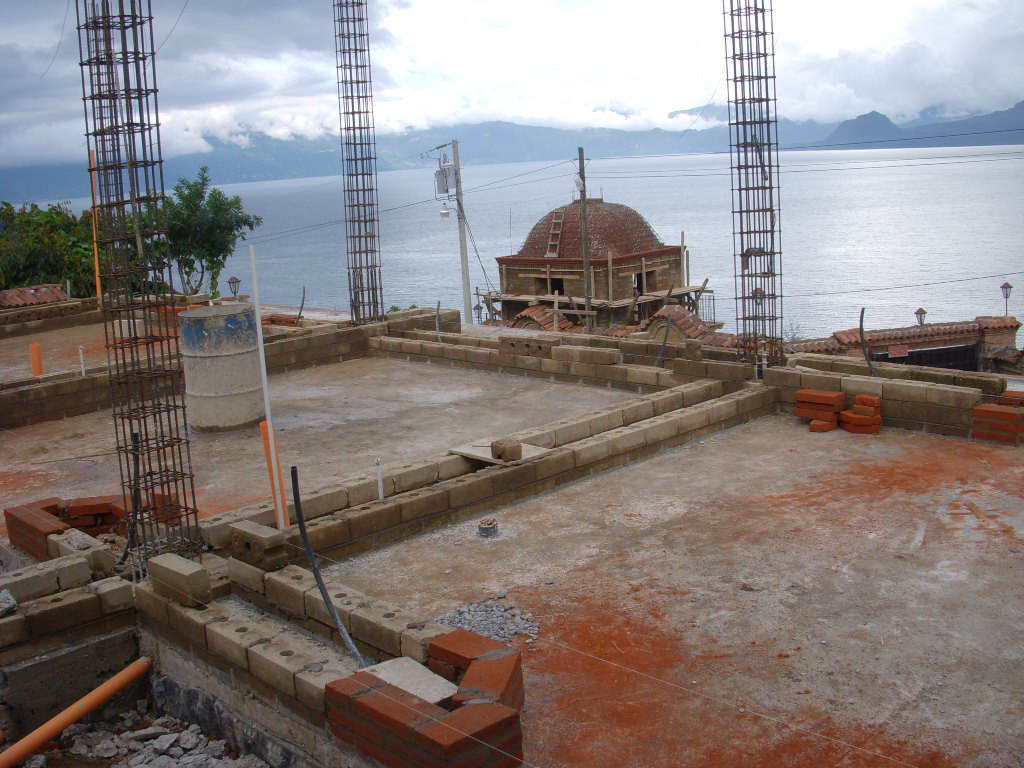
After much deliberation and planning, the clinic is now being built in San Pablo, a town with inadequate water and sewage systems.

Most children get a basic education but seldom leave the lake area. It is a closed community and very difficult to earn people’s trust.

We hired approximately 50 local workers and, with the help of a family member who is an engineer and architect, the workers were taught how to create and build using the earth underneath them. All of the materials are made on site, and rock is hauled from the riverbed to use for the rest of the structures. These men have acquired skills that they will now be able to use for the rest of their lives, hopefully to gain future employment after the project is complete. At this writing, this site has been under construction for over two years. The project itself has had an economic impact on the community, as it is the largest construction project that has ever been implemented in San Pablo.

Before breaking ground, a shaman blessed the land, as this was very important to the local workers. We then joined a local parade to advertise the coming clinic. Our workers started a soccer team for “Clínica Tzanabaj” and wear special shirts to denote who they are. We will continue to find ways to advertise the facility, but in reality, you cannot miss it driving through the area between San Pablo and San Marcos.

Until the clinic is finished, my husband travels from town to town to assist with surgeries as needed. When the clinic is complete, I will join him there to provide primary care. We hope in this way we have been able to impact our world far more than if we had stayed in the US and continued to provide care.

Deborah Flores will be joining the faculty of Research School of Nursing, which is affiliated with Rockhurst Univerisity.  Her husband is a general surgeon who retired early and is providing free care in Central America, and she joins him every few months to assist.

World Pneumonia Day

November 2, 2009 is the first annual World Pneumonia Day, recognizing the world’s leading child killer as a global public health issue. A network of nearly 100 IGO, NGO, research and academic institutions, foundations, and community-based organizations have joined forces to raise awareness and urge governments and policymakers to combat this preventable illness. Each year, over 2 million children under the age of five die from pneumonia and pneumonia-related complications.

Although this is a great venture, it is surprising to see that this is the first campaign of its kind. Being the leading killer of children, it is outrageous to know this disease is not only treatable, but preventable. It leads me to wonder: “Why hasn’t more been done?” Mary Beth Powers, Campaign Chief of Save the Children said in an interview about pneumonia, “The sad thing is this is a disease that is largely preventable, and highly treatable.” This is not a disease that requires decades of scientific research to find a cure. Watch the movie.

According to leading public health organizations such as the World Health Organization (WHO) and UNICEF, many deaths can be prevented through early vaccination, proper medication (antibiotics) and nutrition, and vitamin supplements, such as zinc that is not typically found in a lower-income diet. Read more about the cause, prevention and treatment of pneumonia at the World Pneumonia Day website.

I would encourage everyone to spread the word about World Pneumonia Day, so greater awareness is made. The coalition firmly believes these deaths can be avoided, and encourages others to join the fight against pneumonia by:

1. Signing the pledge to fight pneumonia
2. Joining the coalition
3. Donating to the cause
4. Educating others about pneumonia prevention, diagnosis and treatment
5. Participating in a World Pneumonia Day event

‘Sure Start’ in India Mobilises Communities for Maternal and Neonatal Health

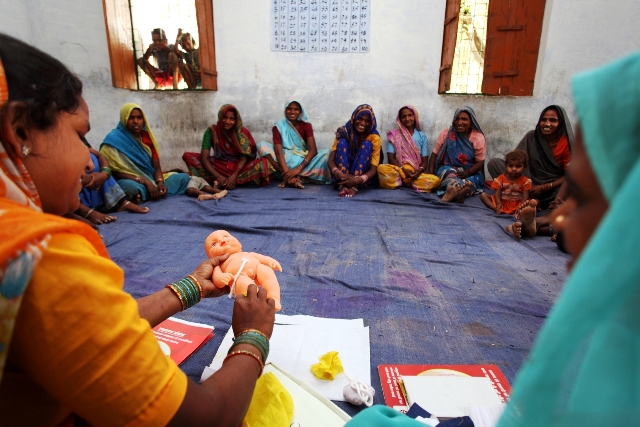
Expecting mothers and their mother-in-laws learn about how to safely sever the umbilical cord of a newborn at a Sure Start facilitated Mothers’ Group Meeting in Sabji Village, Rae Bareilly District, Uttar Pradesh, India

By Tania Lal

A report by UNICEF India in January 2009 found that about a million neonatal deaths occur in the country each year. Uttar Pradesh (U.P.) has the largest population of any state in India and continuing problems with neonatal mortality. In an effort to tackle this problem PATH India with funding from the Bill and Melinda Gates Foundation has initiated Sure Start, a five year project that works with a population of roughly 25 million. The program is described on our website at http://www.path.org/projects/sure-start.php.

A major contributor to these death rates is the lack of literacy and awareness that exists in the rural areas of the country. For example, the benefits of immediate and exclusive breastfeeding are not well understood. For this purpose Sure Start in U.P. works with  community health workers and facilitates the functioning of village health and sanitation committees. Continue reading “‘Sure Start’ in India Mobilises Communities for Maternal and Neonatal Health”

Stories from the Field: Necessary Angels

0014Within the public health community, Community-Based Primary Health Care (CBPHC) is a common point of discussion. But rarely has the story been told by a Pulitzer Prize-winning author or captured in pictures for the National Geographic Magazine. The December 2008 edition shared with the world the story of The Comprehensive Rural Health Project (CRHP) in Jamkhed, India. “Necessary Angels” was the fitting title to a story of history and hope for village health workers who have healed communities, saved lives and transformed the place of the untouchable caste in the process. Continue reading “Stories from the Field: Necessary Angels”