With the explosive growth of social media, these days it seems that every non-profit and NGO has its own blog, Twitter handle, YouTube account, and Facebook page, with some even venturing into Tumblr, MySpace, and Flickr (if you have never heard of these, don’t worry – I barely even know what Flickr is). One organization has done something pretty nifty (at least, I think so) with their YouTube account, though: Save the Children, which works in the U.S. and 41 other countries providing humanitarian relief, education, and other services to children, features a weekly video series called “Dirty Words.” These videos, narrated by its Director of School Health and Nutrition, Seung Lee, are 2-5 minutes long and highlight the water, sanitation and hygiene conditions at schools in developing countries, with simple solutions to address them. This week’s “dirty word” is worms – the video below shows a school in Nepal which has begun a program to provide de-worming medicines and iron to improve the health of the students.
Rotavirus—the most common and lethal form of diarrhea—is one of the most deadly diseases facing children
By Dr. John Wecker, director of the Vaccine Access and Delivery Global Program at PATH
Whether you have heard of rotavirus before or not, it may surprise you to know that you’ve probably had it. Nearly everyone in the world will have at least one rotavirus infection by age 3.
In wealthy countries, ready access to medical care means that few children will die from rotavirus. And with the recent availability of vaccines, the risk of dying, or of ever having to be hospitalized because of rotavirus, has dropped dramatically.
In the developing world, the situation is completely different. Rotavirus—the most common and lethal form of diarrhea—is one of the most deadly diseases a child will face.
This global health crisis can be solved by making rotavirus vaccines widely available in the developing world. The World Health Organization recommends that these vaccines be included in every country’s immunization program. What is lacking is the political will at all levels to make this happen.
Raising awareness about the toll of this disease and the promise that vaccines hold to save lives is critical for building political will. Recently, the scientific Journal of Infectious Diseases released a special supplement on rotavirus, Global Rotavirus Surveillance: Preparing for the Introduction of Rotavirus Vaccines. It provides a comprehensive review of the latest information about rotavirus disease and the role that vaccination can play.
Not only is rotavirus not well known as a major killer of children worldwide, but the fact that diarrheal disease is responsible for the death of 1.5 million young children each year in developing countries is lost on a world that takes for granted access to sanitation, clean water and basic health services. In a recent New York Times story the chief of health at UNICEF, Mickey Chopra, was quoted as saying, “All the attention has gone to more glamorous diseases, but this basic thing has been left behind. It’s a forgotten disease.”
Included below is a short release on the special rotavirus supplement.
The theme of APHA’s annual meeting is Water and Public Health. During the opening general session Dr. Mirta Roses Periago, Director of the Pan American Health Organization (PAHO) underlined the effects of climate change on human health, the new challenges faced by global health and the importance of access to safe water. Dr. Periago reinforced that combining water, sanitation and hygiene interventions can reduce up to 80% of the preventable water borne and related disease. The Millennium Development Goal target for 7c isto reduce by half the proportion of people without sustainable access to safe drinking water and basic sanitation. Dr. Periago stated that a one dollar investment in water and sanitation provides a $46 savings in social and development cost. The ideal would be to have water, climate change and equity addressed in a combined sustainable approach.
Celine Cousteau reinforced the importance of the connection between people and the environment. Ms. Cousteau is a story teller whose passion preserving our natural resources is equaled by her passion to bring health care to the indigenous people of the Vale do Javari reserve in Brazil. The film Amazon Promise is a celebration of one organization’s goal to bring health care to those in need…. the same passion found in so many of our public health workers around the globe.
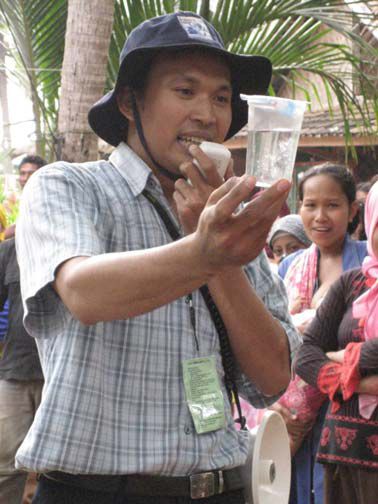
Solihin asks the crowd whether anyone wants to drink a cup of feces-contaminated water.
Project Concern International (PCI) is the first NGO in Indonesia to fully implement Community-led Total Sanitation (CLTS) and offer no subsidies to communities. Watch the video here (and listen to some cool music):
This video is about 18 minutes in length and shows how CLTS gets started in a community. The CLTS method emphasizes the importance of “natural leaders,” community members who emerge during the triggering session and demonstrate strong motivation and resolve to help their village become “open defecation free.” Continue reading “VIDEO about Community-led Total Sanitation in Indonesia – PCI”→
A visiting UK editor’s impressions of the APHA conference….
I didn’t attend that many scientific sessions at APHA this year, being preoccupied with meetings about Global Health database and visiting exhibitors in the vast exhibition but those I did go to seemed to keep bringing up sanitation and hygiene as the key to so much disease prevention. Its really part of next years’ theme, Water and Health.
First, the speech by the US Assistant Secretary for Health Joxel Garcia reminded us that the major impacts on public health last century in the developed world were achieved by vaccines and sanitation. I was thinking- is enough effort now being applied to doing this for the developing world? Or are more glamorous projects getting the money. The Millenium Development Goal for sanitation is apparently behind where it should be. Continue reading “Sun, Sea and Sanitation – APHA 2008 in San Diego”→





 IH CONNECT