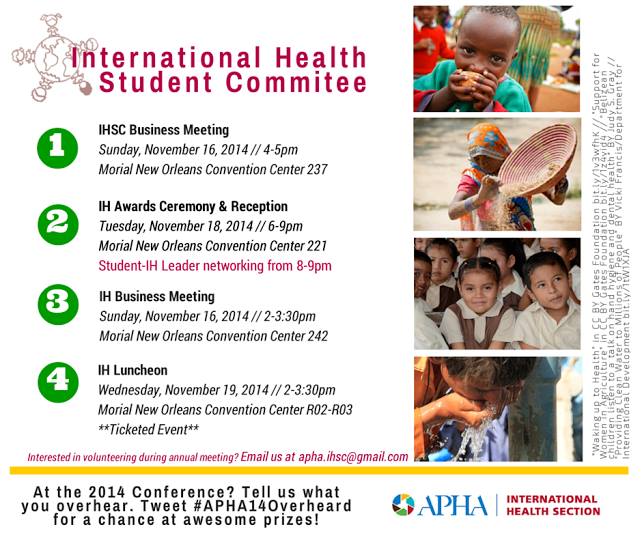
Students, Practice Your Networking Skills at APHA’s 2014 Annual Meeting: Here is How…

Networking can be a daunting task for the young professional, but speaking from experience, it is worth it and a superlative time to perfect this skill-yes, “networking” is a skill- one that you acquire while you are finishing your career as a student.

In today’s professional world, it is becoming less and less about what your resume says and more about who you know. Of course, what you know matters too, but only if you get the interview in the first place. There are many opinions about whether this is a good or a bad thing; regardless it is the reality. In order to make my point I would like to share my personal experiences.

Continue reading “Students, Practice Your Networking Skills at APHA’s 2014 Annual Meeting: Here is How…”

World Mental Health Day Forum by the Global Mental Health Advocacy Working Group: A Review

photo (2)Guest blogger: Socorro Lopez

Mental illness has proven to be one of society’s greatest invisible burdens, accounting for 4 of the 10 leading causes of disability worldwide. The Global Mental Health Advocacy Working Group recently honored World Mental Health Day by hosting a forum to discuss mental health needs amongst people in humanitarian crises, an extremely vulnerable group in terms of developing and dealing with mental illness.

The event’s panelists included Kelly Clements, the U.S. Department of State’s Deputy Assistant Secretary of the Bureau of Population, Refugees and Migration, Dr. Inka Weissbecker, the Global Mental Health Psychosocial Advisor for the International Medical Corp (IMC), and Dr. James Griffith, the Chairman in the Department of Psychiatry and Behavioral Sciences at the George Washington University School of Medicine and Health Sciences.

The discussion touched on three important themes in relation to mental health in emergency settings: the vulnerability of people suffering from mental illness, the critical gap in mental health services, and the detrimental social isolation that the mentally ill are frequently subjected to.

While approximately 10% of a population is traditionally at risk of developing a mental disorder under normal circumstances, this rate has the potential to double during a humanitarian crisis, meaning more people must deal with these disabilities in highly unstable environments. Furthermore, mentally ill individuals are more susceptible to stigma, discrimination, violence, abuse, and human rights violations in these circumstances.
Although there is a vast need for mental health services in emergency settings, there is a significant lack of access to quality care. The number of health professionals who can implement psychosocial interventions that effectively address mental illness is minimal during crises.

“There is a treatment gap between the people who need care and those who receive it,” said Dr. Weissbecker, who has monitored IMC’s mental health and psychosocial programs in countries such as South Sudan, Ethiopia, Sierra Leone, Syria, and Afghanistan.

A lack of healthcare professionals and mental health services often means that the burden of care for a mentally ill individual is placed on their families. Unfortunately, mental disorders are still fundamentally misunderstood around the world, causing many communities to be ill equipped to properly care for a portion of their citizens. In the absence of related health services, families resort to harmful traditional health practices that stem from local beliefs. These practices regularly call for extreme measures, such as chaining the mentally ill to trees or institutionalizing them in inept facilities, to isolate people dealing with mental disorders from the rest of the community.

By acting as natural buffers to instability and prejudice, Dr. James Griffith discussed the vital role that local caregivers, families and communities can play in treating mental illness. In accordance with this line of thought, IMC programs have integrated community involvement into their programs by hosting educational seminars that utilize local volunteers to raise awareness and social consideration for mental illness.

The panelists also addressed how this knowledge could be applied to two topics that have been making recent headlines: Ebola and the Islamic State in Iraq and Syria (ISIS). In terms of treating mental illness within extremist groups such as ISIS, the panelists were quick to correct the misconception that violence can commonly be associated with mental illness, a stereotype creating stigma and driving discrimination. According to the American Psychiatric Association, “the vast majority of people who are violent do not suffer from mental illness.”

In relation to Ebola, preventing and treating mental illness proved to be more applicable. In order to diminish emotional and psychological trauma, Weissbecker discussed the need to provide more education to people who contract the disease and their families, in order to decrease debilitating fear and prevent transmission. Reintegration services should also be offered to survivors who may be treated differently once they return to their communities. Finally, it is important to find ways to safely bury the dead, while ensuring that burials are still culturally significant.

Addressing mental health in emergencies is undoubtedly a multifaceted and complicated health challenge. Nevertheless, increased rates of mental disorders and the potential social ramifications of having such illnesses illustrate that mental illness in humanitarian crises is an urgent issue for global health. Reducing the current treatment gap and increasing communities’ understanding of mental disorders are two of the most promising tactics to improve the health status of the mentally ill in these situations. In doing so, devastating disability and demoralizing hardship can be prevented in populations that have already experienced immeasurable adversity in their lives.


Socorro Lopez is an undergraduate at the George Washington University, majoring in environmental studies and minoring in public health and geographic information systems. Her interests include environmental, reproductive, and global health. Prior to working at the American Public Health Association (APHA) as a Global Health Intern, she was part of the Collegiate Leaders in Environmental Health (CLEH) program at the Centers for Disease Control and Prevention (CDC). Socorro is originally from Roatan, Honduras and recently returned from Tanzania, where she was studying coastal ecology and doing research on water quality.

Remembering My Aunt, Dr. Ameyo Adadevoh, Who Stopped Ebola in Nigeria

This blog post originally appeared on the Management Sciences for Health (MSH) blog and was authored by Video Editor Niniola Soleye. This reposting does not convey an endorsement of MSH from the IH Section.

IMG_3074_

L to R: MSH staffer Niniola Soleye and her aunt, Dr. Ameyo Adadevoh 

My aunt, Dr. Ameyo Adadevoh, identified and contained the first case of Ebola in Nigeria.  She paid with her life because the health system was not ready to deal with Ebola.  The system has since caught up, and is today a model for other countries.  But the loss of such a gifted doctor and family anchor is incalculable.

Ebola arrived in Nigeria at a time when doctors at all federal government hospitals were on a labor strike (my aunt worked in a private hospital).  After ongoing negotiations with the government failed to meet their demands, the doctors – desperate to see significant changes in the health system and seeking improved salaries, positions, and titles – reached their breaking point.  So they went on an indefinite strike.

Patrick Sawyer – the index case – left quarantine in Liberia and collapsed at the airport in Lagos, Nigeria.  He was trying to travel to a meeting of the Economic Community of West African States (ECOWAS) in Calabar, Nigeria.

When he arrived at my aunt’s hospital, another doctor diagnosed him with malaria.  My aunt first encountered him during her ward round the following day and once she saw him she suspected Ebola even though she had never seen an Ebola patient before.  She questioned him and he denied being near anyone suffering from the virus but she immediately contacted the Lagos State and Federal Ministries of Health and got him tested.  While waiting for the test results to come back, the pressure on my aunt began.  Liberian government officials (and the patient himself) insisted that she discharge him so he could attend the ECOWAS conference.  She held her ground and resisted his release.  They even threatened to sue her for a violation of human rights (holding him against his will) but she remained steadfast for the greater public good.  Though she didn’t have the proper protective gear or protocols, she created an isolation area in her hospital to continue his treatment and protect her staff.  The patient couldn’t be moved because there was no isolation facility available in Nigeria at the time —the infectious diseases hospital in Lagos wasn’t functional.

The test results came back.  Patrick Sawyer’s Ebola diagnosis was confirmed, and he died in her hospital.

My aunt became ill ten days later and was taken to a makeshift isolation ward that had been set up for all the Ebola cases in the infectious diseases hospital.  The conditions of the facility were so poor that she and other patients were eventually moved to a former tuberculosis ward that had been donated by the USG.

Between the doctors’ strike and the lack of preparedness, the Ebola outbreak in Nigeria could have been a thousand times worse.  My aunt’s actions helped prevent a major spread of the virus across the country.  Because she raised the necessary red flags quickly and refused to discharge the patient, all Ebola cases in Nigeria can be traced to a single path of transmission originating with the index case. That’s no small feat in a country of more than 170 million people.

The events leading to my aunt’s death were a clear result of the larger health system troubles in Nigeria.  That said, today, Nigeria is Ebola-free.  In fact, other countries – including the US – are now looking to Nigeria to share best practices for the response and containment of Ebola.  This demonstrates that the health system eventually did catch up to Ebola, but the response was too late for my aunt and several others who were on the front lines.  If the index patient had ended up in another hospital under the care of another doctor, the delayed response from the health system may have been much more costly.

There are so many lessons to learn from the current Ebola outbreak in West Africa.  For me, the most obvious one is the importance of health system strengthening as a means to not only improve overall quality and access for all, but also to give countries the ability to properly respond to unexpected health challenges like Ebola.  If any of the affected countries had stronger health systems before this outbreak, the number of fatalities would have been significantly reduced.  We must learn from this outbreak and focus on health system strengthening as a crucial part of the rebuilding process.

One of the biggest challenges in the Ebola current outbreak is a shortage of health workers.  The high fatality rates in this Ebola outbreak reflect that.  Health workers at all levels of a health system need to be properly supported, incentivized, and protected.  They shouldn’t have to go on strike in order to improve their health systems so they can provide higher quality care.  My aunt and the more than 200 other health workers in West Africa who also lost their lives in the battle against Ebola shouldn’t die in vain.

I’m so proud that MSH is developing a solid short-term and long-term response to the Ebola outbreak in West Africa.  As part of my role at MSH, I’m supporting the Ebola response team and I see that as my way of continuing my aunt’s legacy through my job and helping to prevent other families from experiencing what my family has gone through in the last two months.

For me, the inability of the Nigerian health system to adequately prepare and quickly respond to the Ebola outbreak was an agonizing, first-hand example of the need for MSH and it reinforced the importance of the work we do.  My aunt’s death is still very painful but it comforts me to know that I am part of an organization that’s truly committed to saving lives (in everyday practice, not just in theory) and is dedicated enough to step into a crisis situation and mobilize the expertise and resources that are so desperately needed.

Students, Find Your Tools to Address Global and Environmental Health Issues!

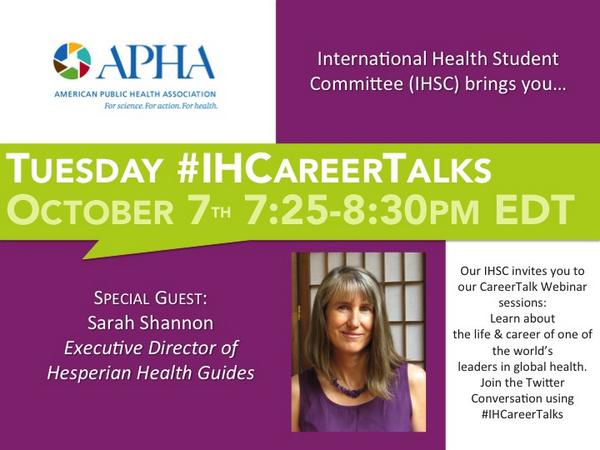
Environmental health issues are present in our everyday lives, and I am committed to improving the environment in which we live, globally. Most recently, I realized that in order to make a difference on environmental issues, all I need are simple tools. This realization inspired me to become involved with APHA’s International Health Student Committee (IHSC). In this committee, I can promote and increase awareness about important international health issues including, environmental health, among students interested in the field. To accomplish these goals, I use tools such as advertising and blog-writing. I help design flyers to advertise IHSC’s initiatives, some of which include educating students on how to address environmental health issues through our CareerTalk series. I am writing this blog to encourage you to attend our upcoming webinar! Continue reading “Students, Find Your Tools to Address Global and Environmental Health Issues!”

Opportunities Lost — Could Ebola Have Been Better Contained?

This blog post, by IH Section member Mary Anne Mercer, originally appeared on Huffington Post. It was co-authored by Scott Barnhart and Amy Hagopian.


In a desperate attempt to contain the highly contagious Ebola virus in Liberia, 50,000 people were recently quarantined in a slum neighborhood of Monrovia, whether they were sick or not. Imagine being trapped in an open-air prison without any sense of when you would be released. And if you get sick inside that slum, there is no organized system to take care of you.

Quarantining 50,000 poor slum dwellers is far different from quarantining a household, a plane, a bus or a boat. Why would Liberia feel driven to take such a drastic move when only a few of the residents in the area had Ebola? Such is the desperation of a country with a health system so weak that it has no other way to cope with an epidemic of any serious threat, let alone one this virulent.

Francis Omaswa, who led Uganda’s successful effort to control an Ebola epidemic in 2000, said last week, “Controlling the epidemic is about early detection, isolation, treatment of new infections, contact tracing, and safe handling of body fluids and the remains of those who die.” These routine infection-control procedures are not hard to implement, but doing so requires basic public health infrastructure. When a country has no capacity to perform these functions, desperate measures such as quarantining a whole slum can seem reasonable.

How did Africa’s health systems come to be so weak? Didn’t the United States and other major donors just spend billions of dollars on global health in Africa? In the process of providing all that care for diagnosing and treating HIV, preventing malaria and distributing vaccines, didn’t we build clinics and laboratories and train health workers and create medical records systems? Well, not exactly.

Recent major global health initiatives have been aimed almost exclusively at specific diseases such as HIV, TB and malaria, while strengthening the health system is typically an afterthought. Funding generally favors the private sector, particularly faith-based non-governmental organizations, and views with skepticism the role of public institutions such as ministries of health. The private health organizations proliferating across Africa lure health workers away from their jobs in public clinics and hospitals, usually offering higher salaries than governments can pay. Yet the over-riding responsibility to care for an entire population, including the poorest, resides with governments, which remain under-resourced and struggle to keep up with the needs of their citizens.

When the choice was made to invest in single-disease programs that were walled off from government health systems, we missed an opportunity. We could have developed the capacity to address other emerging health problems by building infrastructure: facilities, information systems, the work force, logistics and supply chains. Some donors hoped their disease-specific initiatives would “spill over” in a way that would strengthen the health system. Unfortunately, recent research shows this did not occur.

When the funds stop flowing to private organizations that implement these single-disease programs, the work stops. Weak health systems limp along until the next emergency, when another cycle of global health programs sweeps through.

Meanwhile, the routine burden of illness from malaria, pneumonia, diarrhea, TB, malnutrition and, increasingly, diabetes and other chronic diseases, continues to shorten life expectancy in Africa. Weak systems can’t effectively keep up with those problems, let alone the sudden shocks imposed by emerging diseases like Ebola.

What will help? For one thing, we must stop focusing on disease-specific initiatives implemented primarily through the private sector. Donor funding should go through ministries of health whenever possible, and flow from there to health facilities and staff. Health workers funded by external donors must be paid at the same salary scale as the public sector.

Finally, as Ebola has shown, feeble ministry of health surveillance systems must be bolstered. Better surveillance is a large part of why wealthier countries are at much lower risk of major epidemics than are nations with scant public health resources. Ebola would not be the crisis it is today if it had been recognized earlier, with contacts traced, quarantined and cases treated. But for that to happen, the essential elements of functioning health systems in the affected countries would have to be in place. When we hear stories of nurses dying because they didn’t have the simple protective equipment needed to care for Ebola patients, the gaps in those health systems become clear.

The expanding Ebola epidemic underscores the urgency of making investments in the health systems of African governments. Global health initiatives of the last decade largely missed an opportunity to strengthen health care capacity in Africa. Will we have another chance with the next epidemic? Let’s make Ebola the last one to trample across the continent because there are no health systems to contain it.

Mary Anne Mercer began life in rural Montana and recently returned to her Montana roots, where she is rehabilitating a small ranch near Red Lodge. She holds a doctoral degree in public health and is on the faculty of the University of Washington in Seattle, where she teaches global health. She has worked or studied in 15 developing countries, lived in rural Nepal and Thailand, and currently supports maternal and newborn care projects in East Timor for a nonprofit organization, Health Alliance International. In addition to academic publications, Mary Anne co-edited a book on the health effects of globalization, “Sickness and Wealth: the Corporate Assault on Global Health.” She was a silver Solas Award winner for Travelers’ Tales in 2012. During the academic year she also sings and studies writing in Seattle.

Scott Barnhart, MD, MPH, is Professor of Medicine and Global Health at the University of Washington. He has worked on health system strengthening in Haiti, Southeast Asia, and several countries in Africa.

Amy Hagopian, PhD, is Associate Professor of Public Health at the University of Washington. She has studied the migration of doctors and nurses from poor countries to rich ones, including Uganda, Nigeria, and the Philippines.