
Media Wars: #Ferguson, American Hypocrisy and a Hint of Spring

This was originally posted on my professional blog.

America has experienced an ugly spotlight reversal with the eruption of popular discontent into violence in its own backyard. Just a few weeks ago, international media was buzzing with reports of ISIS steamrolling the Iraqi military and Russian-supported separatists in Ukraine shooting down passenger airlines. Now, the US squirms uncomfortably under international scrutiny of Ferguson, Missouri, where the shooting of a young black man by a white police officer has once again raised the specter of racism and police brutality.

Obviously, the incident itself is complicated. Eyewitnesses – who have given conflicting testimonies – are the only window into what happened, since there was no dashboard camera. The initial description of Michael Brown, the victim of the shooting, as a “gentle giant” about to start college clashed with video footage of him stealing a box of cigarillos from a convenience store. Commentators have drawn parallels with the case of Trayvon Martin, whose mother has now reached out to Brown’s mother. Peaceful protests have given way to violence and looting, reporters have been arrested, and witnesses have complained of excessive use of force by the police.

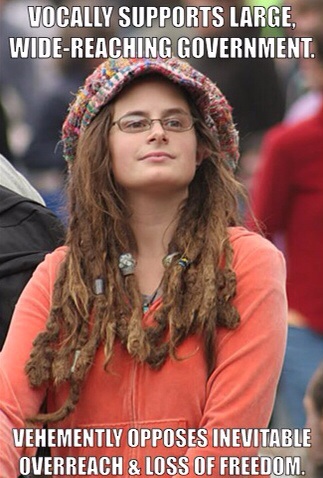
Social media, which played a major role in bringing media attention to Ferguson in the first place, has played host to the battleground of ideological responses to the incident. The primary complaint from conservatives is that the uprising in Ferguson, and the underlying racial tensions it has exposed, don’t deserve our consideration because some of the protesters have been looting and vandalizing stores…

epdara9

ql184ox

…including a few gems that actually blame the community for the excessive force used against it.

RRAKSio

b58p7

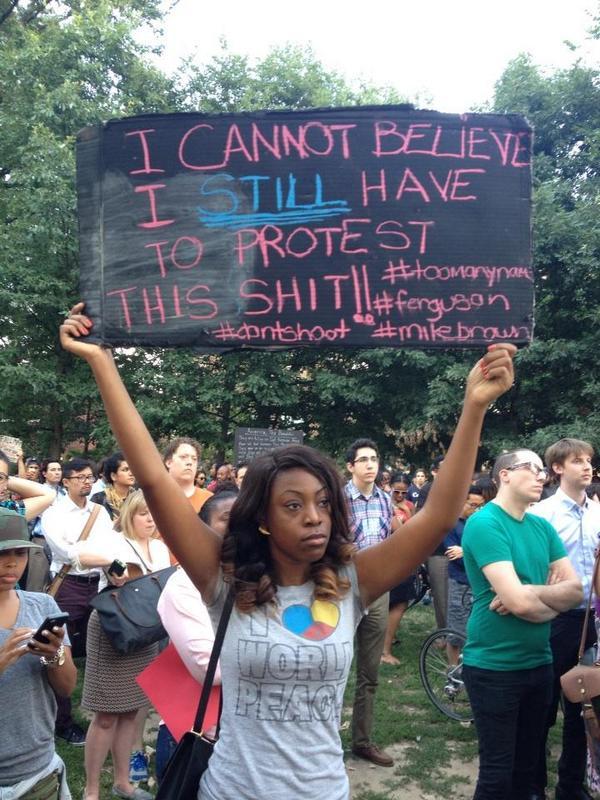
Meanwhile, people used the Twitter hastag #IfTheyGunnedMeDown to spar over which photos of Brown were used by traditional media (wearing a cap and gown vs. striking a “thug” pose) and post their own side-by-side pictures. Still others are expressing frustration at the fact that the vandalism and looting has been used as a straw man to distract from ongoing widespread racial profiling and policy brutality against blacks, including one refreshingly blunt protester at a rally in DC:
BvCci4DIMAEXAIz

What has been the most interesting to me is the global shock and horror at the incident and resulting fallout. The international community sees what many Americans are apparently missing: that the protests and unrest in Ferguson are the manifestation of a minority group sick of being oppressed and ignored. The UN High Commissioner for Human Rights drew parallels to South African apartheid, while several countries have been using the situation to take shots at America’s own human rights record when we so often criticize other countries. One might expect Iran and Russia troll the US over civil unrest, but as one friend of mine pointed out on Facebook, “When Egypt calls you out for human rights abuses, YOU’RE DOING IT WRONG.”

American police brutality, and the unwillingness of many police departments to be held accountable for their actions, have also been focal points. What happened to Michael Brown will unfortunately always be shrouded in mystery, since the Ferguson police department apparently prioritizes riot gear and tear gas over cameras for officers or police cruisers. They also seemed to have forgotten the meaning of “free press,” as they arrested and harassed several reporters who were trying to cover the protests. Interestingly, Obama was quick to condemn the bullying of journalists “here in the United States of America,” despite his own administration’s secrecy and aggression toward the press, including prosecuting a journalist who refused to identify the source of an intelligence leak.

Indeed, many observers have been quick to point out America’s hypocrisy at fingering human rights abuses outside our own borders when we have threads of discontent, similar to those found in the Arab Spring and other global protest movements, woven throughout our own society. A lovely little piece of satire from Vox portrays how American media might describe the events in Ferguson if they happened in another country.

When everything is said and done, America doesn’t look so much like a shining beacon of democracy and human rights – we just kinda look like everybody else.

Review: “EXPOSED” Film Series by Aeras

EXPOSED: The Race Against Tuberculosis (video review)

This post was written together with Niniola Soleye.

EXPOSED: The Race Against Tuberculosis is a series of four short films (about ten minutes each) about the global epidemic of multidrug-resistant tuberculosis (MDR-TB) and extensively drug-resistant tuberculosis (XDR-TB). The series was produced by Aeras, a biotech company working toward a tuberculosis vaccine. It features personal stories from patients, as well as commentary from physicians, researchers, policymakers, and experts around the world.

The global health community has seen TB morph from a death sentence to a treatable disease with antibiotics to an increasingly drug-resistant (and persistent) monster – thus completing the cycle and essentially bringing it back to a death sentence in the case of XDR-TB. Even more terrifying is the emergence of totally drug-resistant TB (that’s TDR-TB) in Iran, India, and Western Europe.

From testing and treatment costs to lost wages and productivity costs, TB, especially DR-TB, is also a very expensive disease. The first video, which features a woman from Tennessee, really drives the point home. She went on a short mission trip with her church to South Africa, where she contracted a strain of TB that was resistant to seven drugs, and wound up in isolation for two years. The total treatment course cost the health department over $1 million – a case in point of how the uninformed desire to “do something” can do more harm than good.

The purpose of the video series, in addition to raising awareness about drug-resistant tuberculosis, is to build support for Aeras’s mission to develop a TB vaccine. Currently, there is no effective vaccine against the most infectious form of tuberculosis, pulmonary TB. The BCG vaccine which was developed 90 years ago does not prevent the majority of TB cases. While the movies play to the emotional side to a certain extent, and I wasn’t crazy about the fact that they opened the series with a profile of a Westerner who “just wanted to help,” I felt that the series did an overall good job of giving voice to individuals in the developing world who are most immediately affected by the disease – both a survivor of treatment and a woman who is volunteering in a clinical trial for a vaccine candidate.

You can watch the films here.

IH Section Communication Survey Results

The results of the IH Communications Surveys are in!  The section’s Communications Committee asked you, the section members, to complete a Survey Monkey questionnaire and provide their thoughts on how the section communicates with you.  The survey was divided into two parts.  Forty-six people responded to the first part, which covered the section’s traditional
communications platforms
(the newsletter, the monthly e-mail and the website);
28 responded to the second part, which focused on the section’s use of new social media (Facebook, LinkedIn, and the IH Blog).

Generally speaking, the respondents read the newsletter (69.6%) and e-mails (80.4%), and they check the website at least occasionally (73.9%).  There were a handful of respondents that did not know that we published these communications, so the section has some work to do to make sure that its members know that these are available.

Unfortunately, use of social media was not as popular as we had hoped.  Of the 28 respondents to this part of the survey, nearly half (42.9%) rarely or never read the blog, and 25% did not know we even had one.  Similarly, very few respondents subscribed to the Facebook page (10.7%) or the LinkedIn group(14.3%).  However, our blog averages 30-40 hits per day (currently around 1,000 visits per month), our Facebook page has 60 subscribers, and our LinkedIn group has 439 members.  Considering these numbers, it seems that there are a lot of non-members plugging into our social media, which is not necessarily a bad thing – but our members should be encouraged to take advantage of them as well!

Considering that our social media platforms are very popular among the online global health community, these should be advertised to the section in general at the Annual Meeting, particularly during the first business meeting when attendance is highest.

We also need to encourage members to contribute to the blog and newsletter.  Several survey respondents mentioned that they would like to read about other members’ programs and want an emphasis on practice, rather than research.
Obviously, people have to WRITE about their programs so that we can read
about them.  This should start with the section leadership, who should be setting the example for the rest of the section.  Another resource could be asking students to write about their practica or recent graduates to summarize
their fellowships.  This is easy enough to do in interview format for the blog (see
https://aphaih.wordpress.com/category/stories-from-the-field/), but those students need to be referred to the blog manager to be interviewed.

Addendum: What does health reform have to do with IH?

While I am sure that most of you have been riveted by my recaps of APHA’s Mid-Year Meeting on health reform, many readers are probably asking what the heck I, your friendly neighborhood Communications Chair, was doing there, and why the IH section was asked to send a representative to this meeting. The whole purpose of inviting section representatives and state affiliate leaders was to stimulate discussion about health care reform as it related to each section or affiliate’s work, and how the sections and affiliates could get more involved in the effort. Upon discovering this, my mind drew a blank.

How does health reform relate to the work of our members?

After some thought, I can see two major areas in which our membership would be interested in health reform. The first is in border health: despite the increased coverage that came with the new law, it does not cover undocumented immigrants and even some classes of migrant workers with temporary work visas (for example, those who come to work during the harvest season).

The other area is in sharing information. Our health reform battle has received much global attention, and the international health community is interested in the way the new health legislation will finally take shape and how individual communities will implement it. Also, a lot of the population health and wellness challenges that are being targeted by the Public Health and Prevention Fund grants (e.g. obesity, diabetes, tobacco use) are receiving increasing amounts of attention in developing nations as professionals are realizing that these countries share a disproportionate burden of chronic conditions. IH members who work in communities outside the U.S. may be interested in seeing how communities here address these issues, and they could apply some successful programs to their own communities facing similar issues.

The section representatives and affiliate leaders attended a luncheon that served as a breakout session to discuss these very issues. We were divided into geographic regions by table (which did not seem to make a lot of sense for section members, but it was productive nonetheless) and hashed out our impressions from the meeting and how the sessions related to the work of the sections and/or affiliates. APHA plans to use the notes from these discussions to compile a report for the sections and affiliates to use in their work as it relates to the mid-year meeting.

APHA Mid-Year Meeting, Day 3: Advocacy and Closing Remarks

Day three of the mid-year meeting started off with one last break-out, then moved to the closing general session and a break-out luncheon for the section representatives and state public health affiliates. I attended the “Assuring Population Health: Advocating for Prevention and Wellness” session, which left me wondering how the presentations in this session related to the topic. While I appreciate learning about how different communities are using their Prevention and Public Health Fund grants, I found myself asking where the advocacy was in some of the slide presentations.

One presentation which I did find interesting was one on “The Employer’s Perspective on Health and Health Care Reform” by Larry Boress, President and CEO of the Midwest Business Group on Health. Mr. Boress brought some very good points on the role of businesses in providing and advocating for health coverage (“We pay for everything, so we are advocating for how our money is spent”), as well as the incentive for employers to provide coverage for their employees – “It’s not because we’re altruistic. We do it for business reasons.” I was disappointed, however, when my question about a graph on one of his slides was completely sidestepped. It looked at the breakdown for how businesses answered the question, “How likely is it that drop health insurance coverage and let employees buy individual insurance from the new health insurance exchanges?” Twenty-six percent answered “Unlikely” while 27 percent said “Not likely” – what is the difference between these two? Are they not the same response? Unfortunately, Mr. Boress responded by explaining to me why employers would choose to provide health coverage to their workers.

On a more positive note, I was very impressed with the closing speech given by Dr. Lawrence Wallack, Dean of the College of Urban and Public Affairs at Portland State University. Not only did he spare us from a script on slides, he drove home some very important points about why health care and health reform are important, how we need to be framing the debate, and how we should engage the opposition when advocating for it. He said that there are two prevailing mentalities among Americans: the “yo-yos” (You are On Your Own) and the “wits” (We are In this Together). While the yo-yos stress personal responsibility and the idea that a person will do whatever it takes to get what he or she wants, wits believe that communities have to stick together to improve the common good, and that one person’s well-being is intimately connected to that of his or her neighbor. Most of us strike a balance between these two, and we need to appeal to the wit philosophy when framing the need for reform.

“If they can get you asking the wrong questions, they don’t have to provide the answers.” Dr. Wallack reminded the audience that we need to stop being distracted by questions that cannot be adequately answered and focus on framing the debate in terms of values that all Americans hold in common. He cited Lakoff’s three levels of analysis:

  1. Big ideas and universal values like fairness, equality, justice, family, community
  2. Issue types such as housing, education, etc.
  3. Specific issues such as beer taxes, toxic waste sites, and health care coverage

During debates, progressives tend to argue from level three down, while conservatives argue at level one. Wallack argues that if we frame the health care issue at level one, we will have success at level three.