Addendum: The Circle of Death (by PowerPoint)

As I mentioned in my first day post, I was delighted when I received a flash drive along with my registration materials that contained speaker bios, PowerPoint slides for each panelist’s talk, and background materials for some presentations. One advantage was that I was able to follow each panelist’s presentation on my laptop instead of furiously taking notes and annoying the attendee sitting next to me with my rapid 80 wpm typing. I can also now look over the slides from the sessions I could not attend.

The second advantage was the ability to blog during the sessions – because I was able to tune out the moderator as (s)he read the text from panelist bios, or the speakers themselves as they read from their slides. Alas, this meant that I still annoyed the attendees unfortunate enough to sit next to me…while they were surfing Facebook on their smart phones and iPads because they had zoned out, too.

I wonder if it ever occurs to speakers that no one will listen to them talk if they can just read the slides on the screen. Granted, many speakers did a great job by elaborating on the content of their slides by discussing programs or activities that related to the text; however, we were most likely not listening to that, either – because we were reading their slides. Most PowerPoint presentations are designed as stand-alone pieces and are written to be read rather than as presentation tools, which is what they are supposed to be. This leads to a high concentration of bulky jargon and large words, which in turn causes the speaker to stumble over some words and mumble others as they wade through their slides. If you have had training in public speaking, you understand that people read differently than they listen. Anyone listening to these presentations would be absolutely lost, as they would be unable to process the barrage of bureaucracy-speak that is clumsily read aloud by each speaker as quickly as possible to leave time for other panelists to read their slides just as quickly so that we can get to questions.

Luckily, we all know what is going on because we are reading their slides rather than listening to anything.
Flickr, HikingArtist.com

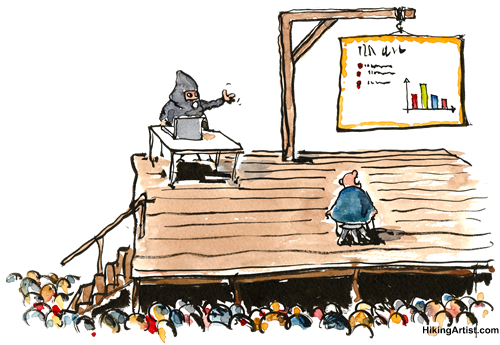
This is the circle of death – by PowerPoint. We all go to sessions and panel presentations, read slides, yawn, get bored, and then give the same types of presentations to pay it forward and bore the audience listening to us. It is a disservice to everyone: it numbs the minds of audiences everywhere and allows presenters to escape a true public speaking experience.

The only way to break the circle of death is to build your presentations differently. Use as few words on your slides as possible. Use pictures and data so that your audience is forced to listen to you explain them – you know it better than they do, so you should not have to read it off your slides. Additionally, if we are actually listening to you, we will get your jokes when you actually crack them, thus bypassing the awkward silence as we emerge from our stupor with the realization that you strayed from your “script.” Better still if you do not need any slides at all! It is a truly intimidating and earth-shattering prospect, but I promise that it is possible – orators did it for thousands of years before computers and teleprompters were invented.

Break the circle of death. Save us from having to read your slides while we ignore you reading from your slides. I may not be able to blog as much, but hey – I am much happier to be listening to you instead.


APHA Mid-Year Meeting, Day 2: Public Health Jobs, Prevention, and Wellness (and why the heck does APHA serve sodas at lunch?)

I get frustrated sometimes with the academic nature of policy presentations. I have spent enough time in masters classes and government work to be used to lofty language and bureaucracy-speak, but I wonder at its utility at a conference that is focusing on how the public health rubber is meeting the road in this climate of health reform. The breakout session I attended this morning was on the public health workforce. I scratched my head while trying to understand the connection between the session topic and the Brian Smedley’s (from the Joint Center for Political and Economic Studies) presentation on the disparities between white-dominated and minority neighborhoods (the moderator had to make the connection for the audience). Cynthia Lamberth from the University of Kentucky raised some good points on planning for changes in the number of public health workers that will be driven by reform. She said that while many universities and states are in a “wait and see” mode, we cannot afford to wait – hospitals and clinical establishments and planning now, and the field of public health should be following suit. (She also pointed out the convoluted and outdated hiring practices that make it so difficult for public health graduates to get jobs in academia or with the government, which I definitely appreciated).

The presentation that got me up to the microphone, however, was one by John Lisco of the CDC on their various fellowship programs. Any students or recent graduates reading this blog are most likely familiar with at least a few of these programs – Public Health Prevention Service, Epidemic Intelligence Service, Presidential Management Fellows, etc. – and are also familiar with how incredibly competitive they are. The competitiveness of a program is not a bad thing in and of itself, but in an economic climate (and corresponding job market) like ours, finding work is extremely difficult no matter where the vacancy is. On top of that, many of these fellowship programs have highly specific rubrics and ranking criteria – while the essays have very vague prompts. You have to know someone on the inside to know what the selection panel is looking for in your essay, and how to make yourself stand out among thousands of qualified applicants.

On the other hand, it was great to hear about the experiences of communities implementing prevention and wellness program during the afternoon sessions. Major areas of focus included obesity, smoking cessation, and working to make health foods available in low socioeconomic neighborhoods. I was particularly impressed by the results of tobacco-cessation program in Indiana presented by Carla Sneegas, Executive Director of the Indiana Tobacco Prevention and Cessation Program. The program used a fax-referral system that targeted employers, allowing them to fax in a form to enroll in the program to help their employees quit smoking. The program utilized various approaches, including “quitting competitions” and monetary incentives, and some employers had cessation rates of 50% or more. Kudos to Ryan Kellog from Seattle and King County for calling out APHA on having soft drinks at lunch. He added a slide at the end of his presentation on the Communities Putting Prevention to Work program in King County with the picture of the spread with Coke, Sprite, and Diet Coke. “Why the heck were there sugar-sweetened beverages at lunch today?” Good question, indeed.

APHA Mid-Year Meeting, Day 1: Technology and Socializing

Greetings from APHA’s Mid-Year meeting in Chicago!  This year’s meeting is on healthcare reform, which is fortunate for me – with so much focus on international health news and topics, I unfortunately do not know much about the intricacies of the new healthcare reform legislation, or how it is being implemented on the ground.  I think many Americans are in the same position, however, so hopefully I will gain a better understanding of reform and be able to pass it on to you, the reader!

Upon checking in, I was given a flash drive in addition to a program and a badge holder.  This is such a great resource – it contains speaker bios and (most of) the PowerPoint presentations from each session.  After I arrived this afternoon, I attended one of the first break-out sessions of the conference, “Technology Implications of Health Reform.”  The panel was made up of a representative from CDC, the Kentucky state health commissioner, and the CEO of the Cabarrus Health Alliance (which, believe it or not, is actually a county health department!).  Each one gave his perspective on implementing electronic medical records and building a health information exchange on the federal, state, and county level, respectively.  While I appreciate the excitement surrounding the possibilities of electronic health records (EHRs), I pointed out that even clinicians and health institutions that have them are not able to use them beyond searching for records by patient name or consultation date, plus whatever queries have been pre-programmed into the software by the vendor so that the practice can get the “Meaningful Use” dollars from the government.  I have experienced this in my public health surveillance work – providers have no idea how to pull the information that we are looking for from their records.  We have a long way to go before EHRs are useful on a large scale to public health surveillance and research.

Later in the evening, I had a chance to meet some of the APHA section representatives that were given the same opportunity as I was to attend the meeting.  This is apparently the first year that APHA has been able to bring section representatives to the mid-year meeting, so it is exciting to be a part of it.  The challenge will be thinking about how the information at this meeting can be applied to the activities of the IH section.  What do you think?

IH Website Maintenance

Our regular blog readers may have noticed a recent lull in activity over the past few weeks (e.g. no weekly news updates, fewer articles posted, etc.).  This is because the Communications Committee is currently working on a major overhaul of the IH section website – updating and cleaning up outdated content, eliminating redundancies, making it more navigable and user-friendly, and improving its appearance.

Since the most recent APHA Annual Meeting, the committee has been working with the section leadership to “modernize” the section’s communications – we are trying to move away from the website as the primary platform for section communication and use it instead as a “repository” of general information while using this blog for announcements, updates, and section activities.  You can subscribe to the blog by e-mail or RSS feed to be notified of new postings.  The blog is also streamed directly to the section’s Facebook page and LinkedIn group, so if you use either of these two social media platforms, please feel free to join or subscribe to those.

The goal of this effort is to make section communication more relevant and timely to you, the members – so please feel free to provide feedback!  We are currently conducting a survey on how members utilize the section’s current communication platforms and what changes they would like to see.  The two parts of the survey can be accessed from the following links:
Traditional Communications
Social Media

The Committee is also open to members who would like to contribute to the blog, either by writing a guest post or volunteering with other activities (helping with the newsletter, gathering information for the weekly news round-ups, etc.), so please contact Jessica Keralis, the committee chair, at jmkeralis [at] gmail [dot] com if you are interested.

We appreciate your patience as the website is being updated.  The news round-ups will return in July.

The Greatest Thing You’ll Ever Learn: Drug-Resistant Tuberculosis on the Rise

On most days, tuberculosis only crosses the average American’s awareness radar when he or she is watching Moulin Rouge! for the fifth time. Even then, the sight of the courtesan Satine (played by Nicole Kidman) coughing up blood after singing about diamonds gives the impression that TB is the problem of sex workers living in elephants in 19th-century France. All of this changed in 2007, when Georgia lawyer Andrew Speaker snuck back into the U.S. through Canada after honeymooning in Europe – and being diagnosed with extensively-drug-resistant tuberculosis (XDR-TB).

As if regular TB were not bad enough, global health professionals are now grappling with the rising incidence of multi-drug-resistant (MDR-TB) and extensively-drug-resistant (XDR-TB) tuberculosis. MDR-TB is resistant at least to isoniazid and rifampicin, the two most powerful first-line antibiotics used to treat TB. It typically develops when patients being treated for fully sensitive TB stop their treatment course or do not follow it regularly (either because they feel better or forget to take their drugs, or because treatment supplies run out). When the treatment is interrupted before all of the bacteria are killed, the microbes develop resistance to the drugs. XDR-TB has all of this and more: it is also resistant to any fluoroquinolone and at least one of three injectable second-line drugs (capreomycin, kanamycin, and amikacin). If these drugs sound scary, it is because they are: most second-line drugs are less effective than isoniazid and rifampicin and can be moderately to highly toxic.

While the incidence of drug-resistant strains of TB is low for the moment, it is on the rise: a recent report by the WHO found that over two million people will contract some form of drug-resistant TB by 2015. The frequency of these infections is increasing fastest in India, China, and the former USSR. The WHO is asking countries to put their money where their mouths are and step up to fight the disease. “Commitments by some countries are too slow off the mark or simply stalled,” said Rifat Atun, director of strategy, performance and evaluation at the Global Fund. In the meantime, the greatest thing you’ll ever learn…is to finish your antibiotic course.