Adaptation Community Meeting 9/21: Climate Change and Health in Mozambique – Impacts and Responses

Remarkable progress is being made across Sub-Saharan Africa on public health. Child mortality, rates of stunting and incidence of diseases such as malaria and meningitis are dropping. But these gains may be lost as changes in climate and weather promote disease outbreaks and greater food insecurity. Owing to its location, demographics and geography, Mozambique is particularly vulnerable to negative outcomes on health resulting from changes in climate. Malaria is already widespread and poor water supply and sanitation infrastructure lead to frequent contamination of water resources during floods.

Over the past few years, the USAID-funded Climate Change Adaptation, Thought Leadership and Assessments (ATLAS) project has been examining the relationship between temperature and rainfall trends and diarrheal disease and malaria rates in Mozambique.

At the September Adaptation Community Meeting, Climate Vulnerability and Adaptation Specialist Fernanda Zermoglio will provide the latest research and findings from this work, as well as what is being done to strengthen Mozambique’s health system preparedness and response.

Thursday, September 21, 2017
4:00 pm – 5:30 pm ET

Location:
Chemonics International, Inc.
1717 H St. NW, Washington, DC 20006

To join remotely:
Online webinar – https://meet93445775.adobeconnect.com/september2017/
*If it is your first time using Adobe Connect please allow for up to 15 minutes for the plug-in to download before you can join the webinar.

For more details and registration, click here.

Speaker:
Fernanda Zermoglio has been on the forefront of climate change adaptation science, assessment methodology, programming and policy for the past 15+ years. A geographer with a detailed knowledge of climate modeling and various adaptation methodologies, she has synthesized applied research, pragmatic tools and knowledge-sharing platforms to inform the design, implementation and integration of climate adaptation assessments across a number of countries, in support of various donors and local governments. Since 2014 she has been the Climate Vulnerability and Adaptation Specialist on the DC-based ATLAS project.

Check out the Adaptation Community Meetings page on Climatelinks to find: 1) information on upcoming meetings, 2) recordings of previous meetings organized by category and 3) post-event blogs.

The Evaluation and Measurement of Health Literacy

This is a guest blog post by Dr. Heather F. de Vries McClintock PhD MSPH MSW, IH Section Member and Assistant Professor in the Department of Public Health, College of Health Sciences at Arcadia University. It is the third blog in a three-part series the IH Blog will feature this summer, Global health literacy: Conceptual basis, measurement and implications.

Part III. The Evaluation and Measurement of Health Literacy

While the IOM’s (now National Academy of Medicine) definition of health literacy (HL) is recognized and accepted, there is a lack of standardization in its conceptualization and operationalization within and between countries. Initially HL was perceived as a derivation of literacy with it’s primary purpose serving to as important tools to maximize comprehension during clinical encounters. In recent years the meaning and purpose of HL have broadened in scope to incorporate a health promotion perspective. This expanded and dynamic definition has resulted in increased utility in both clinical medicine and public health but has left this construct susceptible to conceptual drift.  A recent systematic review of the construct of HL found 17 varying definitions and 12 conceptual models that were employed in the literature.  

According to IOM’s report Health Literacy: Improving Health, Health Systems, and Health Policy Around the World: Workshop Summary, countries around the world have used a wide range of designs and approaches as well as purposes for examining HL.  These approaches have involved the usage of proxies such as education, income, or literacy to approximate HL. Other countries have relied on single items, often as a part of other measures (e.g. school attendance/enrollment, reading score), to evaluate HL. Thus, currently there is lack of comparability between estimates of HL within and between countries. Furthermore, the validity of many measures in assessing IOM’s definition of HL remains unclear. It is important to note that nearly all of the studies in this review were conducted in high income countries. Very little research has constructed a measure for use in LICs and LMICs. A robust measure of HL provides the foundation for comparison of HL across countries as well as its evaluation in relation to health outcomes.

My colleagues and I (see acknowledgements below) sought to develop a robust measure of HL using data from Demographic Health Surveys (DHS) conducted between 2006-2015 in 14 developing countries: Cameroon, Democratic Republic of the Congo, Ethiopia, Ghana, Guinea, Ivory Coast, Lesotho, Rwanda, Niger, Namibia, Sierra Leone, Swaziland, Toto, and Zambia. The same survey was administered in all countries, after translation into versions appropriate by language.  The DHS Program is administered by the United States Agency for International Development (USAID). Beginning in 1984, surveys have been administered in over 90 countries. The DHS survey includes items that represent domains of the IOM definition of HL. We identified eight survey questions that corresponded to elements of the four domains of health literacy as defined by the IOM: capacity to interpret, capacity to obtain, capacity to understand, and ability to make appropriate health decisions. We then applied factor analysis methods to extract a single factor – a measure of health literacy – and evaluate the results for reliability and validity.

In our work, a total of 259,684 individuals between the ages of 15 and 49 years were included.  The derived dichotomous measure of health literacy demonstrated internal consistency (Cronbach’s α = 0.72), good content validity, and importantly, was comprised of the elements described by the IOM.  The prevalence of high health literacy overall was 35.2%.  Health literacy varied by sex (females, 34.1% vs males, 39.2%) and education level (primary education or less, 8.9%, some secondary education, 69.4%, secondary education or higher, 84.4%). Health literacy varied considerably across nations, from 8.5% in Niger to 63.9% in Namibia.  

This was the first study to derive a robust indicator of health literacy following the IOM definition in a large number of national samples. In future work we plan to use this indicator with DHS datasets to measure health literacy in other countries, and ultimately test how health literacy relates to health behavior and outcomes, including for HIV/AIDS and domestic violence. An abstract of these findings was published in the Lancet Global Health, Volume 5, Special Issue, S18, April 2017.

Acknowledgements:

The following individuals contributed to the investigation of HL as discussed in this blog series:

Douglas J. Wiebe, Phd, Associate Professor, Center for Clinical Epidemiology and Biostatistics, Perelman School of Medicine, University of Pennsylvania

Julia M. Alber, Phd, Postdoctoral Fellow, Center for Health Behavior Research, University of Pennsylvania

Sara M. Schrauben, MD, Renal Research Epidemiology Fellow, University of Pennsylvania

Carmella M. Mazzola, College of Health Sciences, Arcadia University

Ashley Andrews, MPH, Perelman School of Medicine, University of Pennsylvania

McClintock.Picture

Dr. Heather F. de Vries McClintockis currently Assistant Professor of Public Health at the College of Health Sciences at Arcadia University. Her research broadly focuses on the prevention, treatment, and management of chronic disease and disability globally. Recent research aims to understand and improve health literacy and the quality of care provision for persons in Sub-Saharan Africa.


CARPHA Conference 2018 – Call for Papers

63rd ANNUAL CARPHA (The Caribbean Public Health Agency) Health Research Conference
June 14th – 16th, 2018

CALL FOR PAPERS
DEADLINE FOR RECEIPT OF PAPERS
January 8th 2018

Theme:
‘Sustainable Health Systems for Economic Growth, Development and Wealth’

The 63rd Annual CARPHA Health Research Conference will be held from June 14th to June 16th, 2018.  The theme for 2018 is ‘Sustainable Health Systems for Economic Growth, Development and Wealth’ however, we will also accept quality research papers in all priority health areas (e.g. NCD, HIV, Health Systems, etc.) Sustainable Health Systems for Economic Growth, Development and Wealth comprises topics such as: Health Insurance systems, health financing in SIDS, health as a human right – the financial implementations, cost of prevention vs cure, cost of natural disasters on health and development, cost of poor health on economic development and cost of NCDs on development.

Selection of Papers
Papers are selected based on scientific merit and relevance to the health priorities areas of the Caribbean. As a guide, Poster presentations are preferable for papers that contain large amounts of data, deal with particular techniques, report highly specialized work, ‘research in progress’ and ‘programmes being implemented’. Authors whose papers are accepted, but who do not present will not have their papers considered for the next two years unless they have a good reason, such as:

  • acute illness
  • loss or bereavement
  • hardship or trauma

Prizes
The David Picou Young Researcher Prize is awarded for the best paper presented by a Caribbean investigator who is not yet an established researcher.

The criteria for being considered is as follows:

  • Age: 40 years or less
  • Qualifications: At least a 1st degree, including a medical degree
  • Work experience: Working in a health-related environment in a position considered junior; e.g. below senior lecturer/consultant grade
  • Nationality: must be a Caribbean national; may be based in an institution abroad (Persons who wish to be considered for the David Picou prize are to send
    a letter clearly answering the above questions.)

Student Prize will be awarded to the best paper presented by a student/student group.
(Persons who wish to be considered for the Student prizes should indicate such in the transmittal letter).

Poster Prize is awarded for the best poster.

For more information:
https://gallery.mailchimp.com/f93f457ff9c6f7046ff32bf20/files/e1e77763-fdab-4f16-bebb-0d3f54855e1e/CallForPapers2018_Final.pdf

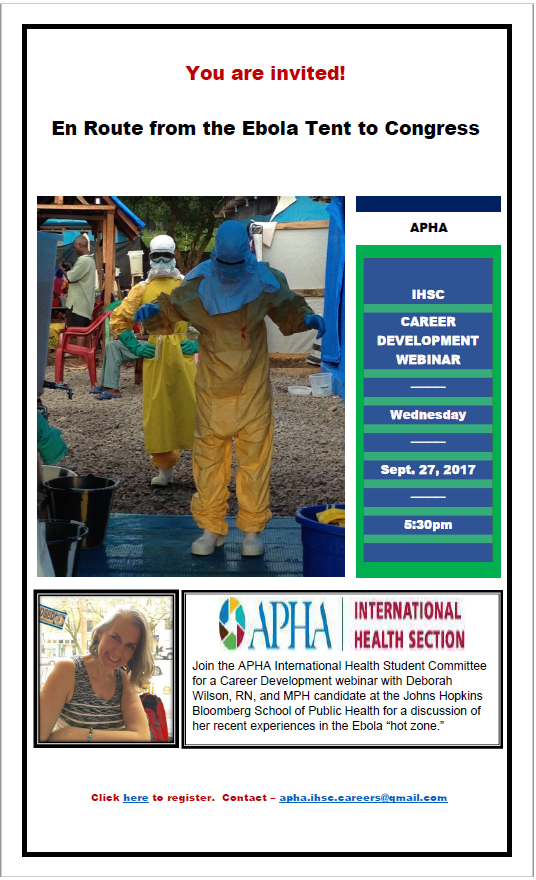
International Health Student Committee (IHSC) Career Development Webinar

Join the APHA International Health Student Committee for a Career Development webinar with Deborah Wilson, RN, and MPH candidate at the Johns Hopkins Bloomberg School of Public Health for a discussion of her recent experiences in the Ebola “hot zone.”

September 27th, 2017 @ 5:30 pm

Click here to register. Contact – apha.ihsc.careers@gmail.com


sept webinar

CUGH Webinar, Global Health at the Centers for Disease Control and Prevention, Now Available

CUGH recently hosted a webinar on Tuesday, August 8, 2017 entitled Global Health at the Centers for Disease Control and Prevention. The recording and slides are now available:

About the Webinar:

Disease knows no borders. CDC’s global activities protect Americans from major health threats such as Ebola, Zika, and pandemic influenza and adverse economic impact. CDC detects and controls outbreaks at their source, saving lives and reducing healthcare costs. As importantly, CDC helps other countries build capacity to prevent, detect, and respond to health threats through its work. The knowledge and lessons learned from CDC’s work abroad are critical to our public health efforts at home, and to protecting Americans.

CDC works in more than 60 countries, working with ministries of health, the World Health Organization (WHO) and many other partners on the front lines where outbreaks may occur. It addresses global health crises that can extend beyond the health sector to contribute to creating more stable societies, including the growing burden of non-communicable diseases.

Join Dr. Hamid Jafari, CDC Center for Global Health Principal Deputy Director, as he walks us through the structure and activities of CDC’s global health center in the United States and abroad.