Preventing Rickets Globally

This is a guest blog post by Dr. Mark Strand, IH Section Councilor and Professor in the Pharmacy Practice and Master of Public Health Departments at North Dakota State University.

For the last fifteen years, I have collaborated with a group of scholars to research and prevent nutritional rickets in children. Recently our newest paper was published, a look at the global burden of disease due to rickets, and prospects for reducing this preventable disease of poverty. Rickets is caused by insufficient circulating 25-OH-D (vitamin D levels), as a result of insufficient sun exposure, high amounts of melanin in the skin, or both; as well as inadequate intake of dietary calcium. Therefore, the condition begins at birth in children facing these conditions, and worsens up to age 2 or 3, when self-selection of food, and outdoor play, tend to slow or stop the progression. However, during that time these children have higher rates of pneumonia and other preventable conditions, and if severe, will maintain the skeletal deformities for life.

I am deeply committed to research which provides scientific evidence to explain causes of disease and burden among underserved and vulnerable populations. This has been one of my more satisfying contributions.

My colleagues and I published this paper on nutritional rickets nearly ten years ago: https://www.researchgate.net/publication/7282059_Nutritional_rickets_around_the_world_Causes_and_future_directions

Here is a link to our newest article:
http://www.tandfonline.com/eprint/p5idF3CXdvKph3tBMHhT/full
Event Invitation: Community Meeting on the Implementation Guidance for the Mexico City Policy, May 10

Global Health Council invites you to a Community Meeting on the Implementation Guidance for the Mexico City Policy

May 10, 2017
9:00-11:00 am ET

PAI
1300 19th Street, NW
Washington, DC

RSVP: http://tinyurl.com/MCPmeeting

In anticipation of the release of the implementation guidance for the Mexico City Policy (also known as the global gag rule), Global Health Council invites you to join us for a community discussion around updated analyses and available resources. We will be joined by speakers from Kaiser Family Foundation, CSIS, PAI, and others to discuss impact and next steps and to answer questions.

In person attendance of advocates, implementers, and grant/development staff is strongly encouraged. In the event that the release is delayed, we will postpone the meeting.

Member spotlight: Len Rubenstein featured on NPR’s Morning Edition

Longtime IH Section member Len Rubenstein was on NPR’s Morning Edition this week! On Monday morning, he was featured in a story on attacks on health workers in conflict:

Leonard Rubenstein, a lawyer who directs a program on human rights, health and conflict at the Bloomberg School of Public Health at Johns Hopkins. says there were a staggering number of assaults on health care facilities in 2016.

“The international community says it wants to stop this and then does nothing to implement its own recommendations,” he says. “These attacks go on.”
Rubenstein is the editor of a new report called “Impunity Must End” about aggression against health facilities and health workers globally last year.

Rubenstein found that health care facilities were under assault last year in many other parts of the world. The report was not able to compile data on the total number of attacks in each country.

“It’s quite remarkable how varied the forms of attack are,” Rubenstein says. “For example we found in 10 countries hospitals were bombed or shelled, in 11 countries health workers were killed, in about 20 countries there were various forms of intimidation — abductions, kidnapping of health workers.”

You to listen to the story here. A transcript is also available.

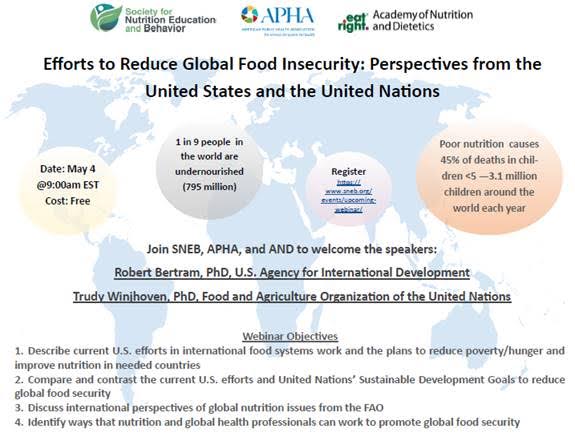
Efforts to Reduce Global Food Insecurity: Perspectives from the United States and the United Nations Webinar on May 4, 2017

On behalf of the Society for Nutrition Education & Behavior (SNEB), American Public Health Association, and the Academy of Nutrition & Dietetics, we invite you to an upcoming webinar on “Efforts to Reduce Global Food Insecurity: Perspectives from the United States and the United Nations”.

unnamed

This webinar will introduce the Global Food Security Act of 2016 and expand on America’s current efforts to help promote food security around the world. Speakers will provide perspectives from the U.S. Agency for International Development and Food and Agriculture Organization of the United Nations to explain the current situation of global nutrition issues and progress made to alleviate global concerns such as hunger, chronic health issues, and mortality. Suggestions will be discussed on how nutrition and global health professionals can pitch in to reduce global food insecurity.

Register for webinar here or paste in browser: https://www.sneb.org/events/2017/05/04/upcoming-webinar/efforts-to-reduce-global-food-insecurity-perspectives-from-the-united-states-and-the-united-nations/

Time/date: 9:00-10:00am EDT, Thursday, May 4th

This webinar is hosted by the SNEB International Nutrition Education Division and co-hosted with the SNEB Advisory Committee on Public Policy, American Public Health Association – Food & Nutrition Section & International Health Section, and the Academy of Nutrition and Dietetics.

New World Bank Massive Open Online Course (MOOC) – ‘From Climate Science to Action’ starting May 8, 2017

The World Bank Group is offering a Massive Open Online Course (MOOC) on climate change – ‘From Climate Science to Action’ – starting May 8th 2017.

The new course presents the most recent scientific evidence on climate change. It explores different strategies for low emission and climate resilient development, and provides an overview to the Paris Agreement ratification with some reflections on COP22 outcomes. Through interactive video talks, complimented with curated readings, resources and quizzes, renowned scientists and policy makers from the field will lead you through the course. An active discussion forum on the course would further enhance learning where participants get to exchange knowledge with peers from across the globe. As the course concludes, you will be invited to reflect on what you can do at the national, local, community, and individual level to limit global warming below 2°C and adapt the impacts already occurring.

You can audit video lectures and some course content for free. If you want to complete the course and earn a Course Certificate by submitting assignments for a grade, you can purchase the course for a small fee. Financial aid is available if you cannot afford the course fee.

Workload: 3-6 hours/ week

Register for this four week course here.