An age-old disease today

In 2015, tuberculosis killed on average 34,000 people per week, a total of 1.4 million deaths.  This is just one of many facts published in a report by the WHO that brings renewed attention to one of the world’s oldest diseases.  Roughly a third of the world’s population – 2 to 3 billion people – are infected with tuberculosis, though only a small proportion (5-15%) will develop an active infection in their lifetime.  Sixty percent of new tuberculosis infections occur in only 6 countries: India, Indonesia, China, Nigeria, Pakistan, and South Africa.

As is a theme in much of medicine, a strain of drug-resistant tuberculosis is affecting people around the world.  Multi-drug resistant tuberculosis, or MDR-TB, cannot be cured with the two most common TB drugs.  In 2014, 480,000 people developed MDR-TB with over a third of patients (190,000) dying.

The road to recovery from tuberculosis requires a 6-month drug regimen.  When not followed or completed, drug resistant forms occur and can be transmitted person-to-person in highly concentrated areas, such as prisons, or among people living in poverty.   For patients with MDR-TB, treatment is grueling, involving at least 18-months of second-line drug treatment and isolation.  Those who suffer from MDR-TB face social stigma and isolation as well as side-effects from the cocktail of treatment, including hearing and vision loss, chronic pain, and mental illness.

When we take the pills, we feel worse. I’m losing my hearing a little. I feel pain in my bones, in my whole body.

– Maria Smolnitcaia (52-year-old woman living with MDR-TB in Balti, Moldova)

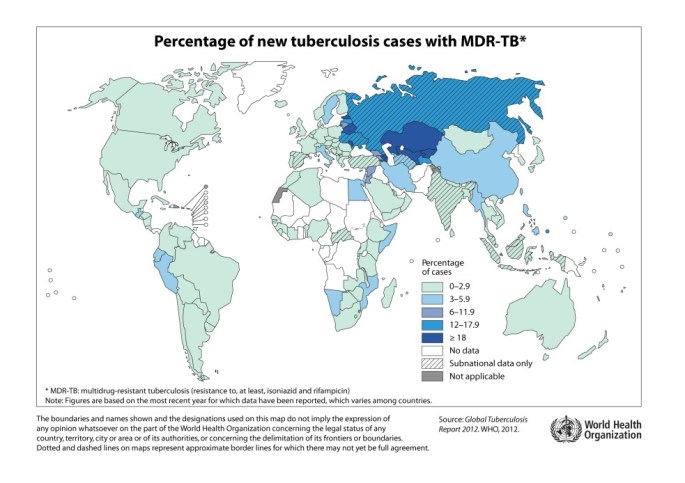
While 6 countries bear the brunt of new tuberculosis infections, the former Soviet Union leads the pack in cases of MDR-TB.  Moldova, a small country at the crossroads of Eastern Europe and Central Asia, has one of the highest rates of MDR-TB in the world at 18% of new TB infections.  Sixty-five percent of tuberculosis re-infections are MDR-TB.
mp1

There are several reasons for the prevalence of MDR-TB in these formerly Soviet states.  Analysis of tuberculosis bacterium links surges in incidence to social upheaval, such as that seen during the collapse of the Soviet Union in the 1990s.  A breakdown in healthcare infrastructure made it difficult for people to follow a sufficient antibiotic course to fight the disease.  MDR-TB in the UK has steadily risen, reaching 81 cases in 2012, and has been traced to the same event.

An extensive prison system has also been blamed for the development and spread of MDR-TB.  Russian prisons prior to 2001 had a tuberculosis infection rate of 7,000 per 100,000 prisoners.  The close quarters of prison are the perfect breeding ground for MDR-TB, which then permeates the community when an infected prisoner is released.

Tuberculosis is the leading cause of death for people living with HIV. Due to a weakened immune system, people with HIV are 26 to 31 times more likely to get TB than the general population.  These facts are doubly worrying when considered with the prevalence of latent tuberculosis infections among healthcare workers.  A study published in PLOS One found that 47% of healthcare workers in 7 low-income countries had a latent infection, ranging from 37% in Brazil to 64% in South Africa. By definition, latent tuberculosis is not contagious, but once infected, an active infection can occur at anytime and be transferred to a patient.  In India, this is troubling as there is no mechanism to reduce the spread of tuberculosis in hospitals:

Therefore, anecdotally, there’s a lot of TB among doctors and nurses, even drug resistance and some mortality.  Hospital staff are vulnerable two ways — because they are in India, a hyper endemic country with half of adults already infected [with latent TB], plus hospitals collect TB patients so staffs are at risk of infection.

– Jacob John, virologist and retired professor from the Christian Medical College, Vellore, India

As cited by WHO and the New England Journal of Medicine, antiretroviral therapy in concert with tuberculosis treatment can significantly improve outcomes and longevity for both diseases. Sadly, concurrent treatment is lacking as reported by WHO.  In 2015, 1.2 million people living with HIV contracted tuberculosis.  Of that number 390,000 received treatment for both diseases.  An equal number died.

mp2

The Sustainable Development Goals are committed to end tuberculosis by 2030, ensuring healthy lives and well-being for all.  What next steps need to be taken to eradicate a disease as old as the human race?

Can the census help us reach our global goals?

On September 25, 2015, the UN General Assembly adopted the Sustainable Development Goals (SDGs) to be completed by 2030.  Seventeen goals with 169 targets fall neatly within a framework of People, Planet, Prosperity, Peace, and Partnership.

sdgs-globalgoalsforsustainabledevelopment-05

To estimate the likelihood of reaching these goals in the next 14-odd years, it is helpful to evaluate the shortcomings of the SDGs’ predecessor.  Established in 2000, the Millennium Development Goals (MDGs) consisted of 8 goals to be achieved by 2015.  Called the “most successful anti-poverty movement in history,” the MDGs made inroads in reducing global poverty, but there is still much to do.

A literature review finds that the MDGs were more favorable to wealthy countries, which for all intents and purposes had met or exceeded the 8 goals prior to inception.  In the development stage, only 22% of member parliaments were involved. Others argue that the MDGs ignored local and governmental capacity in poorer countries and limited policy growth by narrowing focus.  Rather than setting goals realistic for each country’s individual baseline and capacities, the MDGs ‘ghettoize the problem of development and locates it firmly in the third world.’  The final limitation of the MDGs speaks to issues of data collection and surveillance in developing countries.  Reliance on national averages and aggregated data ignored the world’s poorest, meaning they would be the last to benefit.

A video recently released by WHO’s YouTube page culminates with the sentiment “The world needs better health data and ICD is delivering it.”

The ICD or International Classification of Diseases allows global users to share health information about mortality and morbidity.  ICD counts deaths as well as diseases, injuries, symptoms, reasons for encounter, factors that influence health status, and external causes of disease.

ICD is less useful and utilized in developing countries.  In the least developed countries, health records, including birth and death records, are not well recorded and may be based on second-hand information or less scientific means such as verbal autopsies.  Is the ICD accessible to developing countries, ostensibly the same countries who share the largest burden of poverty and disease?  What are the fundamental gaps in data collection and utilization that must be ratified before progress is observed?

One of the first steps to usable data is the census.  A timely, accurate census is the foundation for public health policy and development:

Census data can, for example, highlight sex-ratio imbalance, identify trends in migration, fertility, nuptiality and population ageing. Such information is the bedrock of almost all aspects of human, social and economic development. It helps governments determine the number of schools, hospitals or highways to be constructed, or the kind of programs that should target young and older people, as well as women. Censuses thus contribute to reducing poverty, ensuring sustainable development and supporting reproductive rights and gender equality.

The United Nations Population Fund provides technical and financial support to assist developing countries with census efforts.  When a developing country conducts a census, the results can be unexpected.  Afghanistan’s 2010 census – its first since 1979 – found lower fertility rates and higher contraceptive use than anticipated.  In very remote areas, there is limited data to base projections on, such as in areas of Myanmar where there was no reliable data even on total population.

The 2030 Agenda is built on the assumption that every country will be able to identify and locate the most vulnerable groups, but over 109 countries in the world today don’t have vital statistics and registration. We still need to develop better ways to reach those who have historically gone uncounted.

– Dr. Babatunde Osotimehin, UNFPA Executive Director

Without accurate census information, are we putting the proverbial cart before the horse?

A Trump presidency would be a catastrophe for global health and human rights

With less than a month till the U.S. Presidential election, UN High Commissioner for Human Rights Zeid Radd al Hussein has taken a stand against Donald Trump, calling him a threat to international affairs:

If Donald Trump is elected on the basis of what he has said already – and unless that changes – I think it is without any doubt that he would be dangerous from an international point of view.

The High Commissioner isn’t alone. The Economist‘s Intelligence Unit ranked a Trump presidency sixth on their list of global threats, just after jihadi terrorism destabilizing the global economy.

The Economist might have a point. Trump has made numerous comments that indicate that neither health nor human rights will be prioritized in his administration’s foreign policy:

I would bring back waterboarding and I’d bring back a hell of a lot worse than waterboarding. (Republican Presidential Debate, ABC News 2016 )

What I won’t do is take in two hundred thousand Syrians who could be ISIS. (Face the Nation, CBS – 2015)

This is reinforced by the unusual cadre of suspect world leaders (read: perpetrators of human rights abuses) that he has singled out for praise, including Kim Jong-eun, Saddam Hussein, and Vladimir Putin.

At the moment, Trump is all talk. However, should he be elected and even one of his portentous assertions be made manifest, both health and human rights – which in many cases are inextricably linked – will be imperiled. Here is a look at how Trump might influence health at home and abroad.

Sexual assault
In 2013, Trump dismissed the U.S. military’s atrocious sexual assault record on Twitter in his usual style:

26,000 unreported sexual assaults in the military-only 238 convictions. What did these geniuses expect when they put men & women together?

What Trump’s tweet fails to grasp is that more than half of reported military sexual assault victims are men.

050913-military-assault

Like the perpetrators of these assaults, Trump struggles with issues of consent. Even if we ignore recently surfaced audio of Trump boasting about inappropriately grabbing women or comments made about women consciously and unconsciously flirting with him, Trump has a history of hiring men with dubious ideologies and records. His own private council and a top executive at The Trump Organization, Michael Cohen, recently stated that women cannot be raped by their husbands, in response to decades-old allegations by Trump’s first wife. Ahead of his September 26th presidential debate, Trump was advised by Roger Ailes, former Fox News chairman who was fired by the network amid sexual harassment allegations. As President, Trump would appoint more than 6,000 federal positions, including top officials for all federal agencies.

Reproductive rights
Abortion in the US was legalized in 1973, in part to reduce the public health toll of illegal abortions especially as they impacted low-income women. Shortly after legalization, deaths and hospitalizations due to unsafe abortion practices significantly decreased. However, access to abortion is constantly challenged in the States, through measures such as Texas’s recently-defeated HB2 and legislation that puts restrictions on the administration of medication abortion. Thirty-seven states require prescription of the dual dose by a licensed physician, while 19 others require that a licensed physician be physically present when the medications are taken. As the scope of reproductive rights grow slimmer, what American women need is a champion, not a leader whose basic understanding of female anatomy is that they bleed out of their “wherever.”

clip_image002_000

Trump (despite describing himself as “very pro-choice” when he flirted with a presidential run in 1999) appears to be prepared to encourage the erosion of this ever-embattled constitutional right: in a town hall meeting in March, he voiced his support for the criminalization of abortion and stated that women who seek them should face “some sort of punishment.” He quickly backed down from this extreme position in response to public backlash (even from those within his own party), but his potential ability to appoint up to four Supreme Court justices creates the specter of encroachment on women’s rights. At a time when reproductive choice is finally beginning to see some forward movement around the globe in countries such as Poland and the Philippines. If US law heads in that direction, it could embolden other countries to go the way of Northern Ireland.

Religious discrimination
Trump has taken a hard line on his views of the world’s Muslim population. Besides proposing a ban on Muslims entering the U.S., Trump suggested that all Muslim-Americans be tracked through a surveillance system. Many drew comparisons to Nazi Germany, but in an interview with George Stephanopoulos, Trump justified his proposal by saying it was no worse than the internment of Japanese-Americans under the purview of Franklin D. Roosevelt . A report by the Commission on Wartime Relocation and Internment of Civilians found the internment camps “were motivated largely by racial prejudice, wartime hysteria, and a failure of political leadership.”

War and war crimes in the Middle East
War is a guaranteed human rights catastrophe, and the devastation that armed conflict wreaks on public health infrastructure and health systems is myriad and far-reaching. In addition to the direct destruction of hospitals and killing, often directly and intentionally, of health workers, war and conflict can reverse decades of progress toward eradicating diseases – as evidenced by the recent reemergence of polio in conflict zones. US military activity has been responsible for much of this kind of damage in the Middle East. Iraq’s healthcare infrastructure may never fully recover from the first Gulf War in 1991 and the subsequent 2003 invasion. As it stands, nearly 97% of Iraqi families have no health insurance, and even if they do there are only 7.8 doctors per 10,000 patients, a rate miniscule in comparison to neighbors such as Jordan and Lebanon. Personal safety and security are the top reason physician recruitment and retention in this country is so difficult, according to Médecins sans Frontières (MSF). Additionally, Syria and Yemen are humanitarian tragedies due to ongoing American coalition-funded proxy wars.

Adding nuclear weapons to the mix hardly seems imaginable, but Trump seems to have a bit of a trigger finger when it comes to nuclear weapons. On a morning news show, Trump said that he would never rule out the use of nuclear weapons against ISIS, citing “unpredictability” as a central theme of his foreign policy agenda.

The candidate has also advocated the murder of terrorists’ families, which, as John Oliver helpfully reminds us, is a war crime:

The other thing with the terrorists is you have to take out their families, when you get these terrorists, you have to take out their families. They care about their lives, don’t kid yourself. When they say they don’t care about their lives, you have to take out their families.

Trump has indicated that he is willing to compel servicemen and women to do this and commit other war crimes, such as torture detainees:

They won’t refuse. They’re not going to refuse me. If I say do it, they’re going to do it.

These statements (and many more) have been made – in public fora and broadcasts – since Trump announced his presidential bid 485 days ago. The American voter can only speculate what other dubious position statements will emerge in the scant weeks leading up to election day. Is Trump a threat to global health and human rights? That is a personal call each voter will have to make on November 8th.

Food for thought: can Meatless Monday save the planet?

World-renowned researchers, physicians, government officials, and industry leaders are meeting today in Berlin to discuss the state of global health.  Amidst presentations and discussions about non-communicable diseases, global health security, and priority issues in conflict zones, the attendees of the World Health Summit will gather together to break bread.  The menu might look a little different this year, as the Summit will jump on the Meatless Monday bandwagon.

The brainchild of Sid Learner, in partnership with Johns Hopkins Bloomberg School of Public Health, Meatless Monday was established in 2003 to reduce reliance on red meat, improve chronic disease, and protect the environment.  Meatless Monday is now active in 44 countries – from Bhutan to Togo.

Could wider adoption of Meatless Monday or less reliance on meat as a diet staple prove a boon for food scarcity, health, and reduction of green house gases?  When so much of the world suffers from malnutrition, is this fad a luxury or a necessity?

The ills of large-scale factory farming are well established.  These facilities, known in the US as concentrated animal feeding operations (CAFO), can each produce up to 1.6 million tons of manure a year, more waste than a U.S. city.  Unlike human waste infrastructure, there is no mandated system for the storage or sanitization of animal waste which can be rife with E. coli, antibiotics and other hormones, animal blood, and organic and inorganic compounds dangerous to human health.  Improper or overextended systems for storing untreated manure can cause run off or leaching into ground water.  Degrading animal waste can also affect local air quality and attract insects.

It isn’t just the immediate health effects of factory farming – such as increased incidence of childhood asthma in communities near CAFOs – but the cumulative effects that contribute to global warming.  A 2006 report of the Food and Agricultural Organization of the United Nations found that CAFOs deleterious outputs could account for 18% of global emissions.  The list is literally and figuratively exhaustive: from the methane gas emitted from the aforementioned manure, the oil used to transport carcasses to processing plants and on to stores, the electricity used to keep the meat cool, and the emissions and energy needed to harvest the crops that feed the livestock and pumps for water.  Dig a little deeper and consider, as suggested by two World Bank Scientists, the following:

Should you include all the knock-on emissions from clearing forests? What about the fertiliser used to grow the crops to feed to the animals, or the emissions from the steel needed to build the boats that transport the cattle; or the “default” emissions – the greenhouse gases that would be released by substitute activities to grow food if we were to give up meat? And is it fair to count animals used for multiple purposes, as they mostly are in developing countries, from providing draught power to shoe leather or transport, and which only become meat once they reach the end of their economic lives?

All told, these activities add up to 32.6 billion tons of carbon dioxide annually, or 51% of global greenhouse gas emissions.  Even at its lowest estimate of 15%, greenhouse gas emissions from livestock are equal to exhaust emissions from every vehicle – plane, train, and automobile – in operation today.

How much less meat would we need to eat to keep rising temperatures below the 2-degree Celsius mark that could spell big trouble for life as we know it?  Industrialized countries currently consume more than twice the amount of meat considered healthy.  Americans eat three times as much.  While meat consumption in developing countries is a fraction of those listed above, an increased call for meat has been seen as countries become more urban.   Meat consumption in developing countries has tripled compared to developed nations in recent decades.

While the simple solution is to eat less meat, the type of meat might also be important.  Raising beef requires nearly 30 times more land and 11 times more water than pork, chicken, dairy or eggs.  Three staple crops – potatoes, wheat, and rice – require up to six times fewer resources than pork, chicken, dairy or eggs.

If industrialized countries were to consume less red meat, global malnutrition could be addressed. Only 55% of the world’s crops feed people, the rest are reserved to feed livestock or to make biofuel.  The conversion of calories from grain to meat leaves much to be desired.  One hundred calories of grain produce a mere 3 calories of beef.  Just switching from grain-fed beef to pasture-raised beef, chicken, pork, eggs, and dairy products could free up much more food to feed the world.

It may be that time is running out to make smarter food choice before climate change makes the decision for us.  Currently, 4% of global croplands experience drought each year but could reach as high as 18% by the year 2100.  Even at the current rate, droughts have the capacity to devastate regions and industries.  A recent study found that an extra 500,000 deaths will be attributable to a decrease in nutrient-rich food in 155 world regions by the year 2050.  Rather than malnutrition related to caloric intake, these deaths will be due to lack of vitamins from fruit and vegetables. The majority of these deaths will likely occur in already impoverished countries of Asia and Africa.

If you are reading this blog, you can probably afford to have some lentils or a nice vegetarian burrito for dinner.  While you sup, feel free to check out these great articles by Maryn McKenna.  The first imagines a world without antibiotics – a huge issue especially as it pertains to the food industries over-use. The second examines a Dutch company that is mass producing antibiotic-free boiler hens.

Female sterilization not an answer to global contraception

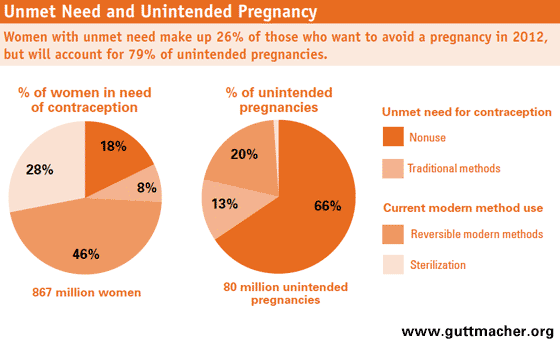
The last week of September marks two days dedicated to improving reproductive health: World Contraception Day  (September 26) and Global Day of Action for Access to Safe and Legal Abortions  (September 28).  Both days are committed to improving the reproductive health and choices of women worldwide. With the vision of making every pregnancy a wanted pregnancy, World Contraception Day aims to help the estimated 225 million women in developing countries who have an unmet need for contraception.

Reports such as the UN’s 2015 Trends in Contraceptive Use Worldwide include somewhat promising data, such as 64% of married or in-union women use a modern contraceptive method. This figure is lower in developing countries, including 17 countries in Africa where modern contraceptive use is below 20%.

Sterilization is the most widely used form of birth control, accounting for a third of modern contraceptive use. Sterilization is heavily weighted toward female sterilization, 18.9% versus 2.4% male sterilization globally.  In certain countries, the prevalence of female sterilization as modern contraception is much higher.  Female sterilization of sexually active women aged 15 to 49 is most prevalent in Latin America.  The Dominican Republic leads the pack at 47%  followed closely by Colombia, Costa Rica, El Salvador, and Puerto Rico.  China (29%) and India (36%) are also front runners.

unmetneedandunintendedpregnancy

Sterilization is a popular choice in the developed countries of Europe and North America, though male sterilization tends to be more prevalent than in the developing world. When practiced safely, sterilization offers many benefits because it is a one-time procedure with no follow-up or maintenance.  While sterilization might be the best choice for some individuals or couples, unsafe, involuntary, or otherwise coercive female sterilizations are altogether too common and an affront to human rights.

China’s “one child” policy  – perhaps one of the more infamous anecdotes in mandated family planning – has relied on sterilization to meet its goals.  In the heyday of the 1980s, neighbors became informants on so-called “out-of-plan” pregnancies.  Offending families were fined and possessions stolen, and local bureaucrats oversaw countless forced abortions and sterilization. 1983 alone saw over 20 million sterilizations. China’s Communist Party has recently relaxed its one-child policy  to allow each couple two children, but many in China, including activist Chen Guangcheng don’t see the difference as stated in this tweet:

This is nothing to be happy about. First the #CCP would kill any baby after one. Now they will kill any baby after two. #ChinaOneChildPolicy

Lesser known is an Uzbekistan policy that assigns gynecologists a sterilization quota of up to 4 per month.  In a report by the BBC, rural women who have had two or more children are the main target of this campaign.  It is estimated in 2011 alone that 70,000 Uzbek women were sterilized, some voluntarily and some involuntarily.  Unlike China’s policy to slow population growth, Uzbekistan’s goal is to manipulate its once abysmal infant mortality ratings.  Fewer infants means fewer infant deaths, and Uzbekistan’s infant mortality rate in 2012 is half of what it was in 1990.

India has received much attention for its sterilization camps.  The name alone conjures images of the Nazi eugenics movement.  In 1951, with Malthusian ideology in mind, an Indian demographer set out across rural India to complete a census.  His prediction – that India’s population would reach 520 million people by 1981 – was both incorrect (India’s population in 1981 was 683 million ) and the catalyst for a mass sterilization program.  This led to compulsory sterilization in 1976  that lasted for 21 months and effectively sterilized 12 million men and women, often rural, poor, and of low caste.  Employment, wages, and even running water were withheld from individuals and whole villages until 100% compliance was met.

Today, while technically voluntary, sterilization in India is incentivized. In the past, men were promised transistor radios in exchange for a vasectomy.   Male sterilization is now considered culturally unacceptable.  Women are the target of sterilization campaigns and can receive up to $23 US – a month’s income – to submit to a tubal ligation.

sterilization
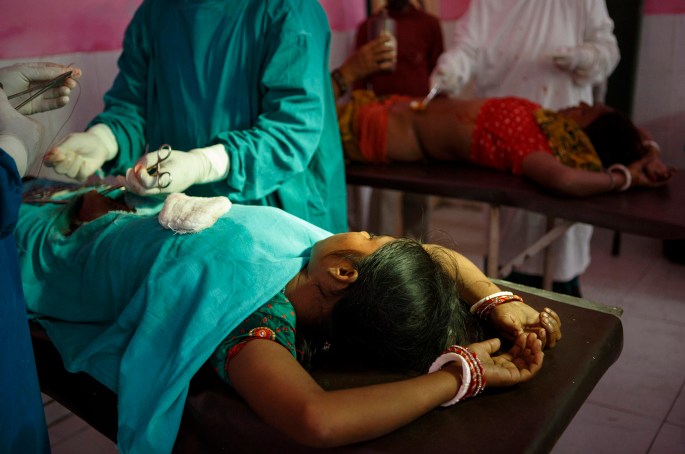
Women undergo sterilization operations at the Cheria Bariarpur Primary Health Centre in the Begusarai District of Bihar. A few dozen women were sterilized in one day. Although India officially abandoned sterilization targets years ago, unofficial targets remain in place, according to people working on the ground. One Primary Health Centre doctor says the targets in themselves are not necessarily the problem, arguing instead that itÕs the lack of a good healthcare infrastructure in some places that makes it difficult to safely meet those targets. SARAH WEISER

Indian women arrive at sterilization camps by the jeep load.  In makeshift operating theaters –  with no electricity and running water – neither gloves nor equipment are changed between the five-minute operations.  Expired antibiotics given to some women are found laced with rat poison.  In 2014, Dr. R.J. Gupta, self-described as performing 300 tubal ligation in one day, was arrested after women he and an assistant sterilized either died or were hospitalized.  The current government regulation is that no one doctor should perform more than 30 sterilizations a day.  On the day in question, Gupta’s six-hour spree resulted in 83 tubal ligation.  It is believed that Gupta was trying to reach a government-set target of 220,000 sterilizations in one year.

On September 14th of this year, India’s Supreme Court ordered a close of all sterilization camps within three years.  That is an unsettling time span in which over a half a million more women could be sterilized and many more deaths and hospitalizations could occur.  Even after the dissolution of government-sanctioned sterilizations camps, women will continue to be subject to this dangerous procedure.

What are low cost, accessible, and humane forms of birth control for the developing world?  A promising alternative might be Sayana® Press, a lower-dose presentation of the three-month injectable contraceptive Depo-Provera® in the Uniject™ injection system.

sayana_press
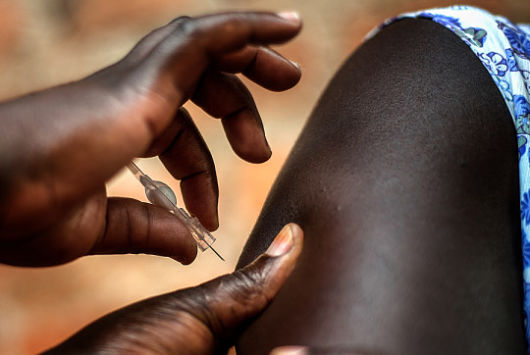
A village health worker counsels a client in family planning and administers Sayana Press. Phiona Nakabuye (left), village health worker trained by PATH’s Sayana Press pilot introduction program, with Carol Nabisere (right), age 18, who chose to receive Sayana Press after being counseled in the various forms of contraception, Kibyayi village, Mubende district.

Original trials of the injectable contraceptive were successful in Florida, New York, and Scotland, and the same seems to be holding true in Uganda.  Most women were able to self-administer the drug after just one training session and again at the next dose, three months later.  Designed for single use, Sayana® Press reduces reliance on needles and needle sharing  which is essential in the fight against HIV/AIDS and women only need to travel to a clinic once to get a year’s supply.

There is so much to consider when it comes to global family planning.  It would be remiss not to mention the impact that the HIV/AIDS epidemic has on sterilization rates in some regions of the world and you can read more here, here, and here.  Organizations such as USAID have been implicated  for funding so-called fertility reduction programs that include mass sterilization.  What can be done to ensure all women have access to contraception?