Global News Round Up

Politics & Policies

A review of US-funded Ebola recovery projects in Guinea, Liberia, and Sierra Leone by the US Government Accountability Office (GAO) released this week found that, of $1.6 billion appropriated by Congress in 2014 for US Agency for International Development (USAID) in the hard-hit region, $411.6 million has been targeted to 131 specific projects.

Programs, Grants & Awards

Each year we commemorate World TB Day on March 24 to raise public awareness about the devastating health, social and economic consequences of tuberculosis (TB) and to step efforts to end the global TB epidemic. The date marks the day in 1882 when Dr. Robert Koch announced that he had discovered the bacterium that causes TB, which opened the way towards diagnosing and curing this disease.

Research

In most health systems, Community Health Workers (CHWs) identify and screen for severe acute malnutrition (SAM) in the community. This study aimed to investigate the potential of integrating SAM identification and treatment delivered by CHWs, in order to improve the coverage of SAM treatment services.

Researchers with the National Institutes of Health (NIH) recently made a breakthrough on the link between iron supplements and worsening malaria infections, as well as curious mutation in African populations.

States that have approved medical cannabis laws saw a dramatic reduction in opioid use, according to a new study by researchers at the University of Georgia.

It seems the multi-billion dollar cannabis industry is having some problems with its employees showing up to work stoned. A recent study published in the American Journal of Industrial Medicine finds that a large percentage of those employed in the businesses of growing and selling weed are getting high either before work at some point during business hours — risking both their safety and that of their co-workers.

Diseases & Disasters

In West and Central Africa, nearly 170 young people are infected with HIV everyday and a disparity in funding has left the youth at risk.

Public Health England has reported a gonorrhea case resistant to the pair of antibiotics (ceftriaxone and azithromycin) that have been typically effective in treating gonorrhea.

For decades now, global health organizations and deep-pocketed philanthropies like the Gates Foundation have worked to eradicate wild poliovirus – and the achievement of that goal often seems tantalizingly close at hand.

The United Nations emergency food relief agency has airlifted over 80 metric tons of vital nutritional supplements to Papua New Guinea – enough to feed approximately 60,000 people in the earthquake-hit country.

Technology

Antibiotics were heralded as life-savers when they became widely available in the 1940s.  Today, they are fast becoming killers themselves. The more any given antibiotic is used, the greater the chances that bacteria will develop antimicrobial resistance (AMR) that renders the drug ineffective.

Environmental Health

The world is facing one of the largest food crises in more than 79 years, and climate change is only making it worse.  Between 2030 and 2050, climate change could kill an additional 250,000 people every year, from malnutrition, malaria, diarrhea and heat stress.

Lebanon’s waste crisis began in 2015 when a huge landfill site closed and government authorities failed to implement a contingency plan in time to replace it; dumping and burning waste on the streets became widespread. The campaign group Human Rights Watch calls it “a national health crisis”.

New research reveals shortening of telomeres due to air pollution in newborn. The researchers analyzed telomeres in the umbilical cord blood of 255 newborns, half of whom were born prior to the coal plant closure and the other half were conceived and born after the plant closure in Tongliang, China.

Equity & Disparities

One of the biggest issues at the intersection of sanitation, poverty and global health, open defecation has also long been one of the hardest to represent visually.

While globally men report a 25% higher cancer incidence than women, a new study reveals the opposite trend in India with more women being diagnosed with cancer than men.

Women, Maternal, Neonatal & Children’s Health

A United Nations employee who says she was sexually assaulted by a top UN official has spoken publicly for the first time, alleging she was offered a promotion if she accepted an apology from the man and claiming that the organization failed to take her complaint seriously.

An international health organization has suspended its partnership with the Heineken beer company because of the controversial use of so-called “beer girls” to promote its products.

Teenage pregnancy – the biggest killer of girls and women aged 15 to 19 in the world – is growing in the east Asia-Pacific region, the only place where the rate is climbing.

Human Rights

UN Security Council members condemned the killing of civilians in Gaza after a peaceful protest turned violent.

Health in All Policies Faculty Development Workshop-June 18-20 in Washington, DC

The World Health Organization (WHO) in collaboration with the Association of Schools and Programs of Public Health (ASPPH) and the National Environmental Health Association (NEHA) invites you to attend a Health in All Policies (HiAP) skill-building workshop from June 18-20 in Washington, DC to build education/training and practice approaches that move policy in support of both health and the environment. Air pollution will be used to provide case examples throughout the workshop.

The deadline for applications is April 25, 2018. To apply online, please visit the ASPPH page here. The WHO site provides more background here.


National Public Health Week is Here!

National Public Health Week (NPHW) is a great opportunity for public health professionals to rally together and raise awareness about work that is being carried out around the nation. NPHW will take place from April 2nd to April 6th this year. It specifically highlights, “Generation Public Health,” a movement focused on creating the healthiest nation in one generation by supporting initiatives and policies that improve social and environmental factors which impact health. No matter what stage you are at in your public health career, you can get involved this week!

The theme of NPHW 2018 is Changing Our Future together. The key focus is to:

Additionally, daily themes will be highlighted in order to focus on one public health topic a day.


Ways To Get Involved


Feel free to also highlight and share social media posts of events that are being held in local neighborhoods, schools, workplaces, and public health organizations near you! Make sure to include the following hashtags with your pictures and social media posts: #NPHW, #1BillionSteps, @ih_section, #ih_section!


NPHW 2018: Healthiest Nation Poem/Song

We want to be the healthiest nation
in one generation
for communities to have a solid foundation
where safety is the norm and we can all be free
to live life to the fullest and pursue our dreams
as we breathe clean air while we sleep, work, and play
our youth go to school and graduate
Our jobs lead to wealth, health, and have meaning
but there are services in place “for the time being” 
when we reach those moments that we fall through the cracks
or fall on hard times and it’s hard to come back
our nation truly practices justice for all
communities are well informed to sound the call
for various needs like fresh water and meals
or access to sidewalks for bicycle wheels
healthcare and prevention go hand in hand
so that unhealthy practices have low demand
Yes, the healthiest nation 
is what we aim to be 
in one generation is when we hope to see
public health infrastructure and improved capacity
to truly serve our nation and support communities

Listen here: https://soundcloud.com/sophianyatonwu/nphw-healthiest-nation

Sophia Anyatonwu, MPH, CPH, CIC
Epidemiologist II


World TB Day 2018

5149398656_ebd66669fa_z

Tuberculosis is caused by Mycobacterium (seen in the image), a genus postulated  to have originated some 150 million years ago! The first written records about TB from India and China, date back to 3300 and 2300 years ago respectively.

Hippocrates accurately defined symptoms of “Pthisis” (Greek for TB) and described it as a fatal disease. There is also plenty of historical evidence about tuberculosis and its impact on human culture. From being identified as a “romantic disease” to being associated with poetic and artistic qualities, TB has had its fair share of time in the limelight.

All this history aside, the fact is, if untreated, TB can be fatal.  Effective treatment became available about 50 years after Robert Koch showed that TB was caused by an infectious agent in 1882Soldier TB 2. Isolation in sanitariums and surgical interventions were all part of treatment until the advent of streptomycin in 1944. BCG vaccine has also been in use since 1921. Several public health campaigns (such as the one seen here) were also conducted to raise awareness once TB was established as a contagious disease.

Unfortunately even to this day, TB is still a major public health concern in many parts of the world and is among the top 10 leading causes of death worldwide.  Seven countries account for two-thirds of total TB cases with India leading the count.

The disease typically affects the lungs and is spread in the air when a person infected with TB coughs or sneezes. Sadly the cost of having TB goes beyond the damage it does to one’s health. Recent studies show that economic impact TB can have people; TB can lead to a downward spiral into poverty and for the poor a TB diagnosis can prolong the cycle of poverty they already live in.

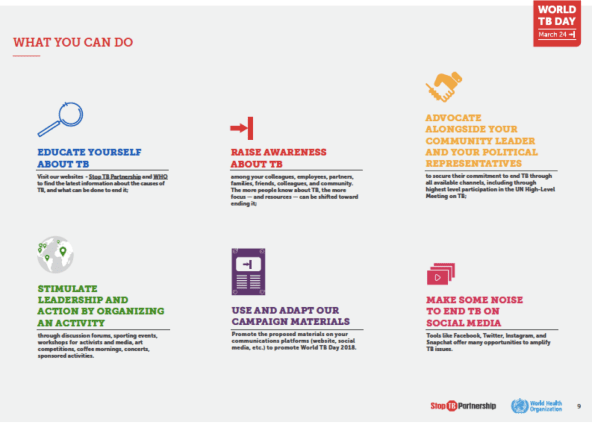
TB3March 24th is World TB Day. The theme for World TB Day 2018 is “Wanted: Leaders for a TB-free World”.

TB rate spike due to the humanitarian crisis in Venezuela, poor TB infection control in South African clinics and jail time for doctors who fail to report TB cases in India, have all been in the news leading up to World TB day. Clearly these news reports show the need for stepping up global action, if we hope to end TB by 2030.

The message about greater commitment and better leadership comes ahead of the UN General Assembly High Level Meeting on TB in September 2018. Given the surge in multiple drug-resistant TB, it is imperative that leaders at all levels work together to end TB. End TB strategy adopted in 2014 outlines interventions that fall under three key pillars that include integrated, patient-centered care and prevention, policies and supportive systems and research and innovation.

But as public health professionals, community leaders and residents, we all can take small steps to make sure we put an end to TB. The path to ending TB will hopefully improve the lives of most vulnerable people world-wide.

TB4.png

Global News Round Up

Politics & Policies

The goal of the  Resolve to Save Lives initiative is to save 100 million lives within 30 years. With $225 million in funding from Bloomberg Philanthropies, the Chan Zuckerberg Initiative and the Gates Foundation, Resolve zeroed in on cardiovascular disease and epidemics as its twin priorities.

Friends of the Global Fight today released an updated, two-page edition of its policy brief, “The Case for U.S. Investment in the Global Fund and Global Health.” This short edition includes updated data and talking points to show how U.S. support for the Global Fund offers extraordinary return on investment.

Ahead of Secretary Tillerson’s budget testimony, humanitarian, development and global health organizations release new data showing the devastating human costs of proposed administration cuts to foreign assistance.

It could take several years before United States aid recipient countries such as Uganda and Nigeria feel the full impact of the expanded Mexico City Policy. But new analysis shows there are already clear signs that the policy is pushing these countries to limit their expansion of key health services, including for women’s health care.

Launching the TB Free India Campaign at ‘Delhi End TB Summit’, PM Narendra Modi said his government is implementing a national strategic plan to end tuberculosis (TB) by 2025.

Global health care efforts rely heavily on U.S. funding, but U.S. attitudes toward spending in this area are increasingly hostile.

Programs, Grants & Awards

Drs. Catherine Blish, Nathaniel Landau, and Sara Sawyer are recipients of the 2018 Avant-Garde Award for HIV/AIDS Research from the National Institute on Drug Abuse.

The Gates Foundation concentrates on advocacy efforts that encourage political leaders to fund initiatives supporting the elimination of global inequalities.  Other notable efforts include initiatives centered around helping farmers in developing countries research and implement better agricultural practices. These include the production of rice and flour enriched with micronutrients.

Research

Human antibody CIS43 protected mice from infection with the malarial parasite Plasmodium falciparum, a new study shows.

Physical inactivity is an important cause of noncommunicable diseases.  Interventions can increase short-term physical activity (PA),  but health benefits require maintenance. Few interventions have evaluated PA objectively beyond 12 months. We followed up two pedometer interventions with positive 12-month effects to examine objective PA levels at 3–4 years.

In a paper in Public Health Research & Practice, published by the Sax Institute, we outline how collaboration between like-minded national governments can improve pre-migration health assessments (PMHAs) through information sharing, collaborative learning and increased capability in countries of origin.

Diseases & Disasters

Egypt has become the first country in the WHO Eastern Mediterranean Region to eliminate lymphatic filariasis. This success comes after nearly 20 years of sustained prevention and control activities.

Whooping cough, caused by the bacteria Bordetella pertussis, is no longer a familiar condition to most Americans. The United States began widespread vaccinations in the 1940s, which nearly eradicated the disease. But whooping-cough has been increasing here over the past two decades despite record rates of vaccination: in 2016, more than 15,000 people in the US came down with the disease, and 7 people died.

There has been an 80 percent decrease in the number of new cholera cases reported among a community of Congolese refugees in Uganda’s western Lake Albert region, the World Health Organization told Devex Friday. As recently as Feb. 28, health care workers were identifying roughly 100 new cases a day and as of March 12, that number is down to 20.

A huge and deadly outbreak of Listeria in South Africa could alter the country’s approach to food-borne disease and prompt improvements in food safety standards, a leading health official said on Friday.

Technology

UNICEF aims to scale up real-time monitoring systems in 110 countries by 2021 using the open source technology called RapidPro.

Researchers are developing low cost technology to improve water quality and to remove contaminants using magnetic nanoparticle based adsorption.

Profusa Inc has developed injectable body sensors that are capable of streaming data to mobile phones and to the cloud.

Environmental Health

After the latest study showed that more than 90% of bottled water brands contained tiny plastic particles, the World Health Organization has announced a review of potential risks of plastic contamination in drinking water.

New study shows that alleviating the effects of global warming with tougher climate policies could save 150 million lives.

New research led by IIASA researcher Narasimha Rao has shown how it might be possible to reduce micronutrient deficiencies in India in an affordable way whilst also reducing greenhouse gas emissions.

Equity & Disparities

Two members of the polio vaccination team were ambushed and killed in a remote tribal region in Pakistan.

Advances in mapping tools and the ability to create maps with extraordinary detail is helping efforts from vaccination to disaster relief.

Maternal, Neonatal & Children’s Health

Even with futuristic advances in medicine and science, and increased access to food and other forms of nutrition, the oldest human health problem has remained stubborn—and, sometimes, seemingly impossible to fix: Young children and infants still die at epidemic rates in the poorest corners of the globe.

An international study of over 300,000 women from across 29 countries showed that pregnant women with anemia are twice as likely to die during or shortly after pregnancy.