Membership Roadmap: The IH Section is Ready When You Are!

In May 2015, I became a graduate student member of the American Public Health Association so that I could attend the Annual Conference and take advantage of networking opportunities. I applied for and received a travel scholarship from my university later that year.

While at the conference, I attended a variety of Student Assembly, Epidemiology, Maternal and Child Health, Community-based Participatory Research and International Health Section sessions. I also visited the Expo Center and made sure to hand out many copies of my resume as well as business cards at various booths. With my student membership, I was able to join two Sections and selected Epidemiology (my concentration) and International Health as my main groups to plug into.

Shortly after attending the Annual Conference and following up with contacts I met using email and/or LinkedIn, I had to switch my focus to finishing my practicum and graduating within the next month. In addition, I began to close out my involvement with student organizations while balancing the “job search” process. It was a busy time for me.

In February 2016, I was hired to work at a local health department as a High-Consequence Infectious Disease Epidemiologist. Since I was living ~3 hours away from where I was going to begin working, I had to find someone to take over my lease while starting the 45 min- 1.5 hour commute to work from my parents’ house. During this time, Zika virus was declared to be a public health emergency by the World Health Organization and became one of my highest priorities.

Fast forward to the end of May 2016. I received a second notification to renew my APHA membership but was weighing whether or not it would be a worthwhile investment since I wasn’t sure how APHA could benefit me. Thankfully, the Early-Career Professionals group was a great incentive for me to choose to renew my membership. Because the membership fee was reduced, funding was available, and products like the journal and newsletter could be shared within my workplace- my employer was willing to cover the membership renewal fee. These elements also played a role in me being able to attend the Annual Conference for the second time. I made a list of conference sessions that could be beneficial to my health department and solicited feedback from leadership as well as my colleagues to see what information they wanted me to bring back. I also focused on seeking out ways to collaborate and contribute to the broader public health community. This led me to take a leadership position with the International Health Section Communications Committee after seeing a Call for Volunteers in an awesome newsletter that came through my email.

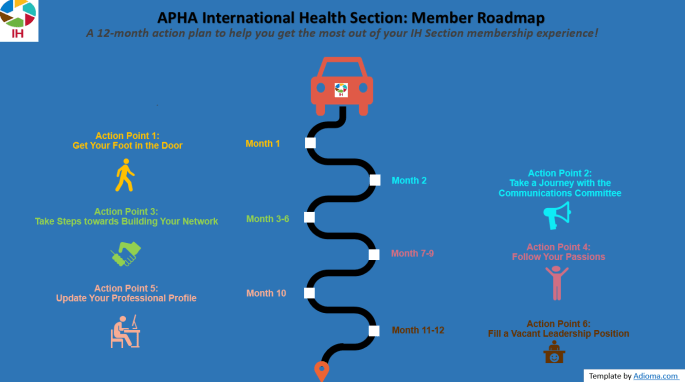
Since joining the IH Communications Committee in October 2016, I have been able to post to the Section blog, create an informational video, utilize new social media outlets, review policy, serve as a proxy for a Governing Councilor at the Annual Conference, create a Membership Roadmap, assist with the Listserv as needed, share professional development opportunities, contribute to strategic planning efforts, review abstracts and much more.

So, what’s the point of me sharing all of this?! It’s never too late to get involved! Even though there were some lapses in my activity due to work and life, when more time became available in my schedule (or my circumstances changed) I was able to fall back on my membership.

If you’re looking for ways to get involved, make sure to check your emails for post-conference opportunities, read the Section blog as well as newsletter, and feel free to use the Membership Roadmap as a flexible guide!


roadmap


Global News Round Up

Politics & Policies

At a meeting with African leaders during the United Nations General Assembly, President Donald J. Trump underscored his commitment to promote the Global Health Security Agenda (GHSA) by noting, “We cannot have prosperity if we’re not healthy.”

In a keynote speech in Washington, D.C., yesterday at the Grand Challenges network annual meeting, US Secretary of State Rex Tillerson voiced support for US collaboration on global infectious disease issues, including ongoing efforts to battle threats such as HIV and malaria.

Programs, Grants & Awards

In recent years, Southeast Asia has surfaced as a “hotspot” for novel respiratory virus emergency due to dense populations of humans and domestic animals living in close proximity. The state of Sarawak in eastern Malaysia, where locals market and eat jungle products such as wild mammal meat, is one of these areas. This summer, six global health students traveled there to study viral pathogens and investigate their impact on humans.

Rosa Chemwey Ndiema, MBChB, MMEd, has years of bedside experience as a gynecologist in her native Kenya, and aspires to have an even greater impact on the health of her community through leadership and research.  Like many countries in eastern and southern Africa, Kenya has a high rate of pediatric HIV, with nearly 100,000 children living with the virus. Ndeima hopes to put Kenya on the path to virtual elimination of the virus through research on how to better involve community leaders to prevent mother-to-child transmission of HIV.

Research

A new study predicts that the worldwide pattern of religious affiliation at the time of death will change over the next 50 years.

The malaria breath test prototype that detects six different volatile organic compounds to detect malaria cases seems to be promising.

Diseases & Disasters

As part of global efforts to end AIDS as a public health threat, UNAIDS, the United Nations Population Fund (UNFPA) and partners have launched a new roadmap to reduce new HIV infections. The HIV prevention 2020 roadmap was launched at the first meeting of the Global HIV Prevention Coalition.

A recent Lancet article calls for a clear strategy and partnerships for reduction in NCDs.

Mongolia has the highest rate of liver cancers and highest mortality rate from this disease in the world.In response to this crisis, the government is subsidizing hepatitis medication,and infusing money in prevention and screening efforts.

Technology

Solar suitcase provides light, heat, battery charging and a baby monitor in a health center in a remote  Nepalese village. Since its installation in 2014, there have been no maternal or neonatal deaths.

The possibility of Amazon entering the prescription drug market might already be disrupting healthcare.

Doctors and engineers at Duke and Stanford Universities have developed a $10 microchip that turns a 2D ultrasound machine to a 3D imaging device.

Environmental Health

Last year more than 50,000 people in 90 First Nations communities across Canada were affected by contaminated drinking water and 133 boil water notices were  issued. Now researchers are partnering with 2 communities to find out what is contaminating drinking water.

The Lancet’s annual Countdown is calling on governments to fight factors that are exacerbating climate change. According to the study, climate change could displace a billion people by 2050.

Equity & Disparities

David Williams, a professor at Harvard University, has found that discrimination, which is a stressful experience, has negative impact on health.

In 2015, lives of 920,000 young children was claimed by pneumonia, a disease of poverty. Only 4 out 30 high burden countries are on track to meet the SDG target by 2030.

In the past 5 years nearly 40,000 students committed suicides in India and about 70% of suicide victims had an yearly income of less than Rs 100,000.

Maternal, Neonatal & Children’s Health

Children in Bangladesh’s Rohingya refugee camps are taking on breadwinner roles exposing them to high risk of exploitation and abuse.

According to the new Global Report on Nutrition, nearly 155 million children under 5 years of age are stunted and about 41 million children under 5 are overweight. The report finds a significant burden of malnutrition in the 140 countries that were included.

About one in five pregnant women carry Group B Streptococcus bacteria, a major but preventable cause of poor health among mothers and babies worldwide.

NHS England New Guidelines Ask For Sexual Orientation

In the United States, doctors are not required to ask patients their sexual orientation. This information is beneficial not only for health professionals but for the country; the importance of knowing this information is multifaceted. Understanding one’s sexual health is significant because it can affect your physical and emotional well-being. One’s sexual orientation may put you at higher risk for certain health conditions. Lastly it can help provide accurate health and behavior counseling. For instance, several research reports conclude that anal cancer is prominent in gay men or that depression is common among the community, therefore it is extremely valuable for health care providers to meet these needs regardless of sexual orientation.

In the United States the Census Bureau is planning to maximize response and participation by the year 2020, specifically to better understand the LGBT population. Coinciding with this, under Healthy People 2020 some of the main objectives fall under the category of increasing the number of population-based data systems used to monitor Healthy People objectives which collect data for LGBT populations. These objectives involve increasing the number of states that include questions on sexual orientation and gender identity in the Behavioral Risk Factor Surveillance System (BRFSS). Don’t get me wrong, this is great progress, although all of these facets seem to be ingredients from different recipes. England has taken it to a new level. Continue reading “NHS England New Guidelines Ask For Sexual Orientation”

You’re Invited! IH Section Climate Change & Health Working Group’s Open House, Sunday, November 5


You are invited to the IH section’s  Climate Change & Health Working Group’s Open House!  

The IH section’s Climate Change and Health working group is small but mighty!  Stop by our Open House at the American Public Health Association’s Annual Meeting on Sunday, November 5th (#283.0) from 4 pm to 5:30 pm in Room B409. We hope to see Environmental Health members, especially those who are also International Health members.  We will network and discuss our 2017 successes and our proposed plans for 2018.  See the link to the brochure below for more information about the working group.

International Climate Change and Health Working Group Brochure

Global News Round Up

Politics & Policies

Health groups joined forces on Sunday with the Conservative opposition to accuse the Liberal government of trying to raise tax revenue on the backs of vulnerable diabetics.

The new head of WHO, Dr. Tedros, has rescinded an invitation to the Zimbabwean President Robert Mugabe to serve as a goodwill ambassador for the agency.

Programs, Grants & Awards

The U.S. Senate has proposed $74.38 million to fund Fogarty in Fiscal Year 2018, about $2 million more than its current allocation.

The World Bank Group and United Nations High Commissioner for Refugees (UNHCR) are establishing a joint data center on forced displacement to improve statistics on refugees, other displaced people and host communities.

WHO has for the first time published guidelines to help frontline clinicians provide high-quality, compassionate, and respectful care to children and adolescents who have or may have been victims of sexual abuse.

Research

A large outbreak of typhoid fever caused most likely by drinking contaminated water and street-vended beverages killed one person and sickened many in Uganda between January and June 2015.

A global study involving researchers from nearly 300 institutions has identified 72 new gene mutations that lead to the development of breast cancer.

New study using multiple mouse models of diet-induced and genetic obesity, shows that introduction of the GDF-15 gene reduced body weight, food intake and serum insulin levels in the animals. These results could pave a way of potential alternatives to bariatric surgery.

Diseases & Disasters

Doctors who have spent years fighting polio in the world’s most remote regions sit down over coffee with a World Health Organization representative to tell war stories.

By August 2016, just over a year after the Zika virus epidemic began in Brazil, the number of live births in Pernambuco declined by nearly 10%, according to a study released in June 2017

A team of scientists at Washington University School of Medicine, digging down to the molecular roots of the Alzheimer’s have come across a good and a bad news.  A gene named as TREM2, is found out to be one of the key player, whose mutations can substantially increase the risk of this disease in that person.

Taking the right antibiotics for just nine months may be as effective against drug-resistant tuberculosis as taking  them for two years, as is currently recommended, according to preliminary findings from an international study.

Technology

Researchers have developed a smartphone based detection instrument with a credit card sized test kit to identify infectious disease-causing agents at the point-of-care.

Majority of new e-health startups in the African subcontinent do not use mobile phones to reach customers, according to a new report.

Medical equipment worth billions of naira has been found to be abandoned at the University of Calabar Teaching Hospital (UCTH) and 13 other federal health institutions in Nigeria.

Environmental Health

According to an in-depth study published in The Lancet, pollution contributes to 9 million deaths each year globally.

China is shutting down entire industrial regions in an effort to inspect the facilities and enforce environmental regulations.

Equity & Disparities

Sao Paulo (Brazil) and New Delhi (India) came out at the bottom as worst megacities for sexual violence against women.

Hate and discrimination is probably associated with the rise of HIV in Russia.

In response to rampant alcoholism among men living in a village in the state of Tamil Nadu in South India, their young teenage daughters have made remarkable strides by taking over the running of the place.

Maternal, Neonatal & Children’s Health

While the under-5 mortality among children has dropped by more than half between 2009 and 2016, nearly 5.6 million children under 5 years of age still die each year.

With an 84% reduction in maternal mortality ratio between 1990 and 2015, Cambodia is one of 9 Southeast Asian countries to have met the UN millennium development goals.