CARPHA Conference 2018 – Call for Papers

63rd ANNUAL CARPHA (The Caribbean Public Health Agency) Health Research Conference
June 14th – 16th, 2018

CALL FOR PAPERS
DEADLINE FOR RECEIPT OF PAPERS
January 8th 2018

Theme:
‘Sustainable Health Systems for Economic Growth, Development and Wealth’

The 63rd Annual CARPHA Health Research Conference will be held from June 14th to June 16th, 2018.  The theme for 2018 is ‘Sustainable Health Systems for Economic Growth, Development and Wealth’ however, we will also accept quality research papers in all priority health areas (e.g. NCD, HIV, Health Systems, etc.) Sustainable Health Systems for Economic Growth, Development and Wealth comprises topics such as: Health Insurance systems, health financing in SIDS, health as a human right – the financial implementations, cost of prevention vs cure, cost of natural disasters on health and development, cost of poor health on economic development and cost of NCDs on development.

Selection of Papers
Papers are selected based on scientific merit and relevance to the health priorities areas of the Caribbean. As a guide, Poster presentations are preferable for papers that contain large amounts of data, deal with particular techniques, report highly specialized work, ‘research in progress’ and ‘programmes being implemented’. Authors whose papers are accepted, but who do not present will not have their papers considered for the next two years unless they have a good reason, such as:

  • acute illness
  • loss or bereavement
  • hardship or trauma

Prizes
The David Picou Young Researcher Prize is awarded for the best paper presented by a Caribbean investigator who is not yet an established researcher.

The criteria for being considered is as follows:

  • Age: 40 years or less
  • Qualifications: At least a 1st degree, including a medical degree
  • Work experience: Working in a health-related environment in a position considered junior; e.g. below senior lecturer/consultant grade
  • Nationality: must be a Caribbean national; may be based in an institution abroad (Persons who wish to be considered for the David Picou prize are to send
    a letter clearly answering the above questions.)

Student Prize will be awarded to the best paper presented by a student/student group.
(Persons who wish to be considered for the Student prizes should indicate such in the transmittal letter).

Poster Prize is awarded for the best poster.

For more information:
https://gallery.mailchimp.com/f93f457ff9c6f7046ff32bf20/files/e1e77763-fdab-4f16-bebb-0d3f54855e1e/CallForPapers2018_Final.pdf

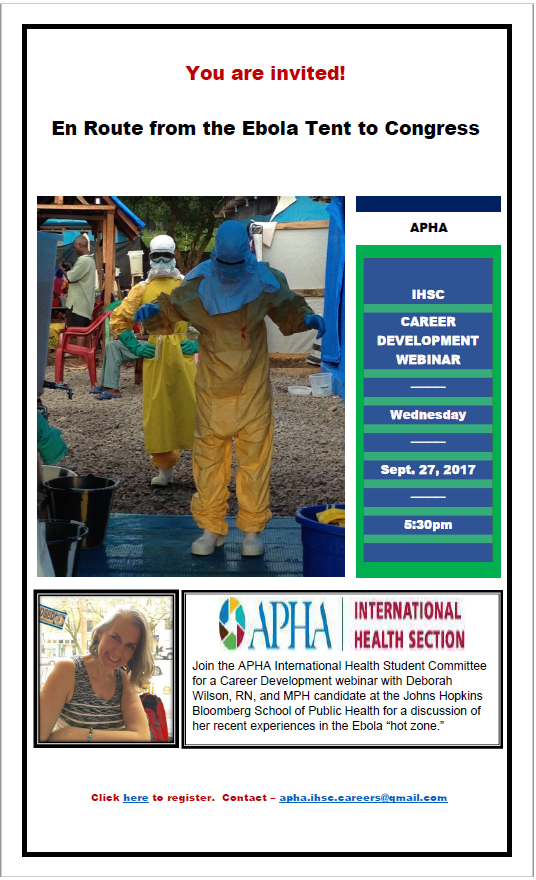
International Health Student Committee (IHSC) Career Development Webinar

Join the APHA International Health Student Committee for a Career Development webinar with Deborah Wilson, RN, and MPH candidate at the Johns Hopkins Bloomberg School of Public Health for a discussion of her recent experiences in the Ebola “hot zone.”

September 27th, 2017 @ 5:30 pm

Click here to register. Contact – apha.ihsc.careers@gmail.com


sept webinar

The 9th TEPHINET Global Scientific Conference: Ending Pandemics in our Lifetime Initiative

From August 7th-11th, The Training Programs in Epidemiology and Public Health Interventions Network (TEPHINET) held its 9th Global Scientific Conference and the 23rd National Epidemiology Seminar in Chiang Mai, Thailand. I had the opportunity to listen to a panel presentation on Global Influenza Surveillance as well as the following presentation on Ending Pandemics. The overview I have provided below summarizes Mark Smolinski’s (Director of Global Health Threats at Skoll Global Threat Funds) presentation on innovations in surveillance for personal, national, and global health security. Feel free to listen to the entire presentation (1:17:00-2:16:28)!

  • Epi curves generally focus on human disease but human disease and animal outbreaks coincide or trigger one another. Additionally, bioterrorism can play a role in outbreaks and should be included in epi curves.
  • There are six main opportunities for epidemiologists/public health practitioners to intervene and reduce risk from pandemic threat:
    • Stop the threat in the animal population
    • Reduce the epi curve in the animal population
    • Find the first human cases (quickly)
    • Limit human infections and stop the epi curve in the animal population
    • Ensure strong surveillance/warning systems are in every country so disease doesn’t spread beyond country borders
    • Know and work directly with neighbors across borders so that regional security exists to stop any outbreak/prevent pandemics
  • It costs 3.4 billion dollars to prevent a pandemic by ensuring that developing countries have baseline capacity/public health systems that meet international standards. The return of investment is 10 fold. We are currently at ~450 million dollars.
  • Innovations in Surveillance – Researchers in tech as well as universities are involved in innovative surveillance methods, not necessarily epidemiologists/public health practitioners:
    • Google Flu Trends –predictive of flu and comparable to CDC flu reports (visits to providers), which were delayed by two weeks (80% of ill individuals did not visit a provider)
    • Twitter – University of Rochester developed an algorithm that can predict flu with 90% accuracy and gives an 8-day notice of when someone will get the flu (based off of tweets of others in your community/social circle)
    • HealthMap/Flu Near You – Participatory surveillance system that allows people to check off symptoms, see results on a map, and find where the closest vaccines are; correlates very well with the CDC influenza-like illness surveillance (over 5 years)
    • Epi Hacks – the idea is to bring together human, animal, and environmental health experts for one week to work with developers to come up with open source products for countries to use (for surveillance purposes); at least one has been conducted on each continent
    • PODD – uses a One Health approach as people in villages are tasked with helping find outbreaks quickly and reporting animal morbidity/mortality in real-time
    • KIDENGA – CDC and the University of Arizona are working together on vector-borne surveillance on the U.S/Mexico border, an epi hack will take place to see if they can create a sustainable way to address vector-borne diseases
    • Guardians of Health app – asked attendees to report health issues or symptoms during the World Cup, attendees received health information and program updates/information in return
    • EPICORE – retrospective analysis of public health information related to outbreaks; an automated system that epidemiologists follow-up on (after requests for information have been sent out)
  • When there are no outbreaks, public health gets no credit…
  • All countries cannot meet the International Health Regulations, even if they agree that they SHOULD be met
  • Skoll Global Threats Fund teamed up with Google and examined publicly available data at the World Health Organization (WHO) to determine how long it takes to detect, report, and respond to outbreaks; found that the global community is improving but has plateaued (due to limited data)
  • Research Paper – Finding Outbreaks Faster – Smolinski MS, Crawley AW, Olsen JM. Finding Outbreaks Faster. Health Security. 2017;15(2):215-220. doi:10.1089/hs.2016.0069.
    • There are epidemiologists in 28 countries looking at data from each outbreak to determine 6 metrics that all countries can follow (over past 5-10 years)
    • Countries had never looked closely at this issue and were able to see their strengths and weaknesses in investigating different types of outbreaks
    • Hot Spots of Emerging Infectious Disease – CORDS
      • Build friendship and trust across borders
      • Helps regional disease investigation networks share best practices, scale innovations, optimize informal networks
      • South Asia and West Africa are the most concerning for emerging infectious diseases, in a few years they may have stronger regional networks
  • Ending Pandemics Collective
    • 14 foundations and leaders of companies concerned about social responsibility want to invest in global health, share ideas, coordinate funding for projects, break down barriers in the foundation world
      • Smithsonian Museum of Natural History wants to do a 2-year exhibit called outbreaks, collectively a great chance to improve the knowledge base of people that visit the exhibit (~7 million people)
      • In 10 years the collective sees a world where:
        • Every outbreak is detected within 3 incubations periods of the index case or cluster
        • Every country’s Emergency Operations Center is utilizing an integrated, event-based detection system being used simultaneously by the WHO and G20
        • Human, animal, and environmental health volunteers are verifying rumors or suspected threats within 24 -48 hours through EpiCore
        • Participatory surveillance is engaging communities directly to detect and respond to outbreaks in every disease hotspot across the globe
        • Field epidemiologists in every country are using the latest technology to detect, verify, and respond to outbreaks faster
  • At the end of the day, pandemics can be prevented because “no community is too hard to reach, no community is too poor to innovate, and curiosity outshines fear!” 

Global News Round Up

Politics & Policies

The Senate Republican bill to repeal the Affordable Care Act might have failed, but threats to health coverage continue. Despite the Senate’s plans for bipartisan hearings in September on ways to improve the individual insurance market, President Trump has created uncertainty over whether the government will continue providing subsidies that help hard-working American families afford coverage.

Programs, Grants & Awards

The National Institutes of Health has renewed its support for University of Washington (UW) as a leader in developing the next generation of physicians, veterinarians, dentists, and scientists, trained in global health with a $4.5 million grant to extend the Northern Pacific Fogarty Global Health Fellows (NPGH) training program for the next five years (2017–2022).

The U.S. Senate on Thursday confirmed former congressman Mark Green as President Donald Trump’s choice to lead the U.S. Agency for International Development at a time the administration is proposing cuts in foreign aid and a reorganization of the agency.

The 3rd Coordination Conference for the Zoonotic Diseases Action Package (ZDAP) will be held in Da Nang, Vietnam on August 28-30.

Research

According to a series of new reports while number of deaths due to violence in the middle east grew by 850% between 1990 and 2015, incidence and death rates of chronic diseases also rose sharply.

While the utilization of rapid diagnostic tests for malaria resulted in a decrease in the number of prescriptions for artemisinin-based combination therapies, the number of antibiotics prescriptions increased.

Diseases & Disasters

Fifteen years after the declaration that leprosy has been eliminated, experts are now warning that every year, millions of new leprosy cases are going undiagnosed and untreated.

In response to the ongoing food crisis in East Africa, the U.S. Agency for International Development announced more than $169 million in funding on Thursday for humanitarian assistance in Ethiopia and Kenya. The majority of the funds — approximately $137 million — will go to Ethiopia.

When cases of Ebola were detected in the Democratic Republic of the Congo in May, local officials moved swiftly and global resources were rushed to help them. By the time the World Health Organization (WHO) declared the outbreak over on July 2, only four people died, four more had survived the disease, and the outbreak had been contained in a remote region of the country.

The UK has pledged to donate £100m to a global bid to eradicate polio by 2020.

More than a million children already suffering from acute malnutrition are at risk from a cholera outbreak sweeping war-torn Yemen, charity Save the Children warned Wednesday.

Research suggests that the number of blind people across the world is set to triple within the next four decades.

Only six countries have taken steps to evaluate their abilities to withstand a global pandemic, according to a report sponsored by the World Bank.

Three additional human infections with novel influenza A viruses were detected in Ohio during week 31. Three persons, all attendees at the same agricultural fair, were infected with influenza A (H3N2) variant (H3N2v) viruses.

Technology

An inexpensive mobile device with wearable cuffs has been developed by a team from ETH, Zürich shows promise for monitoring dehydration in kids.

The Pratt Pouch, a small ketchup packet-like pouch of antiretroviral drugs developed in 2008 that has saved thousands of lives in Ecuador, Zambia and Tanzania is now expanding to Uganda.

A new Whatsapp-based instant messaging tool has been developed by the “WHO and its partners to detect, verify and log the devastating consequences of such attacks“.

Environmental Health

There is an effort to eradicate the goat plague virus, a disease that costs “between $1.5 and $2 billion in losses annually to 330 million of the world’s poorest people.

A new large-scale review has mapped the spread and changes in the range of spread of 100 infectious diseases due to climate change.

Monsanto produced and sold toxic chemicals known as Polychlorinated biphenyls (PCBs) years after it learned about the health and environmental hazards of PCBs.

Equity & Disparities

Troubling signs of racism in the healthcare system as new report shows evidence of Aboriginal women being coerced into tubal ligation in and around Saskatoon, Canada.

A new study analyses how distinctive traits of African cities and economies are increasing vulnerability and in many cases perpetuating poverty and marginalization.

Affordable housing versus green space has become a point of contention for London’s oldest allotment.

With already high unemployment rates, informal economy in sub-Saharan African countries will not be enough to handle the projected workforce expansion in Africa.

Maternal, Neonatal & Children’s Health

Gestational diabetes rate in India is at 26.3%, the highest in the world and it poses a significant risk to the health of the mother and the fetus.

Young women in their late teens or early twenties in Kashmir are being diagnosed with Polycystic Ovarian Syndrome. Experts believe that Kashmiri women are genetically predisposed but early detection can help with treatment.

After decades of shortages of trained people to help in deliveries, the role of midwives has been growing in recent years in Bolivia, which joined international efforts to improve the skills of midwives and bring them into closer contact with the medical community.

There is debate whether the focus on skilled birth attendants (a measure of progress in the Sustainable Development Goals) is distracting countries with high maternal mortality rates from fundamental health systems reforms.

CUGH Webinar, Global Health at the Centers for Disease Control and Prevention, Now Available

CUGH recently hosted a webinar on Tuesday, August 8, 2017 entitled Global Health at the Centers for Disease Control and Prevention. The recording and slides are now available:

About the Webinar:

Disease knows no borders. CDC’s global activities protect Americans from major health threats such as Ebola, Zika, and pandemic influenza and adverse economic impact. CDC detects and controls outbreaks at their source, saving lives and reducing healthcare costs. As importantly, CDC helps other countries build capacity to prevent, detect, and respond to health threats through its work. The knowledge and lessons learned from CDC’s work abroad are critical to our public health efforts at home, and to protecting Americans.

CDC works in more than 60 countries, working with ministries of health, the World Health Organization (WHO) and many other partners on the front lines where outbreaks may occur. It addresses global health crises that can extend beyond the health sector to contribute to creating more stable societies, including the growing burden of non-communicable diseases.

Join Dr. Hamid Jafari, CDC Center for Global Health Principal Deputy Director, as he walks us through the structure and activities of CDC’s global health center in the United States and abroad.