Global News Round Up

Politics & Policies

This year ends in uncertain times, for the world’s political order, the fate of a damaged planet, the seemingly boundless human suffering experienced by civilians and health care staff in war zones, and the continuing failure of antibiotics that once gave medicine its “miracle” cures.

Adopting a draft resolution on global health and foreign policy that focused on the role of health employment in driving economic growth and helping Member States move toward sustainable development, the General Assembly also held a debate on the culture of peace and elected members to the Organizational Committee of the Peacebuilding Commission.

Now that President-elect Donald Trump has selected ExxonMobil CEO Rex Tillerson as Secretary of State, the lifelong oil man will need to field questions raised by the international development community before he can take up his job.

The World Health Organization on Friday urged US President-elect Donald Trump to expand Obamacare and ensure all Americans have access to healthcare.

In a “value for money” assessment released this month, Britain’s foreign aid agency gave top ratings to three organizations to which it donates: the World Bank; the Global Fund to Fight AIDS, Tuberculosis and Malaria; and GAVI, the Vaccine Alliance.

Programs, Grants & Awards

Ban Ki Moon, in his Agenda for Humanity has requested that the United Nations Central Emergency Response Fund expand its annual funding target to $1 billion by 2018.

Research

Chronic HIV-1 infection impairs superantigen-induced activation of peripheral CD4+CXCR5+PD-1+ cells, with relative preservation of recall antigen specific responses.

Viruses can evolve to become more aggressive in men than in women – at least in theory, a study suggests.

Though Zika has been known for 70 years, in many ways the virus is still poorly understood. A new phylogenetic and geographic analysis of Zika’s collected genetic sequences provides the most complete study of the virus’s history to date.

A new systematic review and meta analysis of mass deworming for soil-transmitted helminthiasis and schistosomiasis shows that deworming has little to no effect on nutrition, haemoglobin, school attendance, and school performance, though the quality of evidence was mainly low or very low.

Diseases & Disasters

Yemen’s humanitarian catastrophe is set to worsen as the war has ruined the economy and is stopping food supplies getting through, driving the country to the brink of famine.

Thanks to unprecedented international cooperation, the world is making impressive progress in the fight against malaria.  According to the World Health Organization’s just-released 2016 World Malaria Report, malaria mortality rates among children under age five have fallen by 69% since 2000.

New data from Rio de Janeiro, Brazil, suggest that nearly half of women infected with Zika virus during pregnancy experience a serious complication, whether a miscarriage or significant birth defect, in their baby.

Global progress on controlling malaria risks stalling due to an “urgent need” for more funding, the World Health Organization warned in its annual report on Tuesday.

The Bill & Melinda Gates Foundation will increase its involvement in humanitarian relief to refugees in the Middle East and North Africa Region.

Rabies is classified as a Neglected Tropical Disease (NTD), although many folks in the global north probably don’t think of rabies as a common disease, nor a tropical one for that matter.

An Egyptian woman, believed to be the world’s heaviest woman at 500 kg (1,102 lbs), will soon be flown to India for weight reduction surgery.

Technology

Malawi on Thursday launched Africa’s first drone-testing corridor as developing countries explore how drones could be used during humanitarian crisis such as floods, or to deliver blood for HIV tests.

Tanzania’s new digital health road map offers a pioneering example of “putting national government in the driver’s seat” and of systems based approaches to e-health, experts say.

A 24-year-old woman in London is thought to be the first in the world to have a baby after having an ovary frozen before the onset of puberty.

The United Nations announced today at a meeting of the world’s top agricultural scientists, that in order to achieve the world’s Sustainable Development Goals of defeating hunger and poverty by 2030, governments and the private sector must increase commitment to agricultural science and technology research.

This year’s Tech Awards, hosted by The Tech Museum of Innovation in San Jose, California, shines a spotlight on startups that use technology to make lives better in poor countries.

Environmental Health

Two new studies report that methane levels in the atmosphere are increasing at the fastest pace in two decades. Methane is a greenhouse gas and has a much more potent warming effect when compared to carbon dioxide.

Clearing tonnes of plastic debris off beaches is only the first step—then comes the conundrum of what to do with it all.

Asia, the world’s largest and fastest-developing continent, has less fresh water per capita  than any other continent. This has helped foster growing interstate and intrastate disputes over shared water resources.

Climate science in the US is in an existential crisis. President-elect Donald Trump has promised to cut funding for Earth science and the Republican-controlled Senate and House of Representatives will probably make good on those promises.

Equity & Disparities

Among the estimated 1 million migrants living in Thailand along the remote Thai-Burmese border, threats to health abound.  Infectious diseases such as malaria, HIV/AIDS, hepatitis, tuberculosis, diarrheal conditions and dengue fever run rampant.

Maternal, Neonatal & Children’s Health

Nearly a half million children will face starvation in northeastern Nigeria next year and 80,000 will die if they don’t get treatment in the humanitarian crisis created by Boko Haram’s Islamic uprising, the UN Children’s Agency warned Tuesday.

Although child survival has improved substantially in the past 15 years, the decline in neonatal mortality (particularly deaths related to neonatal sepsis) has been more modest, which has contributed to the overall non-attainment of Millennium Development Goal 4 (to reduce child mortality).

Babies made from two women and one man have been approved by the UK’s fertility regulator.

In a study published in the journal Pediatrics, authors have found that in contrast to premature babies who received conventional incubator care, premature babies who were exclusively breastfed and received kangaroo-mother-care have become adults with larger brains, higher salaries and less stressful lives.

The global news round up was prepared by the communications team.

Sign up for the IH Section’s Global Health Mentoring Program!

About the Program: The IH Section Global Health Mentoring Program is an initiative of the Global Health Connections Working Group to pair experienced global health professionals with student or early career professional members of the APHA IH Section. This program runs January through September each year and emphasizes the personal and professional growth and development of student or early career professional IH Section members.

About the Pilot: This pilot is the second round of an International Health Section initiative to start a Section-specific Global Health Mentoring Program. Many changes were made between this round and the previous pilot round. Applicants who participated in the first round are welcome to apply again for the second round as participation in the first round does not impact your ability to participate in the second round.

This Round 2 Pilot is aiming for 20 mentor/mentee matches and we predict that there will be far more than 20 mentee applications. Therefore, if you know of other IH Section members who may be interested in mentoring please encourage them to apply to be mentors as that allows us to match more students/early career professional mentees with suitable mentors.

Applications for the Round 2 Pilot (January 2017 – September 2017) will be accepted until December 24, 2016 at 12:59 PM Eastern Time.

For more information and to apply, click here.

If you have any questions please feel free to email us at: ih.gh.mentoring@gmail.com

Global News Round Up

Politics & Policies

Donald Trump isn’t really known as a fitness fanatic.  The president-elect has referred to the speeches he gave on the campaign trail as a way in which he has stayed active.

We are in uncharted territory. No one can know what the attitude of the new U.S. administration will be to funding foreign assistance of any kind or to global cooperation in the health area.

HIV/AIDS advocates are warning against any cuts to US spending on the fight against the disease as the new administration of President-elect Donald Trump determines how it will approach global assistance.

Each year, the United States gives $5 billion to $6 billion to fight HIV/AIDS around the world, with particular emphasis on sub-Saharan Africa, which accounts for two-thirds of the nearly 2 million new infections each year.

A new policy lab opening today at the Duke Global Health Institute will address financing solutions aimed at improving the health of the world’s poor.

Some development experts hope a Trump administration will continue the Republican tradition of promoting foreign assistance as a means to promote global health, democracy and economic growth around the world.

India is set to roll out injectable contraceptives for women free-of-cost under its long running family planning program.

UN apologizes for the 2010 Cholera outbreak in Haiti.

Programs, Grants & Awards

A global health program at the Albert Einstein College of Medicine aims to get medical students training in topics such as ethical issues, cultural humility and how to behave when working in another culture.

The Schlesinger Fund for Global Health Entrepreneurship at Babson College is partnering with the National Association for the Advancement of Haitian Professionals, USAID, and other partner organizations to host Haiti, Entrepreneurship, and Global Health: An Evening to Act, supporting the Diaspora Challenge Initiative.

Speaking at a special event commemorating World AIDS Day, United Nations Secretary-General Ban Ki-moon today underscored the need to stop stigma and abuse against those living with the disease and to ensure that they receive the care, treatment and protection they are entitled to.

The Monell Center announced today that it has received a $345,000 grant from the Bill & Melinda Gates Foundation. The grant Ssupports an innovative global health research project titled, “Developing Novel Pediatric Formulation Technologies for Global Health: Human Taste Assays.”

World Antibiotic Awareness Week aims to increase awareness of global antibiotic resistance and to encourage best practices among the general public, health workers and policy makers to avoid the further emergence and spread of antibiotic resistance.

Raj Panjabi, founder of Last Mile Health has won the $1 million dollar 2017 TED Prize. Last Mile Health is an organization that trains people to become community health workers to provide for their communities.

Research

Researchers at Johns Hopkins School of Public Health and around the world have found that men and women respond differently to pathogens and therapies, once again proving the need for designing studies to compare sexes.

A five-year, five-country study of effectiveness of insecticide-treated bednets to prevent malaria shows that the effectiveness of the ITNs ranged wildly for example 1% to 100% in Kenya but 86 to 100% in India. But ITNs seem to offer a level of protection similar to the chemicals even in areas where they barely worked.

Data from Population HIV Impact Assessment Project show significant progress against HIV in Zimbabbe, Malawi and Zambia. These data show that the 90-90-90 targets are within reach for many countries.

In a new study of over 50,000 participants in 21 countries shows that only 1 in 5 people in high income and 1 in 27 people in low and middle-income countries with major depressive disorder received minimally adequate treatment.

Diseases & Disasters

Malnutrition – which includes hunger and obesity – is on the rise and may affect half the world’s population by 2036 unless governments take urgent action to reverse its spread, U.N. agencies and experts said on Thursday.

The number of new HIV infections among adolescents around the world is set to rise sharply unless more is done to fight the epidemic, according to a new report from Unicef.

Some researchers predict that several African countries will soon achieve “epidemic control”, meaning that fewer people are newly infected each year than die of the disease.

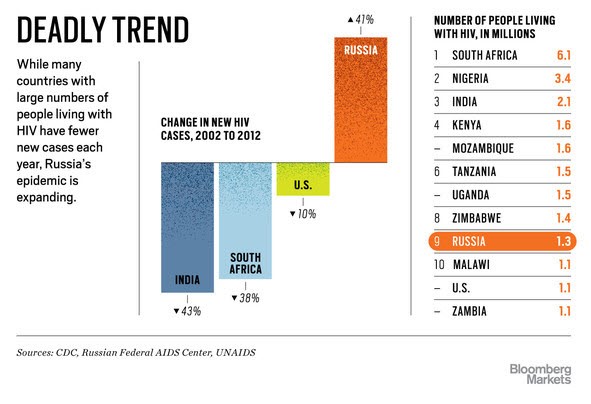
Russia is the new front line in the fight against HIV/AIDS. Critics say the government’s inaction has caused an explosion in new infections. But some experts say there is cause for hope.

While the HIV/AIDS epidemic no longer looks as menacing as it did in the 1980s and ‘90s, efforts to stop the spread of the disease have hit a brick wall.

A new report from the US Centers for Disease Control and Prevention, released Tuesday, finds that the use of syringe or needle exchanges has contributed to significant drops in the rates of HIV among African-American and Latino drug users.

The World Health Organization has noted another record year for new HIV cases in Europe.  An EU agency also reports that one in seven sufferers do not know they are infected, raising chances of spreading the virus.

The first likely case of Sexual transmission of the Zika virus in the UK has been reported by the authorities.

Puerto Rico’s health secretary says nearly 500 new cases of Zika have been reported in the US territory in the past week.

The International Phenome Centre Network (IPCN), which has been initiated by the MRC-NIHR National Phenome Centre (NPC) at Imperial, will seek to tackle such health conditions as autism, cancer, diabetes and dementia.

Technology

Students from Stanford University’s Bio-X Institute have designed a “Shazam for mosquitoes” using cellphones to distinguish different types of mosquitoes based on mosquito wing beats.

Scientists advising Britain’s fertility regulator have said that it is time for three-person IVF.

Scientists at Fred Hutchinson Cancer Center have developed a cheap and easy method using dried blood spots instead of whole blood to diagnose chronic myeloid leukemia, a rare but treatable form of cancer.

Environmental Health

Princess Cruise Lines will pay a fine of $40 million for illegally dumping oil at sea. The ship used a “magic pipe” to dump oily waste into the waters.

With hundreds of thousands of Somalis facing severe food and water shortages due to drought, the Humanitarian Coordinator for Somalia has made appealed for scaling up of humanitarian assistance.

According to data released by Brazil’s National Institute for Space Research (INPE), there has been an increase of about 29% in the rate of deforestation in the Amazon, highest since 2008.

Equity & Disparities

According to the new UNAIDS report, about 18 million are receiving HIV treatment. This would put us on track to reaching the goal of 30 million HIV-positive people by 2020.

Nearly 18 million people with HIV are unable to access treatment and a major barrier to seeking treatment is the lack of diagnosis. Coverage rates for testing, prevention and treatment are low among various population groups, including men who have sex with men, transgender people, sex workers, people who use drugs and people in prisons.  WHO has released new guidelines on HIV self-testing to improve HIV diagnosis.

Analysis of national efforts since the adoption of Convention on the Rights of Persons with Disabilities (CRPD) by the World Policy Analysis Center at the UCLA Fielding School of Public Health has found while progress has been, countries still have a long way to go to protect rights of people with disabilities.

Access to Medicine Index has released its new ranking of pharmaceutical/drug companies who get their drugs and expertise to world’s poorest countries.

Maternal, Neonatal & Children’s Health

Owing to the accessibility to subsidized anti-retroviral therapy, Jamaica must start preparing the HIV-positive youth, originally headed toward hospice care, for transitioning into independent life.

Women’s rights activists in India are opposing the government’s initiative to roll out injectables citing a report by the country’s Drugs Technical Advisory Board that Depot Medroxyprogesterone Acetate (DPMA) causes bone loss.

Britain has announced a £6m package to support innovative grassroot level programs in 17 countries to address female genital mutilation, child marriage and domestic violence.

Fitness & Health

According to a new study, while exercise slashed the risk of dying by 28%, three sports (swimming, aerobics and racquet sports) in particular were linked to even stronger decreases in risk of dying from heart disease and other causes.

The global news round up was prepared by the communications team.

World AIDS Day & the need for SSPs

December 1st, 2016 marked World AIDS Day.  This year’s theme is “Leadership.  Commitment. Impact.”  The White House National HIV/AIDS Strategy for the United States praises the collective efforts of the healthcare workforce, including “increased access to new, sterile syringes and other injection equipment to minimize infections from injection drug use.”

Syringe services programs (SSPs) have proved beneficial to countries across the globe.  In Hong Kong SAR, pharmacies can provide new syringes without a prescription.  Surveys by the health department find that only 2% of HIV infections are attributable to persons who inject drugs (PWIDs) in this country.  In Berlin, Germany, 77% of PWIDs use syringe vending machines at least 4 times per week.  Elsewhere in Germany, syringe SSPs in jail dramatically reduce rate of new infections.

The evidence is clear: Syringe exchange programs work.  Not only do they decrease HIV transmission among PWIDs, but they don’t recruit new drug users and they are cost-effective compared to treating individuals with HIV.  So what’s the hold up?  We need only look at the United States to see that legislation for SSPs is far from universal.

aids-blog-1

There are currently, 228 SSPs in 35 states, the District of Colombia, Puerto Rico, and the Indian Nations.  In states without SSPs, the impact to PWIDs is devastating:

In jurisdictions in the United States, where drug paraphernalia laws were strictly enforced, higher prevalence of HIV infection was observed despite lower risk-taking behavior.  Legal barriers in Maryland and Texas in the United States resulted in a high prevalence of HIV with   up to 25% of PWIDs infected in Baltimore, Maryland and 35% of PWIDs infected in Houston, Texas.  These findings overall suggest that injecting paraphernalia legislation that restricts needle and syringe availability inadvertently increases HIV infection.  There is no convincing evidence that this legislation reduced HIV prevalence.

Whereas Maryland now has one SSPs, Texas is still one of 15 states that do not offer this service.  This is especially concerning due to the prevalence of HIV on the US-Mexico border. Made possible by a combination of illegal and legal sex work, PWIDs, and the highly transient nature of the population, HIV is rampant and largely unchecked in Mexico border towns adjacent to US cities.

aids-blog-2

While syringe exchange programs are key, more needs to be done to educate the citizens of both countries:

And with Mexico’s border cities serving as funnels for workers and goods traversing the two countries, Tijuana’s AIDS crisis poses a direct threat to the United States.

“I call HIV the uninvited hitchhiker,” said Steffanie Strathdee, a leading AIDS researcher at the University of California’s Division of International Health and Cross-Cultural Medicine.

A survey by university researchers found that 64 percent of 116 HIV-positive Tijuana residents crossed into the United States at least once a month. Nearly half of men having sex with men in Tijuana and 75 percent of those in San Diego reported having partners across the border. And of 1,000 prostitutes interviewed in Tijuana, 69 percent had U.S. clients who crossed the border for their services.

The federal ban on syringe exchange programs was lifted in the first few weeks of 2016, largely in response to a nationwide heroin and HIV epidemic in America’s heartland.  Federal monies cannot be allocated to purchase needles, but cover all other expenses including staff, vehicles, and gas.  State and local funding could be used to purchase needles.  Still, adoption of programming has been slow.

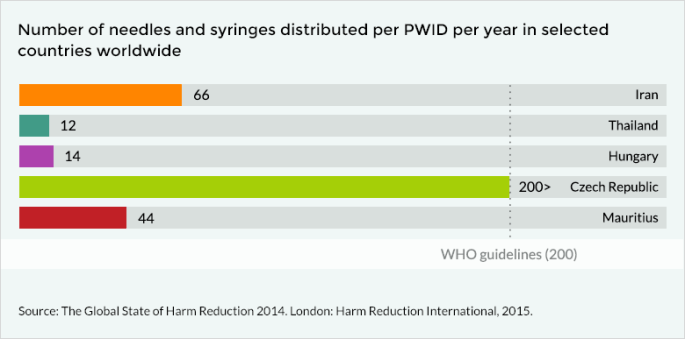
Globally, only 90 needles are available per PWID annually.  This is less than half the recommended amount of 200, and many countries provide far fewer.

aids-blog-3

With a dubious history of HIV prevention and intervention, it is no wonder Russia’s HIV epidemic is increasing 10-15% each year.  Recent data show that 1 in 50 people in Russia’s 4th-largest city are HIV-infected.  When outside funding for SSPs was withdrawn in 2010 – as Russia was then classified as a high-income country – SSPs dwindled from 80 to 10.  Intravenous drug use accounts for 58% of HIV infections.

aids-blog-4

Under Putin’s conservative regime, HIV infections have nearly doubled since 2010 – 500,000 to 930,000 registered carriers – and are projected to reach 3 million (2 million registered carriers) within the next 5 years.  Despite annual spending of $418 million (US) rates are increasing as the lion’s share is spent on antiretroviral therapy, not prevention.

President-elect Trump has been surprisingly vocal in praising Putin, and unsurprisingly obtuse about how he plans to address HIV domestically and abroad.  When asked whether he would support the President’s Emergency Fund for AIDS Relief, Trump was not un-supportive:

Well, I like committing to all of those things. Those are great things. Alzheimer’s, AIDS, so many different — you now, we are close on some of them. On some of them, honestly, with all of the work that has been done — which hasn’t been enough, we are not very close. But the answer is yes. I believe so strongly in that. And we are going to lead the way.

In perhaps the weirdest twist yet, Vice President-elect Mike Pence could prove to be an ally for continued funding of SSPs in the US.  In 2015, an upsurge in HIV infections in Indiana led then-Governor Pence to advocate for syringe exchange programs after a career of staunchly opposing such legislation.

And what of those border states?  Perhaps Trump’s fabled wall might come in handy.

Video @WHO: Intimate Partner Violence

Home should be a place of safety and sanctuary, but for a third of women, this is not the case.  Around the world, 800 million women are subject to physical and sexual abuse at the hands of their husbands and partners.  Per the World Health Organization, intimate partner violence (IPV), also includes emotional abuse, such as threatening to take children away, and controlling behaviors, including isolation and restriction of financial resources, employment, education, and medical care.

IPV causes injury and death, mental health and substance abuse issues, and harm to children who are born to women abused by their intimate partner.  That being said, intimate partner violence isn’t a women’s issue.  IPV is a social concern that runs rampant and largely unchecked in any society that supports – implicitly or explicitly – sexual assault and rape.  Counter to the woman-as-victim trope, violence can occur in any intimate relationship, including between same-sex couples.

What can we do to help millions of men, women, and children in violent homes?  Dismantle those structures which facilitate power imbalance between partners as well as systems that support sexual violence.

Rape culture is a term that is bandied about in regard to leniency and light sentencing of perpetrators, especially on college campuses, in the military, or if the perpetrator is an athlete.  Instead, victims of rape bear the brunt of the burden, such as in the case of a 14-year-old student raped repeatedly by her 49-year-old teacher.  The rapist was sentenced to one month in jail.  The victim took her own life.  A judge declared that the victim was equally in control of the situation because she “seemed older” than her chronological age.

Rape culture doesn’t exist just in our most esteemed institutions, but in the laws that govern our behavior.  A 2010 article published in The Georgetown Law Journal speaks to one of these laws, which allows rapists to seek visitation and custody of children conceived through rape.  Contrary to former State Representative Todd Aiken’s assertions, women can indeed get pregnant as a result of rape as the female body has no mechanism to “shut the whole thing down.”

Once again, we confront another myth of rape culture: that children conceived through rape are unloved and women who choose to keep these children are not true victims.  Statistics show that 80% of rape victims know their attacker, and without laws to revoke paternal custody, some will be forced to continue association with their rapist for at least the next 18 years.

What other institutions contribute to domestic violence?  Child marriage itself is a form of violence perpetrated on some 37,000 girls each day.  Girls who are married before the age of 18 are twice as likely to be beaten and three time more likely to be raped by their spouse.  Abuse is so endemic to this institution that a third of girls married before age 18 believe that, under some circumstances, a man has the right to beat his wife.

For society as a whole, rates of intimate partner violence are intricately associated with the state of society as a whole:

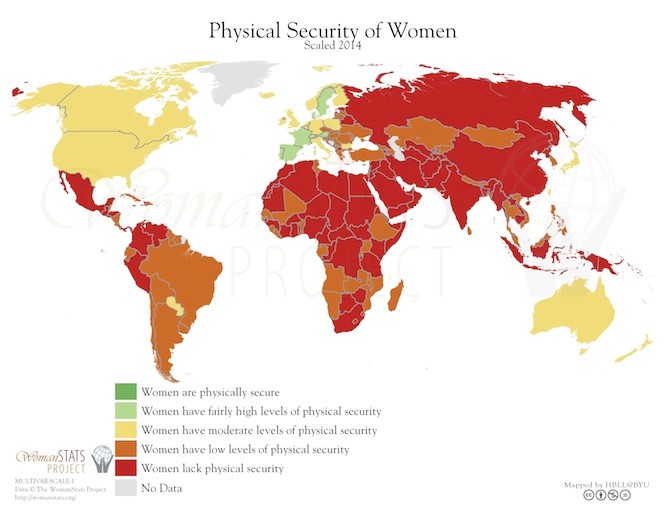
On issues of national health, economic growth, corruption, and social welfare, the best predictors are also those that reflect the situation of women. What happens to women affects the security, stability, prosperity, bellicosity, corruption, health, regime type, and (yes) the power of the state. The days when one could claim that the situation of women had nothing to do with matters of national or international security are, frankly, over.

security-women

As you can see, there is a lot of work to be done.

Further Reading:

Sexual Violence is a tool of war, but we have the weapons to end that.  The Guardian

Guatemala sexual slavery verdict shows women’s bodies are not battlefields.  The Guardian

Ten Things to End Rape Culture.  The Nation