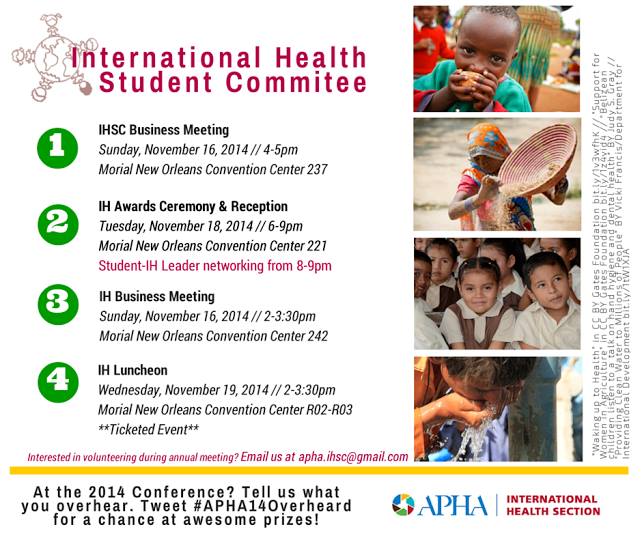
Students, Practice Your Networking Skills at APHA’s 2014 Annual Meeting: Here is How…

Networking can be a daunting task for the young professional, but speaking from experience, it is worth it and a superlative time to perfect this skill-yes, “networking” is a skill- one that you acquire while you are finishing your career as a student.

In today’s professional world, it is becoming less and less about what your resume says and more about who you know. Of course, what you know matters too, but only if you get the interview in the first place. There are many opinions about whether this is a good or a bad thing; regardless it is the reality. In order to make my point I would like to share my personal experiences.

Continue reading “Students, Practice Your Networking Skills at APHA’s 2014 Annual Meeting: Here is How…”

Remembering My Aunt, Dr. Ameyo Adadevoh, Who Stopped Ebola in Nigeria

This blog post originally appeared on the Management Sciences for Health (MSH) blog and was authored by Video Editor Niniola Soleye. This reposting does not convey an endorsement of MSH from the IH Section.

IMG_3074_

L to R: MSH staffer Niniola Soleye and her aunt, Dr. Ameyo Adadevoh 

My aunt, Dr. Ameyo Adadevoh, identified and contained the first case of Ebola in Nigeria.  She paid with her life because the health system was not ready to deal with Ebola.  The system has since caught up, and is today a model for other countries.  But the loss of such a gifted doctor and family anchor is incalculable.

Ebola arrived in Nigeria at a time when doctors at all federal government hospitals were on a labor strike (my aunt worked in a private hospital).  After ongoing negotiations with the government failed to meet their demands, the doctors – desperate to see significant changes in the health system and seeking improved salaries, positions, and titles – reached their breaking point.  So they went on an indefinite strike.

Patrick Sawyer – the index case – left quarantine in Liberia and collapsed at the airport in Lagos, Nigeria.  He was trying to travel to a meeting of the Economic Community of West African States (ECOWAS) in Calabar, Nigeria.

When he arrived at my aunt’s hospital, another doctor diagnosed him with malaria.  My aunt first encountered him during her ward round the following day and once she saw him she suspected Ebola even though she had never seen an Ebola patient before.  She questioned him and he denied being near anyone suffering from the virus but she immediately contacted the Lagos State and Federal Ministries of Health and got him tested.  While waiting for the test results to come back, the pressure on my aunt began.  Liberian government officials (and the patient himself) insisted that she discharge him so he could attend the ECOWAS conference.  She held her ground and resisted his release.  They even threatened to sue her for a violation of human rights (holding him against his will) but she remained steadfast for the greater public good.  Though she didn’t have the proper protective gear or protocols, she created an isolation area in her hospital to continue his treatment and protect her staff.  The patient couldn’t be moved because there was no isolation facility available in Nigeria at the time —the infectious diseases hospital in Lagos wasn’t functional.

The test results came back.  Patrick Sawyer’s Ebola diagnosis was confirmed, and he died in her hospital.

My aunt became ill ten days later and was taken to a makeshift isolation ward that had been set up for all the Ebola cases in the infectious diseases hospital.  The conditions of the facility were so poor that she and other patients were eventually moved to a former tuberculosis ward that had been donated by the USG.

Between the doctors’ strike and the lack of preparedness, the Ebola outbreak in Nigeria could have been a thousand times worse.  My aunt’s actions helped prevent a major spread of the virus across the country.  Because she raised the necessary red flags quickly and refused to discharge the patient, all Ebola cases in Nigeria can be traced to a single path of transmission originating with the index case. That’s no small feat in a country of more than 170 million people.

The events leading to my aunt’s death were a clear result of the larger health system troubles in Nigeria.  That said, today, Nigeria is Ebola-free.  In fact, other countries – including the US – are now looking to Nigeria to share best practices for the response and containment of Ebola.  This demonstrates that the health system eventually did catch up to Ebola, but the response was too late for my aunt and several others who were on the front lines.  If the index patient had ended up in another hospital under the care of another doctor, the delayed response from the health system may have been much more costly.

There are so many lessons to learn from the current Ebola outbreak in West Africa.  For me, the most obvious one is the importance of health system strengthening as a means to not only improve overall quality and access for all, but also to give countries the ability to properly respond to unexpected health challenges like Ebola.  If any of the affected countries had stronger health systems before this outbreak, the number of fatalities would have been significantly reduced.  We must learn from this outbreak and focus on health system strengthening as a crucial part of the rebuilding process.

One of the biggest challenges in the Ebola current outbreak is a shortage of health workers.  The high fatality rates in this Ebola outbreak reflect that.  Health workers at all levels of a health system need to be properly supported, incentivized, and protected.  They shouldn’t have to go on strike in order to improve their health systems so they can provide higher quality care.  My aunt and the more than 200 other health workers in West Africa who also lost their lives in the battle against Ebola shouldn’t die in vain.

I’m so proud that MSH is developing a solid short-term and long-term response to the Ebola outbreak in West Africa.  As part of my role at MSH, I’m supporting the Ebola response team and I see that as my way of continuing my aunt’s legacy through my job and helping to prevent other families from experiencing what my family has gone through in the last two months.

For me, the inability of the Nigerian health system to adequately prepare and quickly respond to the Ebola outbreak was an agonizing, first-hand example of the need for MSH and it reinforced the importance of the work we do.  My aunt’s death is still very painful but it comforts me to know that I am part of an organization that’s truly committed to saving lives (in everyday practice, not just in theory) and is dedicated enough to step into a crisis situation and mobilize the expertise and resources that are so desperately needed.

Students, Find Your Tools to Address Global and Environmental Health Issues!

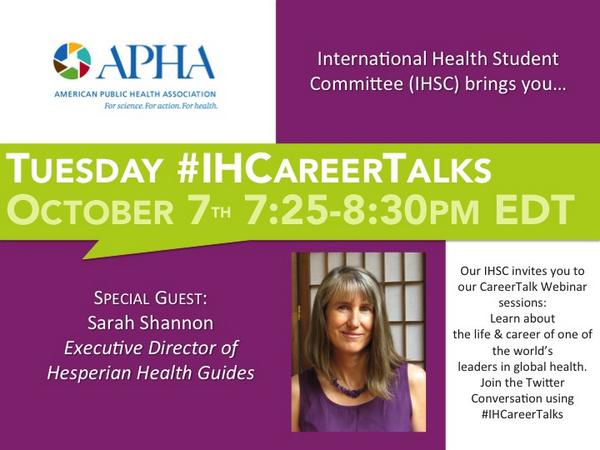
Environmental health issues are present in our everyday lives, and I am committed to improving the environment in which we live, globally. Most recently, I realized that in order to make a difference on environmental issues, all I need are simple tools. This realization inspired me to become involved with APHA’s International Health Student Committee (IHSC). In this committee, I can promote and increase awareness about important international health issues including, environmental health, among students interested in the field. To accomplish these goals, I use tools such as advertising and blog-writing. I help design flyers to advertise IHSC’s initiatives, some of which include educating students on how to address environmental health issues through our CareerTalk series. I am writing this blog to encourage you to attend our upcoming webinar! Continue reading “Students, Find Your Tools to Address Global and Environmental Health Issues!”

Announcing APHA International Health Section Election Results

The following announcement is from Amy Hagopian, the IH Section’s Nominations Committee Chair.


Dear International Health Section members of APHA,

As your nominating committee chair, it is my pleasure to announce APHA has finally, at last, announced the winners of the APHA’s International Health Section election!

I am very very grateful to everyone who agreed to run for these offices. It’s not a democracy unless there is more than one candidate for a position.

As I told the candidates, everyone who ran this time but did not succeed will be an excellent candidate for a position in the next election. Please welcome all our candidates at the next business meetings in New Orleans, as we all work together to strengthen the section.

Paul Freeman will chair the proceedings at our upcoming meeting in November in New Orleans. He will be succeeded by Omar Khan at the end of the meeting. At that time, Laura becomes the chair-elect and Paul becomes the past chair.

For the coming meeting, the following individuals are our section councilors: Jessica Keralis and Michelle Odlum (whose terms end November 2016), Jaya Prakash and Lenee Simon (whose terms end November 2015), and Sosena Kebede and David Fitch (whose terms end November 2014). David Fitch and Sosena Kebede will be replaced by Mark Strand and Christopher Ibanga at the end of the 2014 meeting.

For the coming meeting, the following individuals are our section governing councilors: Laura Altobelli, Gopal Sankaran, Carol Dabbs, Malcolm Bryant, Peter Freeman (all of whose terms end at the end of the meeting this year) and Ramin Asgary (whose term ends November 2015). Laura and Peter will be replaced by Oscar Cordon and Caroline Kingori. Only 3 consecutive terms are allowed, so my records show this is Gopal’s last term until he has a 2-year retirement.

All members are encouraged to get involved in these committees and working groups. Contact the chairs today to find out about meetings scheduled in New Orleans.

Working groups:
Community-based primary care (Elvira Beracochea & Laura Parajon, Elvira@midego.com)
Pharmaceuticals (Maggie Huff-Rousselle, mhuffrousselle@ssds.net)
Trade and Health (Mary Anne Mercer, mamercer@uw.edu)
Global Health Connections (Jaya Prakash, Jayadoc21@gmail.com, and Theresa Majeski, theresa.majeski@gmail.com)
Maternal and Child Health (Laura Altobelli, laura@future.org)
Systems science for Health systems strengthening (Robert Swanson, swancitos@gmail.com; Kaja Abbas, kaja.abbas@gmail.com)
Climate Change (Hala Azzam, hala_azzam@yahoo.com, and Christine Benner, Christine-Benner@ouhsc.edu, and Rose Schneider, RoseSDC@aol.com)
US Border Initiative/PAHO (Josefa Ippolit-Shepherd, ippolitoshepherdj@yahoo.com)

Organizational committees:
Program committee (Mini Murthy, Minimurthy@aol.com)
Communications committee (Jessica Keralis, jmkeralis@gmail.com)
Membership and students (Rose Schneider, rschneider@jhu.edu)
Policy and Advocacy (Peter Freeman, pffreeman@gmail.com)
Awards (Gopal Sankaran, gsankaran@wcupa.edu)
Nominating committee (Amy Hagopian, hagopian@uw.edu)

There are also members of the section who assume organization-wide responsibilities. These include Len Rubenstein (Action Board), Mary Anne Mercer (Trade & Health), Elvira Beracochea and Len Rubenstein (International Human Rights committee), Amy Hagopian (Publications board), and Omar Khan (Science board).

Thanks again to all our candidates for running.

Students, You Should Go Abroad Too!

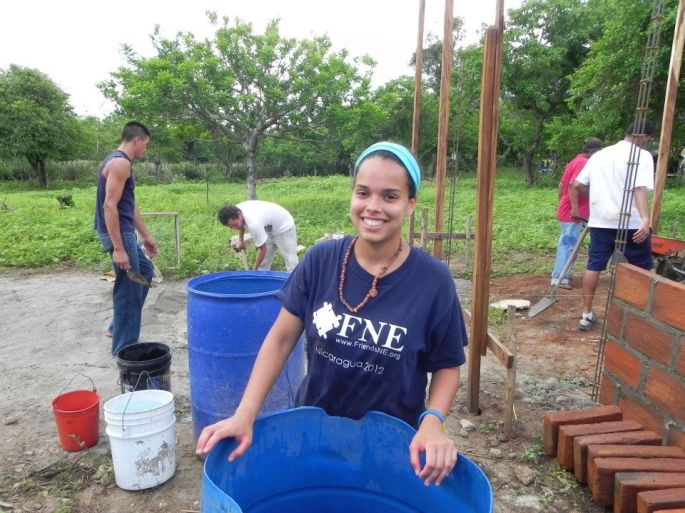
Leaving your comfort zone is one of the hardest, yet most rewarding experiences you can have. It was for me. During my undergraduate years, I spent three consecutive semesters studying abroad in Spain and Chile fulfilling my Spanish & Latin American Literature and Culture major. I realized the importance of expanding my horizons, gaining a multicultural perspective of the world and becoming more culturally competent. As a public health graduate student, my travels to Latin America took a global health perspective. My mind was once again exposed to another side of the world that we often miss while secluded in our comfort zones. In Central and South America, I volunteered on heath initiatives and sustainable development projects, and conducted research. I witnessed numerous global health disparities including lack of sanitation, children living in homes made with plastic walls and dirt floors, and physicians striving to provide quality reproductive care to low-income, immigrant women at a family planning clinic with scarce resources.

My ultimate goal is to become a primary care physician to help reduce health disparities globally. Going abroad was one step towards that goal.

Continue reading “Students, You Should Go Abroad Too!”