
World Heart Day 2018

Today, September 29, marks World Heart Day (WHD) around the world. World Heart Day brings awareness to the prevention and control of cardiovascular diseases (CVDs) which plays a significant role in our daily lives contributing to our overall health and wellness.

What are Cardiovascular diseases?

Cardiovascular diseases are a group of disorders of the heart and blood vessels and they include:

  • Coronary heart disease – disease of the blood vessels supplying the heart muscle;
  • Cerebrovascular disease – disease of the blood vessels supplying the brain;
  • Peripheral arterial disease – disease of blood vessels supplying the arms and legs;
  • Rheumatic heart disease – damage to the heart muscle and heart valves from rheumatic fever, caused by streptococcal bacteria;
  • Congenital heart disease – malformations of heart structure existing at birth;
  • Deep vein thrombosis and pulmonary embolism – blood clots in the leg veins, which can dislodge and move to the heart and lungs.

According to the World Health Organization (WHO), cardiovascular diseases take the lives of 17.7 million people every year, and accounts for 31% of all global deaths. Of these deaths, 85% are due to heart attack and stroke.

Projects around the world

The global fight against CVDs is happening throughout the world. Some examples include:

– Through the HEARTS project based in Manila, Philippines, WHO and partners like the United States Centers for Disease Control and Prevention (CDC), are supporting ways to fight cardiovascular disease through training, planning and implemention.

– A two-year Standardized Hypertension Treatment project launched in 2015 by the Pan American Health Organization (PAHO) and CDC on the Caribbean island of Barbados, enacted a mission to improve hypertension treatment and control among Barbadians with raised blood pressure through standardizing care for hypertensive patients, prescribing and making available the most effective medicines for treating each person’s condition. The principal investigator of the project highlighted, “It was also encouraging to see the cultural and behavioural change in the clinics among health workers who had to deliver a more focused form of care.” It is important to also note how cultural and social factors play a vital role to behavioral change when it came to seeing patients achieving satisfactory blood pressure control.

Specific intervention activities included: (1) Developing salt reduction and tobacco control plans, (2) Implementing simplified and standardized management protocols, (3) Improving access to medicines and technologies, and (4) Building capacities of health and other providers.

http://www.who.int/news-room/feature-stories/detail/treating-cardiovascular-disease-in-barbados

http://www.who.int/news-room/feature-stories/detail/philippines-embraces-efforts-to-step-up-cardiovascular-disease-care

Key messages to protect heart health

There are small, yet very impactful ways to make “heart health at the heart of all health”. Here are some facts/tips!

  • Tobacco use, an unhealthy diet, and physical inativity increase the risk of heart attacks and strokes.
  • Engaging in physical activity for at least 30 minutes every day of the week will help to prevent heart attacks and strokes.
  • Eating at least five servings of fruit and vegetables a day, and limiting your salt intake to less than one teaspoon a day, also helps to prevent heart attacks and strokes.

When it comes to reducing cardiovascular diseases and improving heart health, it is pivotal to identify those individuals with or at highest risk of CVDs due to risk factors such as hypertension, diabetes, hyperlipidaemia or an already established disease to ensure they receive appropriate treatment in order to prevent premature deaths. During 2015, 17 million premature deaths occurred from noncommunicable diseases (under the age of 70) with 82% of deaths reported in low- and middle-income countries, and 37% caused by CVDs (WHO, 2017). Although there has been great strides toward the prevention of cardiovascular diseases, inequalities including access to noncommunicable disease medicines, and basic health technologies in all primary health care facilities is essential to those in need of receiving treatment and education.

The epidemic of cardiovascular diseases has also impacted my life with my grandmother,mother, and all 4 of my aunts and uncles suffering from hypertension. In March 2018, my cousin at the age of 35 suffered from a massive stroke and is successfully recovering. I spent bringing awareness to this day by cooking popular caribbean dishes with a healthy spin and educating family and friends across the United States and Caribbean on the importance of having and maintaining a healthy heart. In addition, I took a 2 mile walk through my neighborhood taking in the beautiful Florida scenery and cool breeze.

How did you celebrate World Heart Day?
 

Food for thought: can Meatless Monday save the planet?

World-renowned researchers, physicians, government officials, and industry leaders are meeting today in Berlin to discuss the state of global health.  Amidst presentations and discussions about non-communicable diseases, global health security, and priority issues in conflict zones, the attendees of the World Health Summit will gather together to break bread.  The menu might look a little different this year, as the Summit will jump on the Meatless Monday bandwagon.

The brainchild of Sid Learner, in partnership with Johns Hopkins Bloomberg School of Public Health, Meatless Monday was established in 2003 to reduce reliance on red meat, improve chronic disease, and protect the environment.  Meatless Monday is now active in 44 countries – from Bhutan to Togo.

Could wider adoption of Meatless Monday or less reliance on meat as a diet staple prove a boon for food scarcity, health, and reduction of green house gases?  When so much of the world suffers from malnutrition, is this fad a luxury or a necessity?

The ills of large-scale factory farming are well established.  These facilities, known in the US as concentrated animal feeding operations (CAFO), can each produce up to 1.6 million tons of manure a year, more waste than a U.S. city.  Unlike human waste infrastructure, there is no mandated system for the storage or sanitization of animal waste which can be rife with E. coli, antibiotics and other hormones, animal blood, and organic and inorganic compounds dangerous to human health.  Improper or overextended systems for storing untreated manure can cause run off or leaching into ground water.  Degrading animal waste can also affect local air quality and attract insects.

It isn’t just the immediate health effects of factory farming – such as increased incidence of childhood asthma in communities near CAFOs – but the cumulative effects that contribute to global warming.  A 2006 report of the Food and Agricultural Organization of the United Nations found that CAFOs deleterious outputs could account for 18% of global emissions.  The list is literally and figuratively exhaustive: from the methane gas emitted from the aforementioned manure, the oil used to transport carcasses to processing plants and on to stores, the electricity used to keep the meat cool, and the emissions and energy needed to harvest the crops that feed the livestock and pumps for water.  Dig a little deeper and consider, as suggested by two World Bank Scientists, the following:

Should you include all the knock-on emissions from clearing forests? What about the fertiliser used to grow the crops to feed to the animals, or the emissions from the steel needed to build the boats that transport the cattle; or the “default” emissions – the greenhouse gases that would be released by substitute activities to grow food if we were to give up meat? And is it fair to count animals used for multiple purposes, as they mostly are in developing countries, from providing draught power to shoe leather or transport, and which only become meat once they reach the end of their economic lives?

All told, these activities add up to 32.6 billion tons of carbon dioxide annually, or 51% of global greenhouse gas emissions.  Even at its lowest estimate of 15%, greenhouse gas emissions from livestock are equal to exhaust emissions from every vehicle – plane, train, and automobile – in operation today.

How much less meat would we need to eat to keep rising temperatures below the 2-degree Celsius mark that could spell big trouble for life as we know it?  Industrialized countries currently consume more than twice the amount of meat considered healthy.  Americans eat three times as much.  While meat consumption in developing countries is a fraction of those listed above, an increased call for meat has been seen as countries become more urban.   Meat consumption in developing countries has tripled compared to developed nations in recent decades.

While the simple solution is to eat less meat, the type of meat might also be important.  Raising beef requires nearly 30 times more land and 11 times more water than pork, chicken, dairy or eggs.  Three staple crops – potatoes, wheat, and rice – require up to six times fewer resources than pork, chicken, dairy or eggs.

If industrialized countries were to consume less red meat, global malnutrition could be addressed. Only 55% of the world’s crops feed people, the rest are reserved to feed livestock or to make biofuel.  The conversion of calories from grain to meat leaves much to be desired.  One hundred calories of grain produce a mere 3 calories of beef.  Just switching from grain-fed beef to pasture-raised beef, chicken, pork, eggs, and dairy products could free up much more food to feed the world.

It may be that time is running out to make smarter food choice before climate change makes the decision for us.  Currently, 4% of global croplands experience drought each year but could reach as high as 18% by the year 2100.  Even at the current rate, droughts have the capacity to devastate regions and industries.  A recent study found that an extra 500,000 deaths will be attributable to a decrease in nutrient-rich food in 155 world regions by the year 2050.  Rather than malnutrition related to caloric intake, these deaths will be due to lack of vitamins from fruit and vegetables. The majority of these deaths will likely occur in already impoverished countries of Asia and Africa.

If you are reading this blog, you can probably afford to have some lentils or a nice vegetarian burrito for dinner.  While you sup, feel free to check out these great articles by Maryn McKenna.  The first imagines a world without antibiotics – a huge issue especially as it pertains to the food industries over-use. The second examines a Dutch company that is mass producing antibiotic-free boiler hens.

Global Nutrition-A report Card

The 2016 Global Nutrition Report, a report that assess progress towards global nutrition targets as set by the World Health Assembly,  was released in June. This annual report is the result of a comprehensive review of state of nutrition by an independent, collaborative initiative that involves a diverse set of partners.

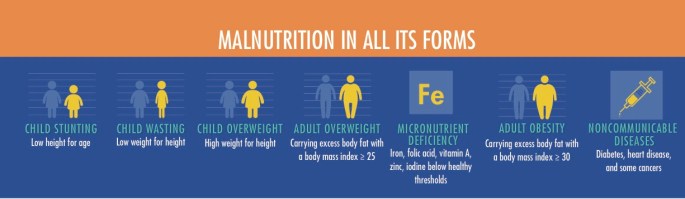
According to the latest report a staggering one in three of us suffers from malnutrition. Malnutrition is defined as “lack of proper nutrition, caused by not having enough to eat, not eating enough of the right things, or being unable to use the food that one does eat.” The one in three number reflects a spectrum of malnutrition ranging from childhood stunting and wasting to adult overweight and obesity. Malnutrition is the number one driver of global disease burden and its occurrence tends to have a cascading effect.

Malnutrition 1Image Source: Global Nutrition Report 2016, p 21.
In the last five years or so, there has been traction and investment into ending malnutrition. The global nutrition targets for 2025 set by the World Health Assembly include:

  • Achieve a 40 percent reduction in the number of children under 5 who are stunted
  • Reduce and maintain wasting in children under 5 at less than 5 percent
  • Experience no increase in overweight in children under 5 years
  • Experience no increase in obesity and diabetes (in adults and adolescents)
  • Achieve a 50 percent reduction of anemia in women of reproductive age
  • Achieve a 30 percent reduction in low birth weight
  • Increase the rate of exclusive breastfeeding in the first 6 months up to at least 50 percent
  • Achieve a 30 percent reduction in average population salt intake

According to the report there is significant variations between countries in the status of meeting the global targets. Many countries have made great progress and are on track to reducing under-5 stunting wasting, and overweight, and exclusive breastfeeding of infants younger than 6 months old. Of particular importance are data that show that under-5 stunting is decreasing in most regions except in Africa and the number of children under-5 who are overweight is increasing in Asia. Despite this success, the report points out that nearly all countries are off course with respect to global targets related to reducing anemia in women and adult overweight and obesity.

The calls to action issued by the authors of this report include:

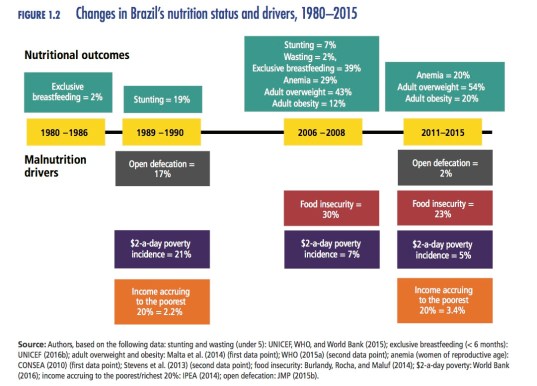
  1. Governments making a commitment to end all forms of malnutrition; dramatic reductions in malnutrition in Brazil, Ghana, Peru and Maharashtra (Indian state) were due to political choices that were made.

Malnutrition 2
Image Source: Global Nutrition Report 2016, p 33.

  1. Invest more, allocate better”: Current spending is not enough to tackle malnutrition. According to the report  government spending and funding from donors are low and remain stagnated.
  1. Collect right data: Countries must strive to fill national and subnational data gaps to understand their unique nutrition contexts that would help them act on it by maximizing investment.
  1. Support evidence-based solutions and identify new solutions: Countries could learn from successes and use proven policies and interventions to tackle malnutrition.
  1. Address all forms of malnutrition: Curbing the rise of dual burden of undernutrition and obesity (and other nutrition-related NCDs) in many low and middle income countries would require policies, strategies and interventions that can take on the double-duty of tackling all forms of malnutrition.

Given the large numbers of refugees and internally displaced people, the report does discuss the vulnerability of this group to food insecurity and malnutrition. The authors also call for better assessment of nutritional status in emergency settings, incorporating nutrition-sensitive interventions and improved accountability of nutrition actions in emergency contexts.

The report does not discuss malnutrition among the elderly or the complete lack of data that would be helpful in understanding the magnitude of this problem. What the report is also missing or perhaps not within its scope, is the importance of maintenance of agro-biodiversity in combating malnutrition. The loss of biodiversity and its impact on providing better nutrition for today and tomorrow is something that cannot be ignored.

You can read the report in its entirety here and let us know what you think!

‘Sure Start’ in India Mobilises Communities for Maternal and Neonatal Health

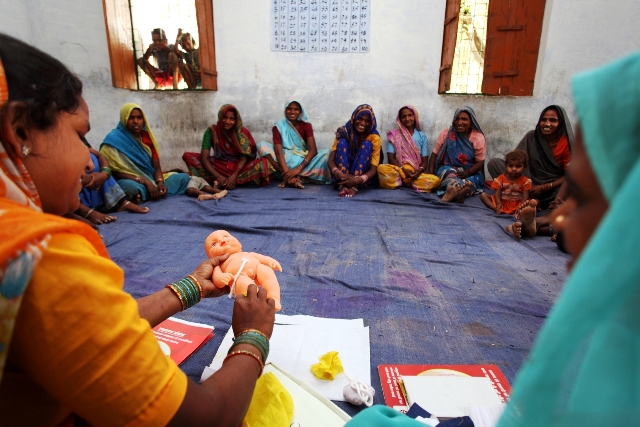
Expecting mothers and their mother-in-laws learn about how to safely sever the umbilical cord of a newborn at a Sure Start facilitated Mothers’ Group Meeting in Sabji Village, Rae Bareilly District, Uttar Pradesh, India

By Tania Lal

A report by UNICEF India in January 2009 found that about a million neonatal deaths occur in the country each year. Uttar Pradesh (U.P.) has the largest population of any state in India and continuing problems with neonatal mortality. In an effort to tackle this problem PATH India with funding from the Bill and Melinda Gates Foundation has initiated Sure Start, a five year project that works with a population of roughly 25 million. The program is described on our website at http://www.path.org/projects/sure-start.php.

A major contributor to these death rates is the lack of literacy and awareness that exists in the rural areas of the country. For example, the benefits of immediate and exclusive breastfeeding are not well understood. For this purpose Sure Start in U.P. works with  community health workers and facilitates the functioning of village health and sanitation committees. Continue reading “‘Sure Start’ in India Mobilises Communities for Maternal and Neonatal Health”

Failed Leadership of the Health Sector in Addressing the 2008 World Food Crisis

By Charles Teller

Where have international nutrition and health sector leaders been during this serious 2008 crisis of spiraling food crises that are worsening food and nutrition insecurity among the most vulnerable in the world?

At a lively, standing room only session (#3302) on the 2008 Global Food Crisis Monday at the APHA meetings, the 4 panelists and moderator agreed that it was much more than a crisis. It reflected a longer term structural and systems issue related to food poverty, international trade, climate change, energy and environment. Case studies on India and Ethiopia helped to contextualize the intra-country discrepancies in undernourishment, stunting and wasting.

On my Ethiopian case, I contrasted the apocalyptic press statements in September 2008 of the UN ( FAO, WFP,Humanitarian Affairs) with my Oct. 20th interview with the well-informed Minister of Health of Ethiopia who felt that overall high inflation and energy costs, as well as drought, were more serious shocks  to health and nutrition of his people.  In presenting the long and short-term trends in food access and malnutrition in Ethiopia, I found that this discrepancy in information reflects the lack of representative and reliable data on the evolution of the situation, causes and immediate effects. Continue reading “Failed Leadership of the Health Sector in Addressing the 2008 World Food Crisis”