
Future of Conflict Minerals murky under Trump administration

You’ve likely heard the term “blood diamonds.”  Also known as “conflict diamonds,” these precious stones have helped fund civil wars and contributed to some 3.7 million deaths in Angola, Sierra Leone, and the Democratic Republic of Congo (DRC) according to an Amnesty International report.

The term “conflict minerals” doesn’t have quite the same ring, nor a titular film starring Leonardo DiCaprio, but they are at the center of a recently leaked memo from the White House.  The memo seeks to dismantle the Conflict Minerals Rule in the 2010 Dodd-Frank Wall Street Reform and Protection Act.  Under Dodd-Frank, companies had to disclose whether or not their products contain minerals mined in the Democratic Republic of Congo or a neighboring country.  The reason to withdraw this clause that valued human life over electronics?  Perceived job loss and costs to American companies, estimated at $3-4 billion in upfront compliance costs and $200 million annually thereafter.

What is life like for the miners of conflict minerals – tin, tantalum, tungsten, and gold ore – in the Democratic Republic of Congo and neighboring countries?  The Guardian reports a systematic web of sexual violence, kidnapping, child labor, and modern-day slavery.

An overwhelming abundance of human suffering all so we can play Bejeweled on an almost dizzying array of devices.  Tech giants, Apple and Intel, have spoken out against the repeal of the Conflict Minerals Rule, but fear that enforcement will be difficult without written law.  Human rights groups representing some 100 organizations in and around DRC have also spoken out against repeal of the Rule:

Thanks to the Dodd-Frank Act, Eastern DRC has to date more than 220 certified green mining sites, more than 300 mining police officers trained and deployed to secure mining sites,an independent audit mechanism, and a regional certification system. These advances undoubtedly contribute to reducing the rate of crime and human rights violations, including rape of women and exploitation of children in mining areas. All these efforts and progress will be destroyed if the US Government decides to contradict itself by repealing the Dodd-Frank Act.

It isn’t just Big Business that has taken a hit under the Conflict Minerals Rule.  A healthy dose of criticism cites that the Rule has actually made miners and their families in DRC poorer.  In many ways, the implementation of the Rule slowed down, or stopped, mining due to implementation issues of the government and business variety.  Millions, out of work, were left between the proverbial rock and the hard place: either face starvation or join the militias that the very Rule were designed to protect them against.  Closing of mines is felt throughout communities:

With less money flowing in, shops in Luntukulu have closed. Many people struggle to feed their families through farming. “If Obama’s law wasn’t signed, the ban would not have existed,” said Waso Mutiki, 41, president of the miners’ co-operative in Luntukulu. “It destroyed everything.

Others who contest the Rule say that the it does not acknowledge or alleviate deeply systemic issues afflicting the region, such as in this open letter signed by academics, politicians, and civil society professionals:

First, while the minerals help perpetuate the conflict, they are not its cause. National and regional political struggles over power and influence as well as issues such as access to land and questions of citizenship and identity are just some of the more structural drivers of conflict. The ability to exploit and profit from minerals is often a means to finance military operations to address these issues, rather than an end in itself.

The authors of the open letter above offer some alternative strategies which seek to buoy the economy by incentivising better practice and fair competition for international and Congolese businesses. Dollar for dollar, the Democratic Republic of the Congo is one of the richest countries in the world when it comes to untapped mineral resources.  The people who seek to own that wealth and exploit its potential are many, and unfortunately, Congolese citizens and their communities are not among those to first reap those benefits.

So, what is the bottom line?   Some might say the Conflict Minerals Rule sees the forest but not the trees, doing significant damage to local economies and livelihoods despite the progress made by eliminating a driver of local conflict.  It serves as yet another example of the need for policies to be developed and refined with community feedback. A globally engaged U.S. administration might attempt to build on the successes of the Rule with foreign and trade policy that takes such feedback into account. But the current administration seems to have different priorities. Rather than approaching policymaking in a way that benefits the communities most heavily impacted, or even that takes into account the expectations of American consumers, President Trump fights for the common man…the average, American CEO:

Government and community collaboration are key in achieving meaningful reform. Whether or not the U.S. Administration will take part in that exchange remains to be seen.

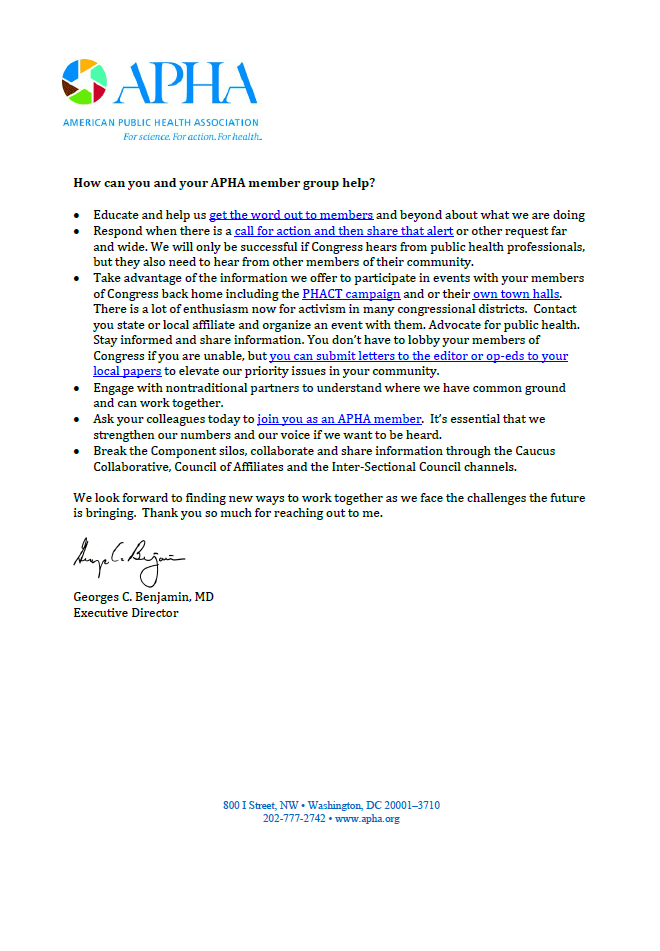
Dr. Georges Benjamin responds to APHA members and Section Leaders

Read Dr. Georges Benjamin’s response to our open letter and learn how you can be involved in public health advocacy efforts:

page 1
Page 1
page 2
Page 2

The Time to Advocate for Public Health is Now

APHA’s Government Relations staff recently hosted a webinar discussing APHA’s current advocacy priorities and how APHA members can get more involved with advocacy efforts to help advance and protect public health.  

In this challenging political climate, the need to advocate for public health could not be more urgent. Regardless of which public health issue you want to advocate for, the time to be an advocate is now. As public health experts, it is our duty to help inform not only our elected officials but also the general public about the vast number of public health challenges facing our world today.

Below are a handful of ways you can get involved:

  • Meet with your elected officials in Washington, DC or in your state. For tips and materials you can bring with you, click here.
  • Sign up to receive legislative updates and advocacy alerts on the APHA website.
  • Send a quick action alert message to your legislators through APHA’s Take Action! website.
  • Call your congressperson via the Capitol switchboard at 202-224-3121.  
  • Attend a town hall or constituent meeting near you. Here are some tips on how to ask questions in a public forum.
  • Submit an opinion piece or a letter to the editor to your local paper. For a template letter or technical assistance, email mediarelations@apha.org.
  • Share articles and your opinions via social media and other communication channels to help educate your friends, family, and the general public. We encourage you to tag the IH section in your Facebook and Twitter posts on global health advocacy so we can share them with our followers.
  • Volunteer for the IH Section’s Advocacy/Policy Committee to assist with drafting Section policy proposals and contribute to goals and strategies to engage Section members in global health advocacy work. Email Kevin Sykes for more information.
  • And last but not least, consider lending your voice as a contributor to the APHA IH blog. Email ihsection.communications@gmail.com for more information.

The APHA website contains extensive resources to help you in your advocacy efforts. For more information, click here.

During the webinar, we were reminded that even though a legislator’s job is to do what’s best for this nation and its people, elected officials also depend on you to get re-elected. A Representative gets elected every two years and a Senator every six. As you can see in the graph below, your influence can make a difference.

abouteffectiveness_0

Source: Communicating with Congress, Perceptions of Citizen Advocacy on Capitol Hill 

———-

Learn more about this year’s Public Health Action (PHACT) campaign priority issues:

The Dire State of Reproductive Rights Worldwide

Each day, an estimated 830 women die of preventable causes related to pregnancy and childbirth. Disproportionately affected are adolescent girls and women living in rural and impoverished areas. Providing women with universal access to family planning is one important and cost-effective way to help reduce maternal deaths. Doing so would decrease maternal deaths by a third. In developing countries, investing in family planning would lead to 2.4 million fewer unsafe abortions (one of the top causes of maternal deaths worldwide according to the WHO) and 5600 fewer maternal deaths related to unintended pregnancies. In addition, it would decrease infant mortality by anywhere from 10 to 20%.

Availability of family planning services has clear benefits in protecting the health of women and children, but it also offers so much more than that. When women can plan the timing and spacing of their pregnancies, women are more likely to attend and finish school; achieve higher levels of education; gain access to better job opportunities; contribute positively to her community; and improves the chances that she will invest in her children’s health, education, and well-being. In short, when women do better, societies do better.

This is all at grave risk now. As part of Trump’s first executive order, he reinstated the global gag rule which when implemented, states that the US can withhold family planning foreign assistance to any foreign non-governmental organization that so little as provides information on abortions, and that’s even if the organization receives funding from other sources. It’s important to note that the US already prohibits any foreign assistance from funding abortions under the Helms Amendment, which has been in place since 1973.

The re-enactment of the global gag rule comes as no surprise, as historically it has been re-enacted by every Republican president since Reagan then overturned by every Democratic president. Ironically although it has been argued that the gag role was put into place to decrease the number of abortions, a Stanford study found that abortions actually increased in years that the gag rule was in effect. It has also been shown that cutting off family planning funding to these organizations severely limits and in some cases, completely ceases, their ability to provide contraceptives and reproductive health services, thus increasing unintended pregnancies and unsafe abortions and further worsening maternal health outcomes.

The newest reinstatement of this rule however, extends far beyond the scope of the original rule and withholds all US global health assistance, not just family planning foreign assistance, to organizations that perform or provide any counseling, referrals, information, or advocacy on abortions. This revision of the global gag rule will not only hurt the millions of women in some of the poorest areas of the world who heavily rely on US-funded organizations which provide family planning services like contraception, but now impacts vulnerable men, women, and children alike. That’s because many of these organizations provide so much more than reproductive health services. Many of these organizations are hospitals and clinics, which in addition to reproductive health services, provide the full spectrum of medical care including life-saving childhood vaccinations, treatment for survivors of gender-based violence, HIV prevention and care, prenatal and postnatal care, and play a vital role in preventing the spread of infectious diseases like Zika and Ebola.

This is an unprecedented setback for the global health community and a huge threat to the advances that we have made in the fight against emerging infectious diseases, HIV/AIDS, and maternal and child mortality to name a few. We cannot let the progress we’ve worked so hard for be eradicated. Let us always remember that progress is something we must work for everyday, a call to action that is becoming more imperative in the precarious times ahead of us.

———–

US support for family planning foreign assistance currently stands at $575 million to 40 countries. With the institution of this new rule, $9 billion of global health assistance to 60 countries is currently at stake.

Here are a few ways to get involved:

Read APHA’s statement opposing reinstatement of the global gag rule.


CIT: a solution for police interaction with the mentally ill

Eight hundred and ninety-six people have been killed by police in the United States since January 1st.  I have had to update the total each morning as I wrote this post.  That boils down to 88.6 people per month.  Were this rate to continue, we’ll fall just short of 2015’s total of 1,146 fatal police shootings.  How does the U.S. compare to other countries?  England and Wales have experienced 55 fatal police shooting in the last 24 years.  Fifty-nine people were killed in the U.S. in the first 24 days of 2015.  Iceland, ranked 15th globally for gun ownership per capita, had one fatal police shooting in 2013, the first since it gained independence in 1944.

In the U.S., hardly a day goes by without a fatal police shooting.  The stories that make the nightly news and overwhelm our Facebook and Twitter feeds depict white cops shooting black men.  These shootings have fanned the flame of civil unrest in cities like Ferguson, Missouri and led to the formation of the Black Lives Matter movement.  In a recent article, Harvard economist Roland G. Fryer Jr. found no evidence of racial bias in police shootings.  Highlights of the study, culled from thousands of reports from 10 police departments in California, Texas, and Florida, found that while minorities are much more likely to be targeted by police and subject to unwarranted stops, frisks, and physical restraints, race was not a motivating factor in fatal shootings.

These findings echo an analysis based on data from the U.S. and Australia.  Researchers found that 1 of every 291 stops or arrests ends in injury or death, but minorities and whites face the same risk.  Both studies got at least one aspect correct.  White people are killed by police officers in large numbers.  Per the Guardian’s definitive record of police shootings, The Counted, 584 of those 1,146 killed in 2015 were white.  One hundred and five were unarmed.  Comparatively, 306 were Black, 79 unarmed.

Those numbers are comparable until adjusted for population.  Per the 2010 U.S. Census, there are approximately 200 million white people compared to 40 million Black.  Do the math and you will find that Black people are about 2.5 times more likely to be killed by police than white people.  Stories in the Washington Post and Vox corroborate and further debunk the source article’s claims:

For one, the study is looking at a very limited pool of police departments in terms of shootings: 10 jurisdictions in three states in the first data set, and just Houston in the second data set. The study even acknowledges that there are questions about whether the data is nationally representative.

Worse, the data runs into a big problem with selection bias. For police shootings, the researchers looked at data that police departments gave up willingly. A few, including New York City, didn’t hand over their shooting data to the researchers. It’s possible the police departments that refused did so because their data would confirm racial biases. We just don’t know.

This all leads to today’s video, a twist on the all-too-common theme.  This is the story of Charles Kinsey, a Black behavioral therapist, who was shot while attempting to deescalate a situation involving an autistic client.

If you question why police guns were trained on Charles Kinsey while he worked, you must also ask why they were pointed at a young, autistic man in distress.  The answer is as simple as it is maddening.  Despite what the media reports, the mentally ill and disabled are likely the population most subject to police shootings.

In the case of Charles Kinsey, the bullet that struck his leg was meant for his autistic charge.  Police responded to a 911 call that placed Kinsey and Arnaldo Eluid Rios in the road.  The caller cautioned the police about a possible weapon, what turned out to be a toy truck, in Rio’s possession.  When police arrived, Kinsey assumed the position while he attempted to convince Rios to lie on the ground.  Despite Kinsey’s pleas for the police not to shoot as he worked to deescalate the situation, an officer fired.  A statement by the officer’s lawyer affirms his intent:

This was not an accidental discharge.  This was a very real perceived threat to the officer — and it simply missed the mark. He had a fear the Mr. Kinsey was going to be killed.

While this story gained national attention, at its heart, the fatal police shootings of people with mental illness or a disability are far too common and under-reported.  Depending on the source, one-quarter to one-half of all police shootings involve a mentally ill or disabled victim.

The vast majority were armed, but in most cases, the police officers who shot them were not responding to reports of a crime. More often, the police officers were called by relatives, neighbors or other bystanders worried that a mentally fragile person was behaving erratically, reports show. More than 50 people were explicitly suicidal.

After the widespread closure of state-funded mental health facilities and an inadequate infrastructure to treat veterans with PTSD and traumatic brain injuries, police have become front-line mental health workers with little to no training.  A recent study by the Police Executive Research Forum found that cops-in-training receive 60 hours of gun handling instruction, compared to 8 hours of training to respond to the needs of the mentally ill or crisis deescalation.

A late-breaking policy statement adopted at the recent American Public Health Association’s Annual Meeting speaks directly to this conflict and asks public health workers and government agencies to work together to reverse the frightening trend:

LB-16-02 Addressing law enforcement violence — In the context of violent and sometimes lethal encounters between law enforcement, people of color and people in marginalized communities, calls for a public health strategy for preventing law enforcement violence that has four main elements: decriminalization; robust police accountability measures; increased investment in racial and economic equity policies; and community-based alternatives for addressing harms and preventing violence and crime. Urges the U.S. Council of State and Territorial Epidemiologists to work with fellow public health experts to create surveillance protocols for law enforcement-related injuries and deaths. Calls on Congress to fund research on the health consequences of police violence, and encourages federal, state and local officials and law enforcement agencies to engage review of those law enforcement agencies’ policies and practices and eliminate those that lead to disproportionate violence against specific populations. Calls on government to reverse the militarization of police and on officials at all levels to fund community-based violence prevention programs.

One such violence prevention program is Crisis Intervention Training (CIT).  CIT is a program that brings law enforcement, mental health providers, hospital emergency departments, and individuals with mental illness and their families to improve responses to those in crisis.  After an investigation by the U.S. Department of Justice found that Portland (Oregon) Police Bureau had used excessive, occasionally lethal force, when dealing with the mentally ill, officers enrolled in CIT.

“It’s really about a culture shift,” said Lt. Tashia Hager, who heads the unit that coordinates the department’s mental health response.  In the past, she said, officers were taught, “If you do this, I’m going to do that.” Now they are encouraged to question whether “that” is really necessary.

To check out CIT at work, watch this video about the Memphis Police Department that pioneered CIT.