Announcing APHA International Health Section Election Results

The following announcement is from Amy Hagopian, the IH Section’s Nominations Committee Chair.


Dear International Health Section members of APHA,

As your nominating committee chair, it is my pleasure to announce APHA has finally, at last, announced the winners of the APHA’s International Health Section election!

I am very very grateful to everyone who agreed to run for these offices. It’s not a democracy unless there is more than one candidate for a position.

As I told the candidates, everyone who ran this time but did not succeed will be an excellent candidate for a position in the next election. Please welcome all our candidates at the next business meetings in New Orleans, as we all work together to strengthen the section.

Paul Freeman will chair the proceedings at our upcoming meeting in November in New Orleans. He will be succeeded by Omar Khan at the end of the meeting. At that time, Laura becomes the chair-elect and Paul becomes the past chair.

For the coming meeting, the following individuals are our section councilors: Jessica Keralis and Michelle Odlum (whose terms end November 2016), Jaya Prakash and Lenee Simon (whose terms end November 2015), and Sosena Kebede and David Fitch (whose terms end November 2014). David Fitch and Sosena Kebede will be replaced by Mark Strand and Christopher Ibanga at the end of the 2014 meeting.

For the coming meeting, the following individuals are our section governing councilors: Laura Altobelli, Gopal Sankaran, Carol Dabbs, Malcolm Bryant, Peter Freeman (all of whose terms end at the end of the meeting this year) and Ramin Asgary (whose term ends November 2015). Laura and Peter will be replaced by Oscar Cordon and Caroline Kingori. Only 3 consecutive terms are allowed, so my records show this is Gopal’s last term until he has a 2-year retirement.

All members are encouraged to get involved in these committees and working groups. Contact the chairs today to find out about meetings scheduled in New Orleans.

Working groups:
Community-based primary care (Elvira Beracochea & Laura Parajon, Elvira@midego.com)
Pharmaceuticals (Maggie Huff-Rousselle, mhuffrousselle@ssds.net)
Trade and Health (Mary Anne Mercer, mamercer@uw.edu)
Global Health Connections (Jaya Prakash, Jayadoc21@gmail.com, and Theresa Majeski, theresa.majeski@gmail.com)
Maternal and Child Health (Laura Altobelli, laura@future.org)
Systems science for Health systems strengthening (Robert Swanson, swancitos@gmail.com; Kaja Abbas, kaja.abbas@gmail.com)
Climate Change (Hala Azzam, hala_azzam@yahoo.com, and Christine Benner, Christine-Benner@ouhsc.edu, and Rose Schneider, RoseSDC@aol.com)
US Border Initiative/PAHO (Josefa Ippolit-Shepherd, ippolitoshepherdj@yahoo.com)

Organizational committees:
Program committee (Mini Murthy, Minimurthy@aol.com)
Communications committee (Jessica Keralis, jmkeralis@gmail.com)
Membership and students (Rose Schneider, rschneider@jhu.edu)
Policy and Advocacy (Peter Freeman, pffreeman@gmail.com)
Awards (Gopal Sankaran, gsankaran@wcupa.edu)
Nominating committee (Amy Hagopian, hagopian@uw.edu)

There are also members of the section who assume organization-wide responsibilities. These include Len Rubenstein (Action Board), Mary Anne Mercer (Trade & Health), Elvira Beracochea and Len Rubenstein (International Human Rights committee), Amy Hagopian (Publications board), and Omar Khan (Science board).

Thanks again to all our candidates for running.
Students, You Should Go Abroad Too!

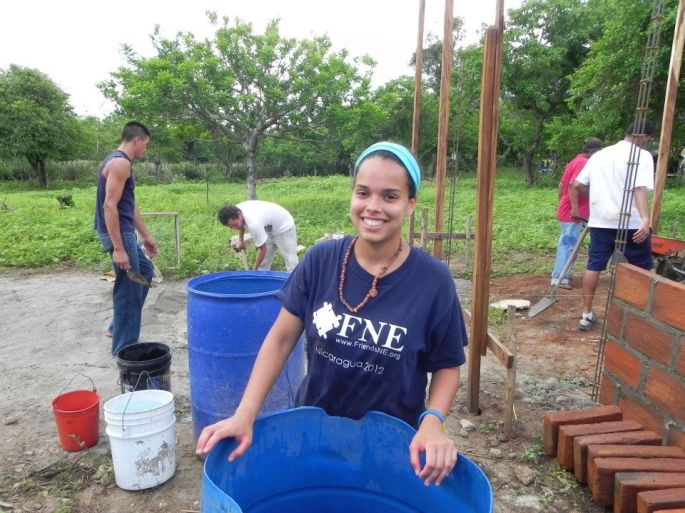
Leaving your comfort zone is one of the hardest, yet most rewarding experiences you can have. It was for me. During my undergraduate years, I spent three consecutive semesters studying abroad in Spain and Chile fulfilling my Spanish & Latin American Literature and Culture major. I realized the importance of expanding my horizons, gaining a multicultural perspective of the world and becoming more culturally competent. As a public health graduate student, my travels to Latin America took a global health perspective. My mind was once again exposed to another side of the world that we often miss while secluded in our comfort zones. In Central and South America, I volunteered on heath initiatives and sustainable development projects, and conducted research. I witnessed numerous global health disparities including lack of sanitation, children living in homes made with plastic walls and dirt floors, and physicians striving to provide quality reproductive care to low-income, immigrant women at a family planning clinic with scarce resources.

My ultimate goal is to become a primary care physician to help reduce health disparities globally. Going abroad was one step towards that goal.

Continue reading “Students, You Should Go Abroad Too!”

Media Wars: #Ferguson, American Hypocrisy and a Hint of Spring

This was originally posted on my professional blog.

America has experienced an ugly spotlight reversal with the eruption of popular discontent into violence in its own backyard. Just a few weeks ago, international media was buzzing with reports of ISIS steamrolling the Iraqi military and Russian-supported separatists in Ukraine shooting down passenger airlines. Now, the US squirms uncomfortably under international scrutiny of Ferguson, Missouri, where the shooting of a young black man by a white police officer has once again raised the specter of racism and police brutality.

Obviously, the incident itself is complicated. Eyewitnesses – who have given conflicting testimonies – are the only window into what happened, since there was no dashboard camera. The initial description of Michael Brown, the victim of the shooting, as a “gentle giant” about to start college clashed with video footage of him stealing a box of cigarillos from a convenience store. Commentators have drawn parallels with the case of Trayvon Martin, whose mother has now reached out to Brown’s mother. Peaceful protests have given way to violence and looting, reporters have been arrested, and witnesses have complained of excessive use of force by the police.

Social media, which played a major role in bringing media attention to Ferguson in the first place, has played host to the battleground of ideological responses to the incident. The primary complaint from conservatives is that the uprising in Ferguson, and the underlying racial tensions it has exposed, don’t deserve our consideration because some of the protesters have been looting and vandalizing stores…

epdara9

ql184ox

…including a few gems that actually blame the community for the excessive force used against it.

RRAKSio

b58p7

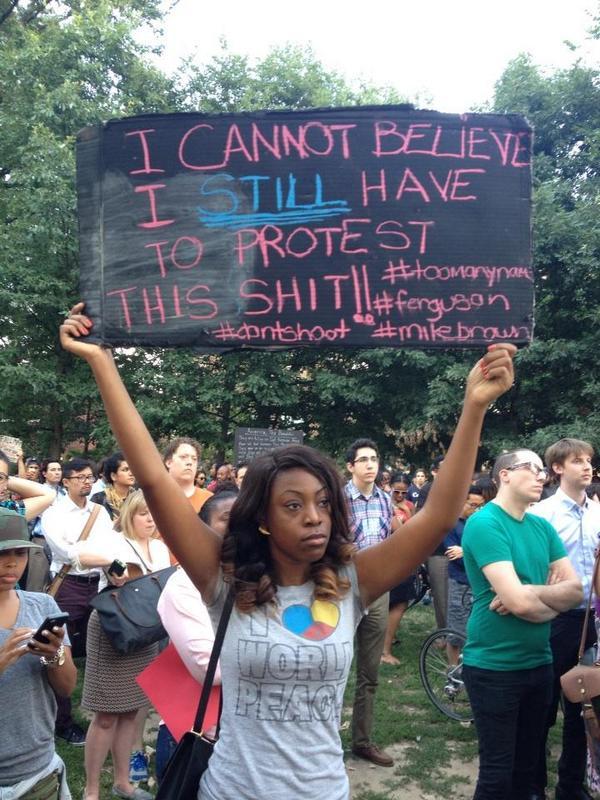
Meanwhile, people used the Twitter hastag #IfTheyGunnedMeDown to spar over which photos of Brown were used by traditional media (wearing a cap and gown vs. striking a “thug” pose) and post their own side-by-side pictures. Still others are expressing frustration at the fact that the vandalism and looting has been used as a straw man to distract from ongoing widespread racial profiling and policy brutality against blacks, including one refreshingly blunt protester at a rally in DC:

BvCci4DIMAEXAIz

What has been the most interesting to me is the global shock and horror at the incident and resulting fallout. The international community sees what many Americans are apparently missing: that the protests and unrest in Ferguson are the manifestation of a minority group sick of being oppressed and ignored. The UN High Commissioner for Human Rights drew parallels to South African apartheid, while several countries have been using the situation to take shots at America’s own human rights record when we so often criticize other countries. One might expect Iran and Russia troll the US over civil unrest, but as one friend of mine pointed out on Facebook, “When Egypt calls you out for human rights abuses, YOU’RE DOING IT WRONG.”

American police brutality, and the unwillingness of many police departments to be held accountable for their actions, have also been focal points. What happened to Michael Brown will unfortunately always be shrouded in mystery, since the Ferguson police department apparently prioritizes riot gear and tear gas over cameras for officers or police cruisers. They also seemed to have forgotten the meaning of “free press,” as they arrested and harassed several reporters who were trying to cover the protests. Interestingly, Obama was quick to condemn the bullying of journalists “here in the United States of America,” despite his own administration’s secrecy and aggression toward the press, including prosecuting a journalist who refused to identify the source of an intelligence leak.

Indeed, many observers have been quick to point out America’s hypocrisy at fingering human rights abuses outside our own borders when we have threads of discontent, similar to those found in the Arab Spring and other global protest movements, woven throughout our own society. A lovely little piece of satire from Vox portrays how American media might describe the events in Ferguson if they happened in another country.

When everything is said and done, America doesn’t look so much like a shining beacon of democracy and human rights – we just kinda look like everybody else.

Spotlight on Brazil: The World Cup and More Doctors

The World Cup ended on Sunday and with all the controversy surrounding host country Brazil, I found myself wondering about their health care system. I knew access to basic health services was one of the main points of protest against the Brazilian government’s spending for the World Cup, but I didn’t know all the details.

A few quick searches online provided me with the information I wanted and led me to this video from the Pan American Health Organization (PAHO) documenting the impact of the arrival of doctors in two Brazilian towns that previously had no doctors. According to the World Health Organization, there is a serious shortage of doctors in Brazil with 1.8 physicians for every 1,000 people. Although the Constitution calls for free health care for all citizens, the reality is that there are major inequalities in access to health services with 700 neglected municipalities and a lack of local primary health care.

The PAHO video focuses on Mais Medicos (More Doctors) – a program between the Brazilian and Cuban governments that allows Cuban doctors to work in under-served Brazilian communities for three years. I did some more searching online and learned that the program is part of an initiative by President Dilma Rousseff to import 13,000 foreign doctors in order to address the shortage of medical professionals. The program has been criticized and although I agree with some of the points of opposition (How are their foreign credentials vetted for local standards? How does this translate to a long-term plan to address the larger issues with health care in Brazil?) I think the reception of Cuban doctors by local Brazilian doctors was too harsh.

Despite the controversy surrounding the program, the PAHO video illustrates its positive outcomes through patient testimonials about improved access to health care, fewer journeys to far away hospitals, and increased treatment and service quality. Residents in the two remote communities featured in the video are quite happy with the program and appreciative to have basic health care.

What do you think? Does the program provide enough value to balance costs and outweigh the risks? Watch the video and share your thoughts in the comments below.

IHSC June 19th Conference Call with Dr. Pablo Ariel-Mendez, USAID

Please see the following announcement from Mary Carol Jennings of the newly-formed Student Committee.


The International Health Student Committee of the APHA IH Section is the section’s newest student group. As part of the core group of leaders, I wanted to plan a nationwide series of virtual events and conversations about leadership and career decisions in international health. Another group member, Nila Elison, has recently joined me, and together we’re starting the IH Career Development Sub-Committee.

I believe that organizations like APHA can play a valuable role in introducing new public health practitioners to potential mentors. I myself am not following a perfectly straight career path. I’ve worked in community organizing, policy, clinical medicine, and now am finally, formally, in public health, in my second year of the general preventive medicine residency at Johns Hopkins. Only recently have I started to find mentors in people, who like me, have taken similarly non-linear paths.

To set the stage for the upcoming year, our first guest speaker is going to talk about his own career path and his insight on leading a large global public health organization.

Dr. Ariel Pablos-Méndez is a public health physician who serves as the Assistant Administrator for Global Health at the U.S. Agency for International Development. Appointed by President Obama in 2011,  his work involves implementing the mission of the Global Health Initiative. His impressive resume includes leadership and experience within the World Health Organization, The Rockefeller Foundation, and Columbia University in New York City.

Dr. Pablos-Méndez will join the International Health Student Committee on June 19th from 4-5pm EST, and we hope you’ll take part in the conversation about developing your own career in international health.

We had previously closed registration, but because we want to share the conversation with those who are inspired by this blog post, we have re-opened the RSVP form until June 15th. We also welcome your sharing this with your classmates and school communication forums.

RSVP link: http://bit.ly/1n9J1Xc

A few twitter hashtags: #IHSCspeakers, #GlobalHealthSpeakers #IHSCCareerDevelopment

Details about the conference line number and access code will be sent to your RSVP email.
Follow the IH Student Committee!
APHA connect http://connect.apha.org/group.htm?igid=257321
Facebook https://www.facebook.com/groups/APHA.IHSC/
Twitter @APHA_IHSC