Health Literacy in the Viral Media Age

October is Health Literacy Month. And even though we only have a few days left in the month, I thought squeezing in a communications related post would be a fitting first blog post for the newest addition to the Communications Committee.

According to the World Health Organization, health literacy is defined as “the cognitive and social skills which determine the motivation and ability of individuals to gain access to, understand and use information in ways which promote and maintain good health. Health literacy means more than being able to read pamphlets and successfully make appointments. By improving people’s access to health information and their capacity to use it effectively, health literacy is critical to empowerment.”

With health literacy playing a critical role in empowering individuals to make positive health choices, it should come as no surprise then that low levels of health literacy are associated with poor health outcomes. As such, it is our responsibility as public health professionals to promote health literacy by ensuring that the health information we disseminate is accurate, accessible, and actionable. In many ways we are already experts at this, from presenting information either orally or through pictures in low literacy settings to adapting messaging to the local culture. We understand the value of delivering contextually relevant health information.

Although many individuals still rely on health professionals for trusted health information, we cannot ignore the influence of communities on health literacy and in particular the rising role of digital communities. Digital communities have helped individuals with similar health concerns share information and support each other and have enabled the growth of viral media campaigns that raise awareness on health topics and reinforce key health messages. And while digital communities have certainly helped advance health literacy by making information more readily accessible, they have also had a detrimental effect.

In the viral media age, inaccurate health information can easily diffuse to a large number of people at lightning speed in digital communities. On top of that, social networks yield incredible power in influencing health behaviors even while taking into account individual characteristics such as income and education. This combination of factors should raise some alarms.

A recent article in The Atlantic discusses the challenges created by the spread of health misinformation and criticism in digital communities during epidemics. From the 2014 measles scare in Vietnam to SARS in China example after example demonstrates the potential harms of digital communities. Whether through exacerbating individual fears or creating mistrust between health professionals and the public, digital communities can negatively impact health literacy.

Although the author notes this is most evident in the Asia Pacific region, where the confluence of Internet users, smartphones, and infectious diseases has created the perfect storm, the problem of health misinformation among digital communities isn’t limited to epidemics or geography. The problem of health misinformation exists anywhere the Internet does. It is a problem that isn’t going away anytime soon and will only continue to grow. In 2015, over 3 billion people worldwide were using the Internet compared to 738 million in 2000. Of those users, 2 billion live in developing countries compared to only 100 million in 2000.

Projects focused on increasing global Internet access, like Facebook’s Internet.org which has brought free basic mobile Internet service to over 25 million people from India to Zambia, are gaining traction. In addition, data and mobile phones are becoming more affordable. These factors are driving the ubiquity of the Internet. Thus, it is imperative that we think about ways to limit the spread of health misinformation by staying ahead of the conversation in the days, months, and years ahead of us.

As we think about how to accomplish this, here are a few ideas to start with:

Check out the “Section Connection” – the IH Section’s pilot e-newsletter!

We are excited to present the Section Connection, the IH Section’s new quarterly e-newsletter! This one-year e-newsletter pilot was conceptualized and compiled by our Global Health Connections Committee Chair, Theresa Majeski, according to feedback from a survey of the Section’s students and early career professionals conducted earlier this year. The newsletter features an introduction to select members of the Section leadership, information on how to get connected within APHA, tips on how to get the most out of the upcoming Annual Meeting in Denver, and a special dedication to one of our most dedicated Section members, Miriam Labbok, who passed away this year.

Many longtime Section members remember our original Section newsletter, which was compiled each year by a designated editor and disseminated by APHA staff. While APHA has retired this version of the newsletter, we have collected and archived previous editions on APHA Connect, going all the way back to the year 2000. You can access those in our Section’s APHA Connect documents library. (Note: You will need to log in with your APHA membership credentials.)

An age-old disease today

In 2015, tuberculosis killed on average 34,000 people per week, a total of 1.4 million deaths.  This is just one of many facts published in a report by the WHO that brings renewed attention to one of the world’s oldest diseases.  Roughly a third of the world’s population – 2 to 3 billion people – are infected with tuberculosis, though only a small proportion (5-15%) will develop an active infection in their lifetime.  Sixty percent of new tuberculosis infections occur in only 6 countries: India, Indonesia, China, Nigeria, Pakistan, and South Africa.

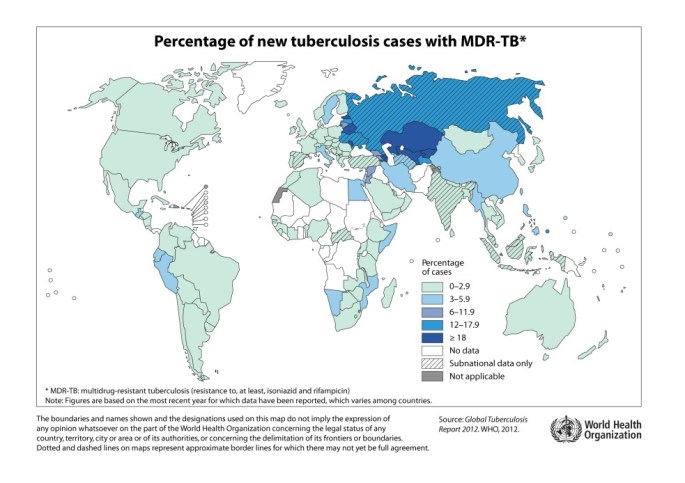
As is a theme in much of medicine, a strain of drug-resistant tuberculosis is affecting people around the world.  Multi-drug resistant tuberculosis, or MDR-TB, cannot be cured with the two most common TB drugs.  In 2014, 480,000 people developed MDR-TB with over a third of patients (190,000) dying.

The road to recovery from tuberculosis requires a 6-month drug regimen.  When not followed or completed, drug resistant forms occur and can be transmitted person-to-person in highly concentrated areas, such as prisons, or among people living in poverty.   For patients with MDR-TB, treatment is grueling, involving at least 18-months of second-line drug treatment and isolation.  Those who suffer from MDR-TB face social stigma and isolation as well as side-effects from the cocktail of treatment, including hearing and vision loss, chronic pain, and mental illness.

When we take the pills, we feel worse. I’m losing my hearing a little. I feel pain in my bones, in my whole body.

– Maria Smolnitcaia (52-year-old woman living with MDR-TB in Balti, Moldova)

While 6 countries bear the brunt of new tuberculosis infections, the former Soviet Union leads the pack in cases of MDR-TB.  Moldova, a small country at the crossroads of Eastern Europe and Central Asia, has one of the highest rates of MDR-TB in the world at 18% of new TB infections.  Sixty-five percent of tuberculosis re-infections are MDR-TB.

mp1

There are several reasons for the prevalence of MDR-TB in these formerly Soviet states.  Analysis of tuberculosis bacterium links surges in incidence to social upheaval, such as that seen during the collapse of the Soviet Union in the 1990s.  A breakdown in healthcare infrastructure made it difficult for people to follow a sufficient antibiotic course to fight the disease.  MDR-TB in the UK has steadily risen, reaching 81 cases in 2012, and has been traced to the same event.

An extensive prison system has also been blamed for the development and spread of MDR-TB.  Russian prisons prior to 2001 had a tuberculosis infection rate of 7,000 per 100,000 prisoners.  The close quarters of prison are the perfect breeding ground for MDR-TB, which then permeates the community when an infected prisoner is released.

Tuberculosis is the leading cause of death for people living with HIV. Due to a weakened immune system, people with HIV are 26 to 31 times more likely to get TB than the general population.  These facts are doubly worrying when considered with the prevalence of latent tuberculosis infections among healthcare workers.  A study published in PLOS One found that 47% of healthcare workers in 7 low-income countries had a latent infection, ranging from 37% in Brazil to 64% in South Africa. By definition, latent tuberculosis is not contagious, but once infected, an active infection can occur at anytime and be transferred to a patient.  In India, this is troubling as there is no mechanism to reduce the spread of tuberculosis in hospitals:

Therefore, anecdotally, there’s a lot of TB among doctors and nurses, even drug resistance and some mortality.  Hospital staff are vulnerable two ways — because they are in India, a hyper endemic country with half of adults already infected [with latent TB], plus hospitals collect TB patients so staffs are at risk of infection.

– Jacob John, virologist and retired professor from the Christian Medical College, Vellore, India

As cited by WHO and the New England Journal of Medicine, antiretroviral therapy in concert with tuberculosis treatment can significantly improve outcomes and longevity for both diseases. Sadly, concurrent treatment is lacking as reported by WHO.  In 2015, 1.2 million people living with HIV contracted tuberculosis.  Of that number 390,000 received treatment for both diseases.  An equal number died.

mp2

The Sustainable Development Goals are committed to end tuberculosis by 2030, ensuring healthy lives and well-being for all.  What next steps need to be taken to eradicate a disease as old as the human race?

Can the census help us reach our global goals?

On September 25, 2015, the UN General Assembly adopted the Sustainable Development Goals (SDGs) to be completed by 2030.  Seventeen goals with 169 targets fall neatly within a framework of People, Planet, Prosperity, Peace, and Partnership.

sdgs-globalgoalsforsustainabledevelopment-05

To estimate the likelihood of reaching these goals in the next 14-odd years, it is helpful to evaluate the shortcomings of the SDGs’ predecessor.  Established in 2000, the Millennium Development Goals (MDGs) consisted of 8 goals to be achieved by 2015.  Called the “most successful anti-poverty movement in history,” the MDGs made inroads in reducing global poverty, but there is still much to do.

A literature review finds that the MDGs were more favorable to wealthy countries, which for all intents and purposes had met or exceeded the 8 goals prior to inception.  In the development stage, only 22% of member parliaments were involved. Others argue that the MDGs ignored local and governmental capacity in poorer countries and limited policy growth by narrowing focus.  Rather than setting goals realistic for each country’s individual baseline and capacities, the MDGs ‘ghettoize the problem of development and locates it firmly in the third world.’  The final limitation of the MDGs speaks to issues of data collection and surveillance in developing countries.  Reliance on national averages and aggregated data ignored the world’s poorest, meaning they would be the last to benefit.

A video recently released by WHO’s YouTube page culminates with the sentiment “The world needs better health data and ICD is delivering it.”

The ICD or International Classification of Diseases allows global users to share health information about mortality and morbidity.  ICD counts deaths as well as diseases, injuries, symptoms, reasons for encounter, factors that influence health status, and external causes of disease.

ICD is less useful and utilized in developing countries.  In the least developed countries, health records, including birth and death records, are not well recorded and may be based on second-hand information or less scientific means such as verbal autopsies.  Is the ICD accessible to developing countries, ostensibly the same countries who share the largest burden of poverty and disease?  What are the fundamental gaps in data collection and utilization that must be ratified before progress is observed?

One of the first steps to usable data is the census.  A timely, accurate census is the foundation for public health policy and development:

Census data can, for example, highlight sex-ratio imbalance, identify trends in migration, fertility, nuptiality and population ageing. Such information is the bedrock of almost all aspects of human, social and economic development. It helps governments determine the number of schools, hospitals or highways to be constructed, or the kind of programs that should target young and older people, as well as women. Censuses thus contribute to reducing poverty, ensuring sustainable development and supporting reproductive rights and gender equality.

The United Nations Population Fund provides technical and financial support to assist developing countries with census efforts.  When a developing country conducts a census, the results can be unexpected.  Afghanistan’s 2010 census – its first since 1979 – found lower fertility rates and higher contraceptive use than anticipated.  In very remote areas, there is limited data to base projections on, such as in areas of Myanmar where there was no reliable data even on total population.

The 2030 Agenda is built on the assumption that every country will be able to identify and locate the most vulnerable groups, but over 109 countries in the world today don’t have vital statistics and registration. We still need to develop better ways to reach those who have historically gone uncounted.

– Dr. Babatunde Osotimehin, UNFPA Executive Director

Without accurate census information, are we putting the proverbial cart before the horse?

Finally, a #humanrights win for #HIV in Korea

Note: This was cross-posted to my own blog.


Seven years after it dismissed initial complaints against the South Korean Ministry of Justice’s (MOJ) policy of mandatory HIV and drug tests for foreign English teachers, the National Human Rights Commission of Korea (NHRCK) has (finally!) recommended that the MOJ remove the testing requirement. NHRCK’s recommendation follows the decision of the UN’s Committee on the Elimination of Racial Discrimination (CERD) in May 2015, which stated that the MOJ’s policy requiring a health check which includes HIV and drug tests for native-speaking English teachers (those on the E-2 visa) constitutes racial discrimination.

The complaint which led to the ruling, filed by a teacher from New Zealand against the Ulsan Metropolitan Office of Education, was initially submitted to the NHRCK in 2009 when the testing policy was first implemented. Unfortunately, the commission dismissed it, along with 50 others protesting the policy, and cancelled its initial plans for a public hearing on the grounds that they were not willing to hear cases on individual complaints. (You can read more about the NHRCK’s decision and the events leading up to it in a paper (PDF) by Ben Wagner, the human rights attorney who filed the case on the New Zealand teacher’s behalf.) In dismissing the complaints, however, the commission allowed the case to be taken to the CERD, where it was accepted in 2012.

Now the commission has formally backed the CERD’s ruling, which – despite the fact that it took seven years to get there – is a big win on the topic. HIV is a forgotten disease (PDF) in South Korea and is incredibly stigmatized, which makes it easy for government agencies like the MOJ to codify this kind of direct discrimination without any public outrage or pushback from within the country. In this sense, the challenge to this ongoing affront to human rights from an authoritative domestic institution is crucial. In particular, the commission’s decision calls out the MOJ’s policy as blatant racial discrimination, specifically citing the fact (also noted in the CERD’s decision) that the tests have no basis in the protection of public health because both Korean nationals and non-citizen ethnic Koreans are exempt from the testing requirement:

[T]he Ministry of Justice takes a stand that an independent state is bestowed with wide discretion in its immigration control and, in particular, such tests are indispensable as the instructors are supposed to protect young students and facilitate a safe environment and public health.

However, as noted by the CERD, even the vast discretion embedded in immigration control hardly renders it reasonable that while Korean teachers and ethnically Korean foreign language instructors are exempted from the testing, only foreign E-2 visa holders are under an obligation to test for HIV. Likewise, the concerns about a safe public health environment offer little ground for different treatment between ethnically Korean teachers and foreign instructors with E-2 visas.

Second, it points out that the policy has the potential to stigmatize foreigners as being high-risk for HIV and thus lead the general public to believe that they are not at risk for infection. This is important, as the country’s HIV infection rate continues to climb.

The MOJ never responded to, or changed its testing policies in response to, the UN CERD’s ruling. Hopefully the Korean government will be more responsive to a ruling from a domestic institution, but there is no way to know for sure. However, foreign English teachers now have a resource to challenge the testing if they wish. The NHRCK decision explicitly states that the UN CERD decision carries the same authority as domestic Korean law:

Article 6 (1) of the [Korean] Constitution states, “Treaties duly concluded and promulgated under the Constitution and the generally recognized rules of international law shall have the same effect as the domestic laws of the Republic of Korea,” indicating that the country has a legally binding obligation to facilitate the rights prescribed by the treaty to which it agrees by means of accession, ratification or succession. Article 26 of the Vienna Convention on the Law of Treaties stipulates, “Every treaty in force is binding upon the parties to it and must be performed by them in good faith,” while Article 27 states, “A party may not invoke the provisions of its internal law as justification for its failure to perform a treaty.”

English teachers may be able to use the CERD decision to persuade their employers not to require the HIV test; alternatively, they have the option to file a complaint with the NHRCK (either named or anonymous) and/or the UN CERD Secretariat. The full decision has been made available by Matt von Volkenburg on Gusts of Popular Feeling.

Shameless plug: I will be presenting on this topic, including successes and ongoing advocacy initiatives, at this year’s APHA Annual Meeting in Denver.