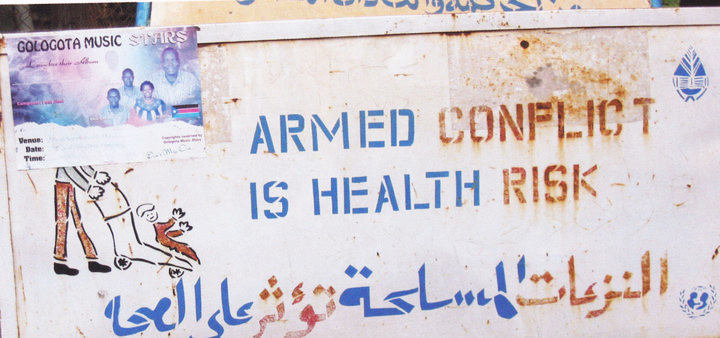
It is important for early-career professionals interested in pursuing a career in global health to be aware of the realities of working internationally. Although stories of setting up vaccination clinics or fighting Ebola may stir up feelings of excitement, being a part of the action may require additional education and training in conflict resolution and institution building. This is especially true when it comes to conflict-affected areas and fragile states that are the most in need of health care/public health services as a result of the local health system infrastructure being weakened. A different kind of public health professional, one that is willing to risk their life and invest in the indigenous health system, is required in our world today.
I currently work as an epidemiologist at a regional health department in Texas. We serve two main roles for the 30 counties we cover. One of our roles is to function as a local health department and deliver a diverse range of services to 23 counties. The other main role is to serve as an extension of the state health department and provide surveillance/investigation guidance for the reportable conditions that health care providers, schools, and community members are mandated to report. This relationship is seen especially when we work with the 7 counties in our region that have their own local health departments. Before beginning this job, I actually worked at one of these local health departments and was on the receiving end of the interaction described above.
For most of my life, I’ve been interested in pursuing a career in global health or humanitarian work. When I was younger, I thought the only way I could pursue this dream was by being a physician (especially if I wanted to be able to support myself financially). I also believed this to be a great way to help communities that were dying from preventable illnesses. My introduction to public health helped me see that there were many other ways to help achieve the goal of combating deaths due to preventable illnesses. I focused in on epidemiology as a way to combine my science/laboratory background with my desire to serve and entered into an MPH program after completing my B.S. in Biology. Most of my MPH program was spent working hard to obtain tangible experiences in public health practice and deciding which skills would be most necessary for me to have before entering into the workforce. While pursuing my MPH from 2014-2015, some of the hot topics in public health were Ebola, antimicrobial resistance, bioterrorism, anti-vaccination movements, hospital-acquired infections, opioid abuse, tuberculosis trends related to travel, maternal and child health gaps, and continued efforts to end polio and AIDS, to name a few. Towards the end of my program, I began to hear more about the dangers of humanitarian work and global health as stories involving health care and humanitarian workers being targeted in conflict-affected areas/fragile states were highlighted in various media outlets. I also knew of at least one faculty member at the university I attended whose global health team was attacked shortly after the individual returned to the US (after working in the field for a number of years).
When I entered into the public health workforce in 2016, Zika was just becoming a hot topic in public health circles in the U.S. But there were other things for me to learn at my local health department. I received an introduction to the Immunization team and programs such as Texas Vaccines for Children which enable young people in Texas to receive affordable immunization coverage (there is an adult vaccine program too). I also received an introduction to the statewide ImmTrac system that stores vaccine records and learned about some of its strengths and challenges. Ultimately, I was able to see the importance of public health collaborating with healthcare providers, schools, and community members to ensure that a community has adequate herd immunity or, in the case of outbreaks, can deliver effective interventions in response to infectious disease threats. Something else I learned about was the role of immunization clinics or point of dispensing units (PODS) during natural disasters, such as floods, and other public health emergencies.
I’ve shared some of my experience working at the local level because it gave me a tangible picture of how public health functions in stable environments or areas that are not weakened by natural disasters. In conflict-affected areas or fragile states, public health efforts may be fragmented at best. For example, in August 2015 Nigeria was removed from the World Health Organization’s list of countries with endemic Wild Polio Virus (WPV). This was the result of global efforts aimed at eradicating polio through targeted immunization campaigns. Nigeria went two years without WPV cases before, in August 2016, two cases were reported in Borno-a conflict-affected state. Two additional cases were reported in September 2016. The cases were from inaccessible areas of the state with limited security and indicated that prolonged transmission had gone undetected as a result of armed conflict. Although the number of areas held by insurgents, and therefore without access to vaccines, eventually decreased, the conflict in Borno prevented timely vaccination campaigns and posed a risk to Nigeria as a whole. Specifically, migration between Internally Displaced People (IDPs) camps and refugee communities resulted in a higher potential for WPV cases to be reported in states not directly tied to the conflict. A similar trend was noticed with the Ebola outbreak that occurred in West Africa from 2014-2015. The disease posed an increased risk in fragile states and areas affected by conflict. For example, prior civil wars in Liberia and Sierra Leone severely weakened the countries’ infrastructure in the 1990s. The conflicts also affected surrounding countries and resulted in millions of displaced people. In some of instances, countries had the resources needed to respond to public health emergencies caused by conflict. However, groups of people or areas deemed to be inaccessible as a result of conflict continued to undermine the effectiveness of immunization clinics and infectious disease response efforts.
A comparative analysis conducted by Bourdeaux et al. in 2015 assessed the effect of conflict on health systems in Haiti, Kosovo, Afghanistan and Libya. Health systems were defined as, “the organized network of institutions, resources and people that deliver health care to populations” and was based on the World Health Organization’s (WHO) Framework for Action (2007). The framework highlights financing, leadership/governance, information, medical products/vaccines/technologies, health workforce, and service delivery as essential components of effective health systems. When this organized network is destroyed as a result of armed conflict, high levels of morbidity and mortality occur and can have negative effects that persist even after the conflict is over. The analysis found that the building blocks most affected by conflict and security forces were “governance, information systems and indigenous health delivery organizations.” In order to address these gaps, a suggestion provided by the authors is to deploy Health Security Teams comprised of individuals with training in public health and institution building to conflict-affected areas and fragile states. The teams would support indigenous health systems instead of creating parallel or temporary systems, and not be involved in serving military interests. Additionally, these teams would know how to guide security forces as they engage with health systems in diverse political climates.
At this point in time in my career, most of my work is done in an office on a phone or computer. When I started my journey in public health, I pictured something different. I still have the long-term goal to work internationally (or financially support myself while volunteering internationally). However, I am sobered by the fact that if I want to serve those who are truly in need (especially as it relates to conflicted-affected areas and fragile states) I will have to be at peace with laying my life on the line. I will also have to be prepared to navigate the challenges presented above. This includes learning as much as I can about conflict resolution and negotiating to protect health systems. In general, I feel that public health has much to do in terms of educating and re-assuring those we serve (both domestically and internationally). As a result, part of my journey in public health will include developing skills as a connector of people and someone that can see both sides of an issue. I think that all public health professionals interested in working in a global health or humanitarian worker capacity should consider this. At the same time, immigrants or refugees that have left their homes due to conflict or in search of better opportunities can also develop the skills needed to resolve conflict and rebuild institutions. The success of the suggested Health Security Teams could depend on this.
Photo: Diane Budd, M.D.




 IH CONNECT