Global News Round Up

Politics & Policies

A study shows a significant reduction in the India-Nepal drug trade due to the 2015-2016 Indian blockade and thus, potentially leading to shortage of medicines.

Since FY 2010, U.S. funding for global health has remained relatively flat. The FY 2018 President’s budget request proposes to reduce global health funding to $7.9 B, its lowest level since FY 2008.

Guided by the country’s oldest community-based health promotion project Nizwa Healthy Lifestyle Project (NHLP), businesses and communities in the Sultanate of Oman have joined forces to lead the charge against non-communicable diseases.

Yesterday, Global Health Council (GHC) applauded U.S. Senators Susan Collins (R-ME) and Chris Coons (D-DE) who led a bipartisan group of 10 Senators to reintroduce the Reach Every Mother and Child Act (S.1730).  This bipartisan legislation aims to accelerate the reduction of preventable child, newborn, and maternal deaths, putting us within reach of the global commitment to end these deaths within a generation

Programs, Grants & Awards

The WHO has launched the consultation of the draft global action plan to promote physical activity. The overarching goal is to get 100 million people more active by 2030.

Ethiopia will host an International Conference on Maternal and Child health on August 24th and 25th, the theme of which will be “Overcoming critical obstacles to maternal and child survival”.

Distance education graduate courses led by USC faculty are attracting students from around the world to virtual classrooms where they learn about global health leadership and ethics.

Hear from experts in the field, participate in collaborative exercises and network with colleagues at the 2018 UC Global Health Institute’s Women’s Health, Gender and Empowerment Center of Expertise annual retreat.

This year, five new trainees will join the Global Health Pathway for Residents and Fellows, administered by the Duke Hubert-Yeargan Center for Global Health, a part of the Duke Global Health Institute (DGHI).

Research

In this study in French Guiana involving 12 men with ZIKV (Zika Virus) infection for whom semen samples were available, we determined the prevalence of ZIKV RNA, the duration of ZIKV persistence and potential intermittent ZIKV excretion.

Results from a new study shows that people who do not eat a Western diet (such as the Hadza people in Tanzania) have greater diversity of microbes in their guts. Additionally, Western diet seems to lead to a loss of certain bacterial species.

Diseases & Disasters

A woman’s body was discovered as Harvey’s floodwaters started dropping, while Texas says more than 48,700 homes have been affected.

Crews in Texas have found the bodies of 21 victims of Harvey’s wrath, and warned on Wednesday that the number of dead would almost certainly rise as water levels across much of the Houston area start to recede.

City officials in Houston imposed an overnight curfew to guard against opportunistic crimes as Tropical Storm Harvey continued to deluge southeast Texas on Tuesday, breaking the record for the most extreme rainfall on the U.S. mainland.

Emergency workers rescued many more soaked and frightened people in southeast Texas on Tuesday as floodwaters continued to rise and officials counseled patience, warning that conditions would not improve soon.

Tropical Storm Harvey is causing catastrophic flooding along the Texas Gulf Coast as the storm lingers and continues to drop record-breaking rainfall.  Houston is experiencing unprecedented flooding, with shoulder-high water in some areas after a 20-plus-inch rainfall, and Houston Police Chief Art Acevedo calling it “a 500-year event.”

The cholera outbreak in Yemen is overwhelmingly affecting rebel-controlled areas due to Saudi-led air strikes and blockades, according to a letter by researchers from Queen Mary University of London, published in The Lancet Global Health.

Sierra Leone, a country that has been battered by Ebola, civil war and massive floods, suffered yet another tragedy this week,  Government and international aid workers are racing the clock to find survivors after a mudslide struck capital city Freetown early Monday morning.

Of the many steps governments can take to prevent people from getting sick, none can save more lives than reducing tobacco use.  Around the world, 1 in every 10 deaths is caused by tobacco.  In the 20th century, tobacco use killed 100 million people, far more than World War I and II—and most of the other major wars of the past century—combined. In the 21st century, unless we act, tobacco could kill a billion people.

The Cholera epidemic in Yemen is on track to claim more than 2500 lives in the coming months. At the current rate, this easily treatable disease could kill more people than the 2013-2015 Ebola epidemic in Guinea.

Technology

Using a walkie-talkie app called Zello, volunteers in Houston and beyond (including a woman in New Jersey) have established a parallel emergency response network to supplement overwhelmed government agencies, according to The New Yorker. Volunteer dispatchers field desperate calls for help and coordinate volunteer boaters trying to reach the stranded.

Royal Philips, a global leader in health technology, today announced an agreement with Lakeland Health to integrate the Philips IntelliVue Guardian Solution with automated Early Warning Scoring (FWS) at all three of the Lakeland Health’s hospitals. The IntelliVue Guardian Solution contains software and intelligent clinical decision algorithms allowing caregivers to accurately obtain vital signs and seamlessly integrate validated patient data directly to the EHR – reducing human errors and saving time.

Environmental Health

Bad news for humans about the spread of mosquito-borne disease as climate change continues to worsen. New research from the University of Notre Dame, recently published in PLOS Neglected Tropical Diseases, proposes a new way that climate change could contribute to mosquitos’ capacity to drive disease epidemics. As climate change continues to rise, so could the speed of epidemics of mosquito-borne diseases like dengue and Zika.

Equity & Disparities

Adolescent girls living in neighborhoods with wide salary gaps and low-income households showed increased thinning in the brain’s cortical thickness, which could indicate higher levels of stress.

Violence, preventable diseases and traffic accidents are to blame for a widening of the youth mortality gap between the developed and developing world, according to a new Guardian analysis of the most recent World Health Organisation (WHO) data.

Maternal, Neonatal & Children’s Health

Globally, nearly eight out of every 1,000 children in the general population Iis estimated to have Fetal Alcohol Spectrum Disorder (FASD), according to a new study by the Centre for Addiction and and Mental Health (CAMH).

Results from a large clinical trial of a specific combination of oral preparation of probiotics  in newborns in India showed a 40% reduction in sepsis and deaths in the first 2 months of infancy. The trial ended early because it proved to be so effective.

Results from the secondary data analysis from the Child Health Epidemiology Reference Group (CHERG) shows that one in five infants are born small for gestational age and one in four neonatal deaths occur among such infants.

A global study reveals that nearly 8 in every 1000 babies are born with fetal alcohol syndrome.


The Evaluation and Measurement of Health Literacy

This is a guest blog post by Dr. Heather F. de Vries McClintock PhD MSPH MSW, IH Section Member and Assistant Professor in the Department of Public Health, College of Health Sciences at Arcadia University. It is the third blog in a three-part series the IH Blog will feature this summer, Global health literacy: Conceptual basis, measurement and implications.

Part III. The Evaluation and Measurement of Health Literacy

While the IOM’s (now National Academy of Medicine) definition of health literacy (HL) is recognized and accepted, there is a lack of standardization in its conceptualization and operationalization within and between countries. Initially HL was perceived as a derivation of literacy with it’s primary purpose serving to as important tools to maximize comprehension during clinical encounters. In recent years the meaning and purpose of HL have broadened in scope to incorporate a health promotion perspective. This expanded and dynamic definition has resulted in increased utility in both clinical medicine and public health but has left this construct susceptible to conceptual drift.  A recent systematic review of the construct of HL found 17 varying definitions and 12 conceptual models that were employed in the literature.  

According to IOM’s report Health Literacy: Improving Health, Health Systems, and Health Policy Around the World: Workshop Summary, countries around the world have used a wide range of designs and approaches as well as purposes for examining HL.  These approaches have involved the usage of proxies such as education, income, or literacy to approximate HL. Other countries have relied on single items, often as a part of other measures (e.g. school attendance/enrollment, reading score), to evaluate HL. Thus, currently there is lack of comparability between estimates of HL within and between countries. Furthermore, the validity of many measures in assessing IOM’s definition of HL remains unclear. It is important to note that nearly all of the studies in this review were conducted in high income countries. Very little research has constructed a measure for use in LICs and LMICs. A robust measure of HL provides the foundation for comparison of HL across countries as well as its evaluation in relation to health outcomes.

My colleagues and I (see acknowledgements below) sought to develop a robust measure of HL using data from Demographic Health Surveys (DHS) conducted between 2006-2015 in 14 developing countries: Cameroon, Democratic Republic of the Congo, Ethiopia, Ghana, Guinea, Ivory Coast, Lesotho, Rwanda, Niger, Namibia, Sierra Leone, Swaziland, Toto, and Zambia. The same survey was administered in all countries, after translation into versions appropriate by language.  The DHS Program is administered by the United States Agency for International Development (USAID). Beginning in 1984, surveys have been administered in over 90 countries. The DHS survey includes items that represent domains of the IOM definition of HL. We identified eight survey questions that corresponded to elements of the four domains of health literacy as defined by the IOM: capacity to interpret, capacity to obtain, capacity to understand, and ability to make appropriate health decisions. We then applied factor analysis methods to extract a single factor – a measure of health literacy – and evaluate the results for reliability and validity.

In our work, a total of 259,684 individuals between the ages of 15 and 49 years were included.  The derived dichotomous measure of health literacy demonstrated internal consistency (Cronbach’s α = 0.72), good content validity, and importantly, was comprised of the elements described by the IOM.  The prevalence of high health literacy overall was 35.2%.  Health literacy varied by sex (females, 34.1% vs males, 39.2%) and education level (primary education or less, 8.9%, some secondary education, 69.4%, secondary education or higher, 84.4%). Health literacy varied considerably across nations, from 8.5% in Niger to 63.9% in Namibia.  

This was the first study to derive a robust indicator of health literacy following the IOM definition in a large number of national samples. In future work we plan to use this indicator with DHS datasets to measure health literacy in other countries, and ultimately test how health literacy relates to health behavior and outcomes, including for HIV/AIDS and domestic violence. An abstract of these findings was published in the Lancet Global Health, Volume 5, Special Issue, S18, April 2017.

Acknowledgements:

The following individuals contributed to the investigation of HL as discussed in this blog series:

Douglas J. Wiebe, Phd, Associate Professor, Center for Clinical Epidemiology and Biostatistics, Perelman School of Medicine, University of Pennsylvania

Julia M. Alber, Phd, Postdoctoral Fellow, Center for Health Behavior Research, University of Pennsylvania

Sara M. Schrauben, MD, Renal Research Epidemiology Fellow, University of Pennsylvania

Carmella M. Mazzola, College of Health Sciences, Arcadia University

Ashley Andrews, MPH, Perelman School of Medicine, University of Pennsylvania

McClintock.Picture

Dr. Heather F. de Vries McClintockis currently Assistant Professor of Public Health at the College of Health Sciences at Arcadia University. Her research broadly focuses on the prevention, treatment, and management of chronic disease and disability globally. Recent research aims to understand and improve health literacy and the quality of care provision for persons in Sub-Saharan Africa.


CARPHA Conference 2018 – Call for Papers

63rd ANNUAL CARPHA (The Caribbean Public Health Agency) Health Research Conference
June 14th – 16th, 2018

CALL FOR PAPERS
DEADLINE FOR RECEIPT OF PAPERS
January 8th 2018

Theme:
‘Sustainable Health Systems for Economic Growth, Development and Wealth’

The 63rd Annual CARPHA Health Research Conference will be held from June 14th to June 16th, 2018.  The theme for 2018 is ‘Sustainable Health Systems for Economic Growth, Development and Wealth’ however, we will also accept quality research papers in all priority health areas (e.g. NCD, HIV, Health Systems, etc.) Sustainable Health Systems for Economic Growth, Development and Wealth comprises topics such as: Health Insurance systems, health financing in SIDS, health as a human right – the financial implementations, cost of prevention vs cure, cost of natural disasters on health and development, cost of poor health on economic development and cost of NCDs on development.

Selection of Papers
Papers are selected based on scientific merit and relevance to the health priorities areas of the Caribbean. As a guide, Poster presentations are preferable for papers that contain large amounts of data, deal with particular techniques, report highly specialized work, ‘research in progress’ and ‘programmes being implemented’. Authors whose papers are accepted, but who do not present will not have their papers considered for the next two years unless they have a good reason, such as:

  • acute illness
  • loss or bereavement
  • hardship or trauma

Prizes
The David Picou Young Researcher Prize is awarded for the best paper presented by a Caribbean investigator who is not yet an established researcher.

The criteria for being considered is as follows:

  • Age: 40 years or less
  • Qualifications: At least a 1st degree, including a medical degree
  • Work experience: Working in a health-related environment in a position considered junior; e.g. below senior lecturer/consultant grade
  • Nationality: must be a Caribbean national; may be based in an institution abroad (Persons who wish to be considered for the David Picou prize are to send
    a letter clearly answering the above questions.)

Student Prize will be awarded to the best paper presented by a student/student group.
(Persons who wish to be considered for the Student prizes should indicate such in the transmittal letter).

Poster Prize is awarded for the best poster.

For more information:
https://gallery.mailchimp.com/f93f457ff9c6f7046ff32bf20/files/e1e77763-fdab-4f16-bebb-0d3f54855e1e/CallForPapers2018_Final.pdf

International Health Student Committee (IHSC) Career Development Webinar

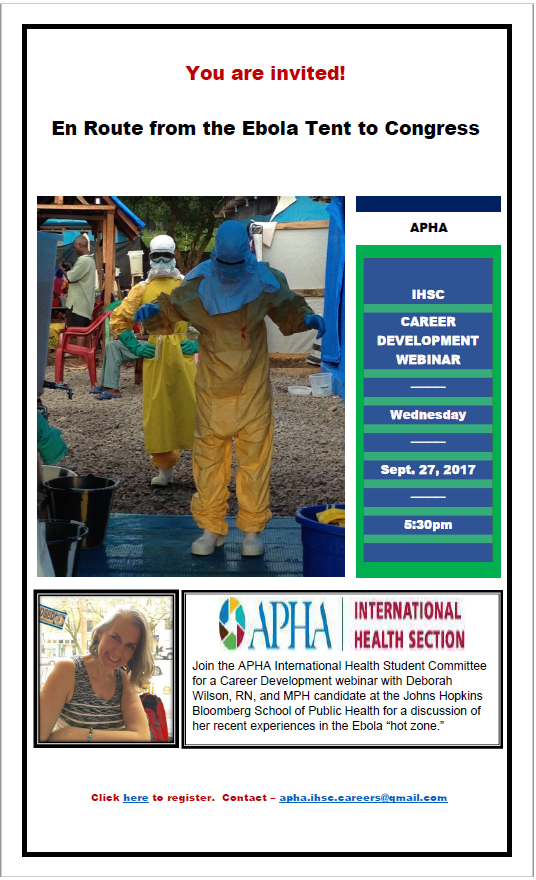
Join the APHA International Health Student Committee for a Career Development webinar with Deborah Wilson, RN, and MPH candidate at the Johns Hopkins Bloomberg School of Public Health for a discussion of her recent experiences in the Ebola “hot zone.”

September 27th, 2017 @ 5:30 pm

Click here to register. Contact – apha.ihsc.careers@gmail.com


sept webinar

The 9th TEPHINET Global Scientific Conference: Ending Pandemics in our Lifetime Initiative

From August 7th-11th, The Training Programs in Epidemiology and Public Health Interventions Network (TEPHINET) held its 9th Global Scientific Conference and the 23rd National Epidemiology Seminar in Chiang Mai, Thailand. I had the opportunity to listen to a panel presentation on Global Influenza Surveillance as well as the following presentation on Ending Pandemics. The overview I have provided below summarizes Mark Smolinski’s (Director of Global Health Threats at Skoll Global Threat Funds) presentation on innovations in surveillance for personal, national, and global health security. Feel free to listen to the entire presentation (1:17:00-2:16:28)!

  • Epi curves generally focus on human disease but human disease and animal outbreaks coincide or trigger one another. Additionally, bioterrorism can play a role in outbreaks and should be included in epi curves.
  • There are six main opportunities for epidemiologists/public health practitioners to intervene and reduce risk from pandemic threat:
    • Stop the threat in the animal population
    • Reduce the epi curve in the animal population
    • Find the first human cases (quickly)
    • Limit human infections and stop the epi curve in the animal population
    • Ensure strong surveillance/warning systems are in every country so disease doesn’t spread beyond country borders
    • Know and work directly with neighbors across borders so that regional security exists to stop any outbreak/prevent pandemics
  • It costs 3.4 billion dollars to prevent a pandemic by ensuring that developing countries have baseline capacity/public health systems that meet international standards. The return of investment is 10 fold. We are currently at ~450 million dollars.
  • Innovations in Surveillance – Researchers in tech as well as universities are involved in innovative surveillance methods, not necessarily epidemiologists/public health practitioners:
    • Google Flu Trends –predictive of flu and comparable to CDC flu reports (visits to providers), which were delayed by two weeks (80% of ill individuals did not visit a provider)
    • Twitter – University of Rochester developed an algorithm that can predict flu with 90% accuracy and gives an 8-day notice of when someone will get the flu (based off of tweets of others in your community/social circle)
    • HealthMap/Flu Near You – Participatory surveillance system that allows people to check off symptoms, see results on a map, and find where the closest vaccines are; correlates very well with the CDC influenza-like illness surveillance (over 5 years)
    • Epi Hacks – the idea is to bring together human, animal, and environmental health experts for one week to work with developers to come up with open source products for countries to use (for surveillance purposes); at least one has been conducted on each continent
    • PODD – uses a One Health approach as people in villages are tasked with helping find outbreaks quickly and reporting animal morbidity/mortality in real-time
    • KIDENGA – CDC and the University of Arizona are working together on vector-borne surveillance on the U.S/Mexico border, an epi hack will take place to see if they can create a sustainable way to address vector-borne diseases
    • Guardians of Health app – asked attendees to report health issues or symptoms during the World Cup, attendees received health information and program updates/information in return
    • EPICORE – retrospective analysis of public health information related to outbreaks; an automated system that epidemiologists follow-up on (after requests for information have been sent out)
  • When there are no outbreaks, public health gets no credit…
  • All countries cannot meet the International Health Regulations, even if they agree that they SHOULD be met
  • Skoll Global Threats Fund teamed up with Google and examined publicly available data at the World Health Organization (WHO) to determine how long it takes to detect, report, and respond to outbreaks; found that the global community is improving but has plateaued (due to limited data)
  • Research Paper – Finding Outbreaks Faster – Smolinski MS, Crawley AW, Olsen JM. Finding Outbreaks Faster. Health Security. 2017;15(2):215-220. doi:10.1089/hs.2016.0069.
    • There are epidemiologists in 28 countries looking at data from each outbreak to determine 6 metrics that all countries can follow (over past 5-10 years)
    • Countries had never looked closely at this issue and were able to see their strengths and weaknesses in investigating different types of outbreaks
    • Hot Spots of Emerging Infectious Disease – CORDS
      • Build friendship and trust across borders
      • Helps regional disease investigation networks share best practices, scale innovations, optimize informal networks
      • South Asia and West Africa are the most concerning for emerging infectious diseases, in a few years they may have stronger regional networks
  • Ending Pandemics Collective
    • 14 foundations and leaders of companies concerned about social responsibility want to invest in global health, share ideas, coordinate funding for projects, break down barriers in the foundation world
      • Smithsonian Museum of Natural History wants to do a 2-year exhibit called outbreaks, collectively a great chance to improve the knowledge base of people that visit the exhibit (~7 million people)
      • In 10 years the collective sees a world where:
        • Every outbreak is detected within 3 incubations periods of the index case or cluster
        • Every country’s Emergency Operations Center is utilizing an integrated, event-based detection system being used simultaneously by the WHO and G20
        • Human, animal, and environmental health volunteers are verifying rumors or suspected threats within 24 -48 hours through EpiCore
        • Participatory surveillance is engaging communities directly to detect and respond to outbreaks in every disease hotspot across the globe
        • Field epidemiologists in every country are using the latest technology to detect, verify, and respond to outbreaks faster
  • At the end of the day, pandemics can be prevented because “no community is too hard to reach, no community is too poor to innovate, and curiosity outshines fear!”