
How much education does it take to learn to wash people’s feet?

By Barbara Waldorf RN, MPH (candidate)
Boston University School of Public Health
Recently, in a health policy class at BUSPH, I listened to Dr. Jim O’Connell describe how, as a hot-shot young doctor fresh from being the chief resident at MGH, he was told that to start his new job at the Pine Street Inn, he would be washing the feet of the homeless clients at the nursing clinic. The struggle with his (and the medical profession’s) ego was palpable. To his credit and the benefit of thousands of homeless people over the next 20 years, he chose, in that moment, to not know, to trust the nurses and to learn a in new way.

Ruth Stark, in her training manual for working abroad, speaks of the critical importance of learning to listen when in a another country or culture. Her advice to everyone who ventures beyond their boundaries, who wishes to have an impact in a different cultural context, is to spend significant time asking questions rather than assuming prior knowledge, and to cultivate humility.

There is no doubt that facts and figures, economic theory and the scientific process are important. These can be taught. Graduate education in public health gives us the tools for financial analysis, the application of management principles and the rigor of epidemiology and biostatistics. These are the building blocks of the profession.

Yet, without the more intangible skills of listening, humility, curiosity about the unknown and a profound respect for the deep threads of humanity that bind us together, we will not be able to make the right decisions. Paradoxically, the depth of respect for, and willingness to learn from, other people’s wisdom and knowledge is based in the confidence and knowledge of one’s own culture, experience and education. Without grounding in self-respect, how can we access that which needs to be given? In order to become an advocate for real change and have the discernment to make important decisions, we need to know ourselves.

I washed the feet of homeless women at the Pine Street Inn the same year as Jim O’Connell. As a student nurse at UMass/Boston, it was my community health placement. I was young, suburban, and middle class with noe xperience of inner city, drug addicted, alcoholic or mentally ill homeless folks. I was scared and felt I had nothing to give. But as I sat with them, day after day, soaking their feet, listening, being with them as a human being, something happened.

Something was touched that opened my eyes, both inner and outer, to a very different way of being. It changed me in a fundamental way and shifted both the trajectory and context of my professional life. I owe the homeless women who allowed me to wash their feet for an education I have utilized all my life. It has taken me throughout the world, and allowed me to be with people I could not speak with; to work in situations I did not understand and to take risks and move into arenas I did not know.

That thread has led me to now pursue a Masters degree in public health, where new vistas are opening up. Understanding how economic theory explains the provision of care, finding a new perspective on health care systems and gaining the building blocks to decide when and where to intervene in complex emergencies. Something has come together here, which is the place where my education from the university meets my education from the women of Pine Street, from the Tibetan refugees I cared for in the mountains of Nepal and from my schizophrenic clients in Boston.

To answer the question, it takes a lot of education to wash people’s feet, to be present for them, to be a true advocate and to understand when to speak and when to listen.

Barbara Waldorf is an RN and working on her MPH at Boston University School of Public Health with a concentration in International Health. Having lived and worked in Asia, Europe and Australia, her current interest is in the emerging field of Global Health nursing and learning from other nurses who are active in this field.
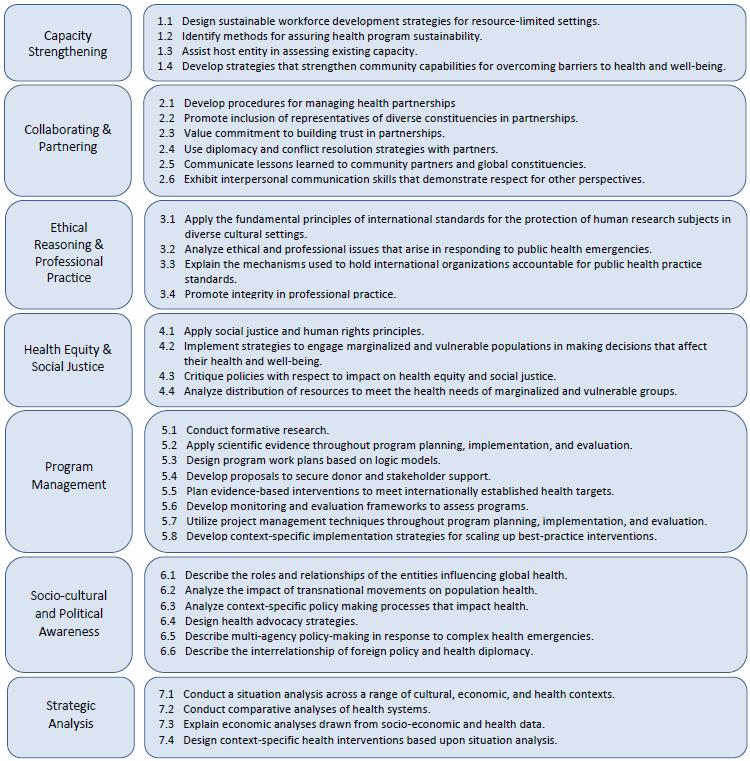
ASPH Calls for Comments on its Draft Global Health Competencies

ASPH has recently released a draft of its Global Health Competency Model, a set of competencies recommended for graduates of master’s level programs in global health.  They are based on the organization’s MPH core competencies and are divided in to seven “domains,” or categories.  According to the draft,

…formal educational programs for global health professionals are highly fragmented in terms of the institutions offering such programs and quite varied in terms of the outcomes and qualifications expected of graduates. As the number of institutions offering formal training in global health grows, ASPH has taken leadership in developing a competency model based on the necessary roles and functions of the global public health system of the future. This approach recognizes that global health and public health represent a unified front with a long tradition of bringing scientifically-validated programs, policies, and services to bear upon the world’s most pressing health needs. A Lancet article in February 2010, in which ASPH global health leaders sought to emphasize the common framework of global health, international health, and public health, stated that “[g]lobal health and public health are indistinguishable,” further defining the scope of this initiative.

The document (pdf) can be viewed here.  Below is a screen grab of the competencies.

ASPH is calling for comments on the draft by Friday, September 23.  Comments may be sent to ghcompetency@asph.org.

CDC Evaluation Fellows Program (Atlanta, GA)

Evaluation Fellows Program
Office of the Associate Director for Program, Centers for Disease Control and Prevention (Atlanta, GA)
CDC-OADPG-2011-0032

Project Description:

CDC seeks applicants for the inaugural class of the CDC Evaluation Fellows Program.  This is a new initiative within CDC and represents a major commitment by the Agency to program evaluation and program improvement.  Fellows will be selected and will be housed in the newly-created Office of the Associate Director for Program and collaborate with the evaluation team under the leadership of CDC’s Chief Evaluation Officer.  Fellows selected for this new initiative will be assigned out to CDC programs to help develop and implement program evaluations and evaluation studies.  These host programs will be selected through a competitive process to ensure Fellows are being assigned to important and productive evaluation projects that will build the knowledge base of the program and enhance the professional development of the Fellow.

Fellows will conduct  evaluations and help to build the evaluation skills and capacity of the staff in the program to which they are assigned.  Fellows may be assigned to one program/project for the duration of their fellowship or may rotate to several programs, depending upon the duration of the project.  Fellows will have a  point of contact within the program as well as mentoring and support from AD Program staff. In addition, we have reserved some dedicated resources for training and professional development of Fellows.

The participant will receive a monthly stipend depending on education level and experience. The participant must show proof of health insurance. The appointment will be full-time at the CDC in the Atlanta, Georgia area. Participants do not become employees of CDC or the program administrator, and there are no fringe benefits paid.

Additional details regarding the ORISE Research Participation Program can be found at http://www.orau.gov/cdc

Qualifications:
The ideal candidate has a PhD in evaluation, social sciences, public health, or other relevant discipline plus some experience with applied evaluation projects.  Master’s-level candidates with significant experience in applied evaluation projects are also welcome.  Candidates must have received their degree within the past five years to qualify for this program.

Technical Questions:
The Research Participation Program for CDC is administered by the Oak Ridge Institute for Science and Education. To be considered, send a current resume to Tasha Powell via email at Tasha.Powell@orau.org  or via fax at (865) 241-5219. Please reference Project # CDC-OADPG-2011-0032 in all communications.

Global Health News Last Week

SECTION NEWS

The following announcement is from Peter Freeman, chair of the section’s Advocacy and Policy Committee, regarding their first Advocacy Day to take place in conjunction with this year’s Annual Meeting in Washington,DC.

To all International Health Section Members:

The Advocacy/Policy Committee would like to invite you to participate in our first Advocacy Day, led in partnership with the Global Health Council. The day, scheduled for Thursday, November 3rd, 2011, will be an opportunity for us to voice support for a continued focus on international health to our elected officials. With the intense Congressional pressure to cut the budget, our voices can make a real difference. As a participant during this exciting day, you will be provided with training materials on effective advocacy techniques to ensure your message is clearly heard. Even if you do not have advocacy experience, you need not hesitate to sign up because you will be teamed with others. Please consider joining your fellow International Health Section members on Thursday, November 3rd, 2011 on Capitol Hill to advocate for a healthy globe.

Interested parties should contact Peter Freeman, Advocacy/Policy Committee Chair, at pffreeman@gmail.com or 773.318.4842 with their name, phone number and e-mail address. A registration link for the Advocacy Day will be sent out to the section by mid-September; please be on the lookout for it.


August 20 was World Mosquito Day.

On August 22, the Gates Foundation celebrated its 12-year anniversary (well, sort of).

POLITICS AND POLICY

PROGRAMS

  • Donor funding for AIDS has decreased by 10 percent during the recent economic recession. The overall decrease in global AIDS funding marks a stark reversal in trends for previous years.

RESEARCH

  • Proposals for Round 8 of the Grand Challenge Exploration, a $100 million grant initiative to encourage innovation in global health and development research, are now being accepted.  Proposals can be submitted until November 17, 2011 at 11:30 am Pacific Daylight Time.
  • Researchers from Michigan State Universityare working on bringing a low-cost, hand-held device to nations with limited resources to help physicians detect and diagnose cancer. The Gene-Z device is operated using an iPod Touch or Android-based tablet and performs genetic analysis on microRNAs and other genetic markers.
  • The problem of obesity is spreading around the world and poses serious health threats.  The finding is part of a new special report on obesity, and how to combat it in the medical journal the Lancet.
  • A team of Australian researchers have discovered a breakthrough in the reduction of dengue. By injecting mosquitoes with a bacteria, they were able to block them from transmitting the virus that kills 20,000 people a year.
  • Nanotechnology, the science of manipulating tiny particles, has is rapidly finding wide application. Developing countries that embrace nanotechnology should not overlook possible risks and must regulate products that contain nanoparticles.
  • A study has found that nasal spray vaccines for influenza delivered to children between the age of six months and three years old are more effective than other vaccines.
  • In a study released by the International Journal of Biological Sciences, analyzing the effects of genetically modified foods on mammalian health, researchers found that agricultural giant Monsanto’s GM corn is linked to organ damage in rats.

DISEASES AND DISASTERS

  • The current famine in the Horn of Africa has again brought to our attention the interaction between climate change, food prices and extreme weather conditions on the African continent.
  • Most of the world’s population growth today is in urban areas creating what some are dubbing unstable, unsustainable “mega-cities.” A new report by the World Wildlife Fund says that by 2050, about 70 percent of the world’s population will live in urban areas creating “horrendous” problems.
  • In Sub-Saharan Africa, a combination of inaccurate testing and patients quick to seek treatment has lead to a worrisome trend: treating patients for malaria when they do not have the disease.
  • HIV epidemics are emerging among men who have sex with men in the Middle East and North Africa, researchers say. It’s a region where HIV/AIDS isn’t well understood, or studied.  More than 5 percent of men who have sex with men are infected by HIV in countries including Egypt, Iran, Lebanon, Morocco, Sudan and Tunisia, according to a recent study in PLoS Medicine. In one group of men in Pakistan, the rate of infection was about 28 percent.

INFOGRAPHICS AND OTHER INTERESTING VISUALS

Thanks to Tom Murphy and Mark Leon Goldberg, Tom Paulson, and Isobel Hoskins.