Member spotlight: Len Rubenstein featured on NPR’s Morning Edition

Longtime IH Section member Len Rubenstein was on NPR’s Morning Edition this week! On Monday morning, he was featured in a story on attacks on health workers in conflict:

Leonard Rubenstein, a lawyer who directs a program on human rights, health and conflict at the Bloomberg School of Public Health at Johns Hopkins. says there were a staggering number of assaults on health care facilities in 2016.

“The international community says it wants to stop this and then does nothing to implement its own recommendations,” he says. “These attacks go on.”
Rubenstein is the editor of a new report called “Impunity Must End” about aggression against health facilities and health workers globally last year.

Rubenstein found that health care facilities were under assault last year in many other parts of the world. The report was not able to compile data on the total number of attacks in each country.

“It’s quite remarkable how varied the forms of attack are,” Rubenstein says. “For example we found in 10 countries hospitals were bombed or shelled, in 11 countries health workers were killed, in about 20 countries there were various forms of intimidation — abductions, kidnapping of health workers.”

You to listen to the story here. A transcript is also available.

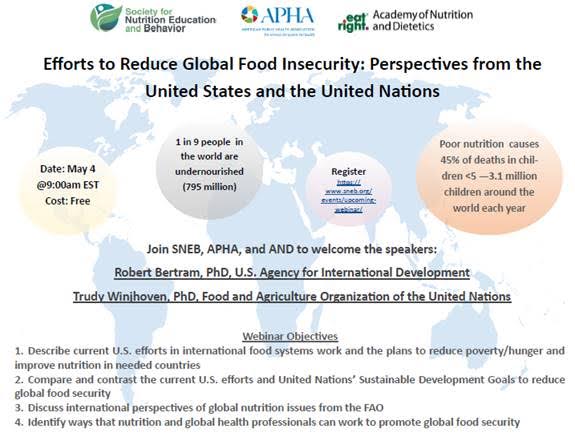
Efforts to Reduce Global Food Insecurity: Perspectives from the United States and the United Nations Webinar on May 4, 2017

On behalf of the Society for Nutrition Education & Behavior (SNEB), American Public Health Association, and the Academy of Nutrition & Dietetics, we invite you to an upcoming webinar on “Efforts to Reduce Global Food Insecurity: Perspectives from the United States and the United Nations”.

unnamed

This webinar will introduce the Global Food Security Act of 2016 and expand on America’s current efforts to help promote food security around the world. Speakers will provide perspectives from the U.S. Agency for International Development and Food and Agriculture Organization of the United Nations to explain the current situation of global nutrition issues and progress made to alleviate global concerns such as hunger, chronic health issues, and mortality. Suggestions will be discussed on how nutrition and global health professionals can pitch in to reduce global food insecurity.

Register for webinar here or paste in browser: https://www.sneb.org/events/2017/05/04/upcoming-webinar/efforts-to-reduce-global-food-insecurity-perspectives-from-the-united-states-and-the-united-nations/

Time/date: 9:00-10:00am EDT, Thursday, May 4th

This webinar is hosted by the SNEB International Nutrition Education Division and co-hosted with the SNEB Advisory Committee on Public Policy, American Public Health Association – Food & Nutrition Section & International Health Section, and the Academy of Nutrition and Dietetics.

Global News Round Up

Politics & Policies

China is on the course to unseat the US as the next leader in global health.  While the US has historically had a strong role in providing vaccinations, reducing global deaths from measles, polio, and malaria, China is evolving from a receiver of aid and vaccinations to a provider.

President Donald Trump, striving to make good on a top campaign promise, is pushing his fellow Republicans who control Congress to pass revamped healthcare legislation but the same intraparty squabbling that torpedoed it last month could do it again.

President Trump’s budget has proposed drastic cuts to foreign affairs funding – by almost 30%. This reduction in aid would hit U.S. and United Nations agencies that lead the global fight against many infectious diseases, polio among them.

On the global health front, the new administration is on the steep part of the learning curve.  And people worried about its understanding of and appreciation for the benefits of US global health spending — worries exacerbated by proposed to-the-bone cuts in the president’s budget blueprint — are hoping to fast-track that education process.

SNAP is one of the largest safety net programs in the United States, and the largest nutrition program. It currently helps 45 million low-income Americans – nearly half of them children –  pay for food each month. But while the program’s current benefits reduce hunger, they don’t go far enough to help most families to purchase healthy food.

On March 30, the Center for Technology Innovation (CTI) at the Brookings Institution hosted three expert panelists at our forum on health governance capacity to discuss the findings of the recently released Health Governance Capacity report. This was the first of six reports to be released as a part of the Brookings Private Sector Global Health R&D Project.

Programs, Grants & Awards

Polly J. Price, professor of law and professor of global health at Emory University, has been named one of 35 recipients of the 2017 Andrew Carnegie fellowship.

The Global Health Leadership Institute, founded by Elizabeth Bradley in 2009, will lose its funding from the Provost’s Office and integrate into the School of Public Health after the end of the University’s fiscal year on June 30.

The 14th Annual World Health Care Congress convenes decision makers from all sectors of healthcare to catalyze meaningful partnerships and change. In 2017, faculty focus on policy and market forces impacting the healthcare business environment including consolidation, consumer empowerment, digital health, and the ongoing shift to value-based payment.

The World Health Assembly is the decision-making body of WHO and will be meeting in Geneva, Switzerland on May 22-31.  It is attended by delegations from all WHO Member States and focuses on a specific health agenda prepared by the Executive Board. The main functions of the World Health Assembly are to determine the policies of the Organization, appoint the Director-General, supervise financial policies, and review and approve the proposed programme budget.

The diplomats who met to form the United Nations in 1945 also discussed the need for a global health group; that led to the creation of the World Health Organization. Its constitution went into effect on April 7, 1948, and World Health Day is celebrated annually on April 7.

Research

The impact of environmental change can be passed on in the genes of tiny nematode worms for at least 14 generations – the most that has ever been seen in animals – scientists have discovered.

In the first study to link depression with underweight body types, the research found that both both men and women can be impacted by negative thoughts about being too skinny.

Despite the well recognized health benefits of fresh fruit consumption, substantial uncertainties remain about its potential effects on incident diabetes and among those with diabetes, on risks of death and major vascular complications.

The model of infectious disease prevention and control changed significantly in China after the outbreak in 2003 of severe acute respiratory syndrome (SARS), but trends and epidemiological features of infectious diseases are rarely studied. In this study, we aimed to assess specific incidence and mortality trends of 45 notifiable infectious diseases from 2004 to 2013 in China and to investigate the overall effectiveness of current prevention and control strategies.

Diseases & Disasters

The National Primary Healthcare Development Agency, NPHCDA, on Friday said vaccinations, including against Cerebrospinal Meningitis, CSM, are provided free of charge by the Nigerian government.

The incidence of angiostrongyliasis, nicknamed “rat lungworm” illness because of its origins (it comes from a parasite in the lungs of rats via rat feces to snails and slugs and then through contaminated food or drink to humans) is on the rise in Hawaii.

About 1.24% of the 5000 Latin-American born LA residents were tested positive for Chagas disease.

While the number of deaths due to malaria has dropped by nearly two-thirds over the last 15 years, there is growing concern about the signs of resistance to existing anti-malarial drugs.

To mark the World Malaria Day on April 25th, WHO announced that the world’s first malaria vaccine is moving to the next phase and is going to be introduced in Kenya, Ghana and Malawi next year.

A new water supply system was inaugurated by the UN in Lascahobas, Haiti to combat the cholera epidemic.

More than two thirds of people living in Chile, Ecuador and Mexico are overweight or obese, costing their economies tens of billions of dollars every year, driving rates of disease and straining health services, a UN report said on Tuesday.

Technology

MIT research scientist Richard Fletcher directs the Mobile Technology Group at MIT D-Lab, which develops a variety of mobile sensors, analytic tools, and diagnostic algorithms to study problems in global health and behavior medicine

Researchers have isolated a substance in the blood of Komodo dragon that appears to have potent germ killing properties.

Researchers have built a device that could harvest water from dry air and is powered by the sun.

Environmental Health

Diesel car owners might be paid to trade in their cars under UK’s new air quality plans.

While fossil fuel like oil and coal get most of the blame for climate change and pollution, agriculture also contributes to the problem. American farmers – the world’s biggest grain producers – are responsible for 9 percent of all US greenhouse-gas emissions, and rice has three times as much per acre as corn and five times that of wheat, according to a University of California-Davis study in 2012.

Environmental groups have urged the UK Prime Minister not to water down climate change and illegal wildlife trade regulations to secure post-Brexit deals.

Equity & Disparities

The Summit on Neglected tropical Diseases held in Geneva is an opportunity to identify solutions to address gaps that prevent millions of people from seeking care and  treatment.

Gender mainstreaming is a stated policy in Papua New Guinea but a new study shows that the application of this policy has often been technocratic. The study found that gender is rarely mentioned except in the context of maternal and child care programs.

Maternal, Neonatal & Children’s Health

A new analysis shows that children and adolescent mortality burden is larger in countries with low socioeconomic status.

According to the Kenyan Demographic Health Survey, infant mortality rate has decreased from 59 per 1000 live births in 2009 to 39 per 1000 live births in 2014 and there also has been an impressive increase in the number of mothers seeking antenatal care (88% in 2003 to 96 % in 2014).

New World Bank Massive Open Online Course (MOOC) – ‘From Climate Science to Action’ starting May 8, 2017

The World Bank Group is offering a Massive Open Online Course (MOOC) on climate change – ‘From Climate Science to Action’ – starting May 8th 2017.

The new course presents the most recent scientific evidence on climate change. It explores different strategies for low emission and climate resilient development, and provides an overview to the Paris Agreement ratification with some reflections on COP22 outcomes. Through interactive video talks, complimented with curated readings, resources and quizzes, renowned scientists and policy makers from the field will lead you through the course. An active discussion forum on the course would further enhance learning where participants get to exchange knowledge with peers from across the globe. As the course concludes, you will be invited to reflect on what you can do at the national, local, community, and individual level to limit global warming below 2°C and adapt the impacts already occurring.

You can audit video lectures and some course content for free. If you want to complete the course and earn a Course Certificate by submitting assignments for a grade, you can purchase the course for a small fee. Financial aid is available if you cannot afford the course fee.

Workload: 3-6 hours/ week

Register for this four week course here.

2017 Zika Update: A Synopsis

In 2015, I put together a panel of diverse public health professionals in order to provide graduate students with guidance on how to best prepare for (and land) a relevant public health job. The majority of the seasoned professionals on the panel (all epidemiologists) mentioned the impact 9/11 had on them being able to get a job, as a result of new positions created with emergency preparedness funding. I graduated shortly after this presentation and was able to secure a High-Consequence Infectious Disease (HCID) position at a local health department in Texas. These surge capacity epidemiologist positions had been made available as a result of the Ebola outbreak. Some of my peers were able to land similar positions around the state of Texas during the same time (or shortly after).

Although these positions were created in response to the Ebola outbreak, the emerging Zika crisis in Brazil became the high-consequence infectious disease of focus for us. Within a few weeks of starting my position, the epidemiology office at my local health department began to receive requests from local media for more information about Zika virus and the risk it posed to community members. Additionally, we were receiving continual updates from the Department of State Health Services, Zoonosis Control Branch concerning laboratory testing, preventive measures, and risk assessments for pregnant women and their partners. I was in charge of consolidating and disseminating this guidance to our local health care providers and community partners. It was also during this time that I  created a short quiz to gauge knowledge of key aspects of the illness and provide answers from relevant sources such as the Centers for Disease Control and Prevention (CDC), the Pan American Health Organization (PAHO), and the World Health Organization (WHO). The survey was tested out in the LinkedIn Global Health group and then later included in a presentation I put together for local health department and county staff. The quiz answers and presentation were updated periodically, as we learned more about Zika virus through conference calls and webinars. By the time I started a new position a year later, the number of Zika virus cases being reported globally had started to decrease.

That’s just a little of my experience with Zika. Now, I will share a brief, global synopsis of Zika.

In 2016, the World Health Organization (WHO) declared Zika virus to be a Public Health Emergency of International Concern due to its association with congenital microcephaly in infants born to women who had been infected during their pregnancy. Additionally, neurological conditions such as Guillain-Barre syndrome (GBS) were also being reported in adults who had been infected with Zika virus. Zika virus is said to be transmitted through the bite of an infected Aedes aegypti mosquito. It is also spread through sexual and congenital transmission.

Since May 2015, more than 750,000 confirmed and suspect Zika virus cases have been reported globally. Cases have been spread throughout more than 60 countries and territories. From May 2015-Dec 2016, there were 707,133 suspect and laboratory confirmed Zika virus cases in the Americas due to local transmission. Twenty-five percent of these cases were laboratory-confirmed. By late 2016, Zika virus transmission had occurred in 48 countries and territories in the Region of the Americas. Peaks were observed at various points during this time period (some regions even experienced more than one):

-January 2016 (Central America)
-February 2016 (Southern Cone, Andean subregions, and non-Latin Carribean)
-June 2016 (Central America and non-Latin Carribean)
-January-July 2016 (Latin Carribean; also the region with the highest number of Zika virus cases)

Zika virus rates in North America were relatively low, with a small peak occurring in October 2016. According to the U.S. Zika Pregnancy Registry (USZPR), 10% of completed pregnancies with confirmed Zika virus infection reported birth defects. Microcephaly was reported in 84% of completed pregnancies with birth defects. Additionally, birth defects were higher during the first trimester of pregnancy. Compared to pre-Zika levels in 2013-2014, 30 times more fetuses/infants were reported to have birth defects in 2015-2016. A similar trend was seen in Brazil when comparing pre-Zika data to data collected from mid-2015 to Jan 30, 2016 (read limitations in both articles).

In November 2016, WHO re-classified Zika virus as a long-term public health challenge  (instead of a Public Health Disease of International Concern). Since December 2016, there has been a significant drop in the number of cases being reported, however, CDC is reminding the public to follow preventive measures as the mosquito season gets closer.