
Read Dr. Georges Benjamin’s response to our open letter and learn how you can be involved in public health advocacy efforts:

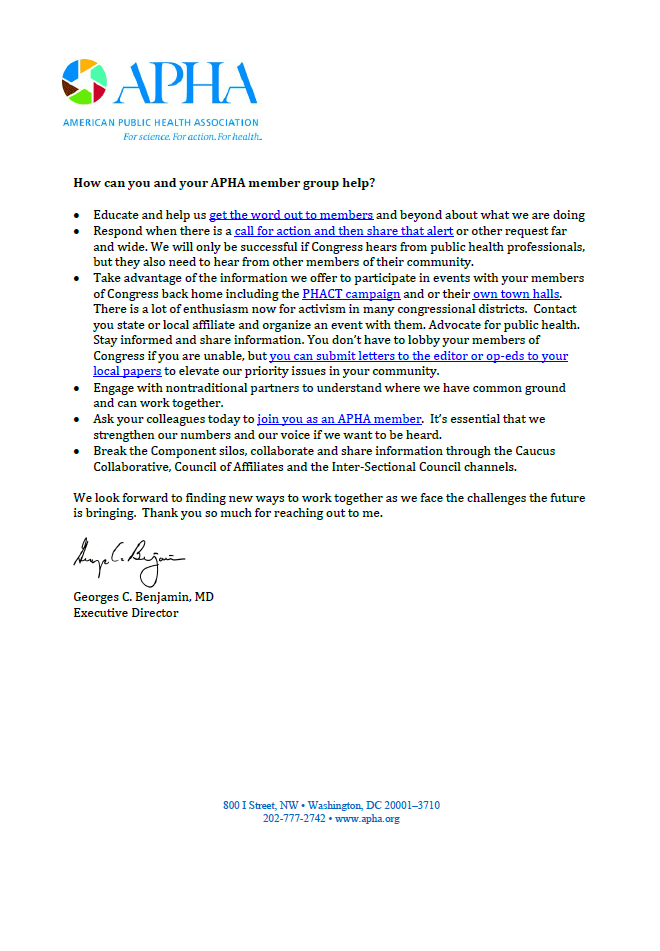

Read Dr. Georges Benjamin’s response to our open letter and learn how you can be involved in public health advocacy efforts:
This is the final installment of a three-part series the IH Blog will feature this week called Global health career insights: Lessons on the job market, how to crack it, and what to do once you’re in.
Jessica’s post on the results of the Section’s analysis of the global health job market speaks a lot to the harsh realities of the global health field, and development more broadly. Much like her, I did not start out working in global health – in fact, I entered it 10 years after my public health career already started. I worked for free (well, academic credit) to fulfill my (200 hour minimum) MPH practicum requirement (which I did while working basically full-time and continuing to take classes) on a global health project with my current organization, whom I now work for full-time. When I started my practicum, I already had a very robust set of specialized knowledge and like so many other global health professionals of my generation, I was lucky enough to be introduced to my organization through someone in my public health network.
Throughout my public health career, it has been disheartening for me to see how limited the opportunities are for entry-level public health professionals. In the short three years I’ve spent working in global health now, I’ve learned that for many employers, both big and small, it is the nature of our projects and our funding cycles that often prevents us from taking big risks (and this applies beyond just hiring decisions). It’s not that we don’t want to hire entry level folks! Unfortunately, grants and projects are often done in short to very short cycles, which puts employers in the tough position of needing someone who can really hit the ground running – and running really, really hard.
While the field is admittedly tough to crack, it is not impossible. Global health will always need dedicated professionals who will bring their passion, persistence, and innovative thinking to their “dream job,” whether it is managing projects, analyzing data, or filling that elusive technical advisor role. The goal of the global health jobs analysis project isn’t to discourage our Section’s students and aspiring professionals from entering the global health field completely. Rather, it’s meant to provide a roadmap on how to enter the field. With that in mind, here are five practical strategies you can integrate into your career development:
1. Find a way to live abroad and learn another language. This is more essential for some technical areas than others, but it never hurts – and for many employers, it can make your application stand out even if the position you are vying for doesn’t explicitly require it. Experience living overseas in particular demonstrates that you are adaptable to challenging environments and able to work with individuals with different cultural backgrounds. You don’t even necessarily have to be doing global health work. Even teaching English or a working holiday doing manual labor can showcase your resilience as a job candidate.
2. Build a robust set of technical skills. From my perspective, the toughest job search reality for public health generalists trying to enter this field is the shift favoring the hiring of candidates with more technical skill sets. I work in the mHealth sector of development where there is a huge need for talent. However even if the position isn’t that of a computer programmer, these job descriptions often still look for technical knowledge. So regardless of if you have a degree in anthropology or in engineering, employers seeking candidates need someone who has more than just a passion for global health and good communication skills. They need employees with technical know-how and in my field that’s either knowing project management standards, how to write and debug code, develop databases, write technical reports, run statistical analyses, or create data visualizations. Find out what technical skill set is needed for your “dream job” and work on perfecting your craft. This will help your resume stand out from the crowd greatly.
3. Work somewhere else first. A growing number of entry-level jobs in global health are going to people in country, and this isn’t a bad thing. In fact, it’s absolutely essential for country ownership. However, there is still significant need for trained professionals in a wide variety of fields who know how to function in a professional environment and work well with a wide variety of colleagues. Sure some basic soft skills are essential – flexibility, open-mindedness, and a willingness to learn from others can take you far. But many more can be learned on the job. If you really want to make an impact in global health, find a professional vocation you are passionate about, get really good at it, and hone in on your ability to teach and be taught. Whether you’re a nurse, a project manager, an architect, a 5th grade teacher, or a data scientist, there is a need for your know-how somewhere in development.
4. Find alternative ways to work for free that don’t break the bank. I know many of us young professionals are shouldering what feels like a mountain of student loan debt, but if you can find a way to swing this and be practical about it, this is still one of the best ways to get your foot in the door. You don’t have to forego a day job, either. For those of you currently pursuing a Master in Public Health, find an organization that does work in an area you are interested in and ask if you can do a practicum, internship, or fellowship with them. If you’re already out in the workforce, volunteer your professional skill set to global health professional societies (like the IH Section!) or other professional volunteer organizations (like Engineers Without Borders, DataKind, or Teachers without Borders). Even a Google or LinkedIn search of organizations you’re interested in volunteering for should do. If you’re cold contacting an organization, make clear to them what value proposition you can offer and don’t be afraid to be persistent. While it can be a hustle, it is a good way to get experience that will give you a leg up and help you build a professional network. Which leads to…
5. Build a professional network. This advice is true in any field, but it is especially true in development. While requesting email and phone informational interviews can be helpful, getting out and meeting people one-on-one is still the best way to network. Attend relevant lectures at your local university or find a local organization that does (World Affairs and Commonwealth Club offer lectures for those living in my home base in the San Francisco Bay Area) and meet other like-minded folks. You never know who you could be sitting next to. Sign-up for list-servs like Global Health Delivery Online to connect virtually with the global health community. Attend professional society meetings with a global health focus or track like APHA’s Annual Meeting. Talk to the presenters or the person sitting next to you. These meetings are a networking gold mine!
It will take some time for the incoming generation of global health professionals to transform this field. Shifting from short-term funding cycles to long-term ones is only one way to facilitate more attainable entry points into a global health career. Until then, those of us already working in the field must make sure that we invest in aspiring global health professionals, encouraging them to take on leadership roles, and fostering their talents and ambitions through mentorship. Global health and development needs young people and their fresh perspectives in order to keep up with this rapidly changing world.
Now we want to hear from you! Please share your stories and insights on how you crafted your career and positioned yourself to enter the global health field. Get in touch with us at ihsection.communications@gmail.com.
This is the second part of a three-part series the IH Blog will feature this week called Global health career insights: Lessons on the job market, how to crack it, and what to do once you’re in.
One “global health career beginnings” story that has stuck with me over the years was one that was shared at the International Health Careers panel discussion put on by the Section at APHA’s 2011 Annual Meeting. The panelist explained that he got his start in global health because he and his wife were hopeless idealists who wanted to provide health care to the poorest. In true 60s hippie spirit, the two of them climbed into their Volkswagen after he finished medical school and drove from Germany to Morocco by way of the Bosphorus to volunteer their services through an order of nuns who were providing care and support to the locals. “Of course,” he chuckled, “you can’t do that anymore.”
Nearly every career path story I hear from the global health professionals that are now approaching retirement is woven with the same frustrating thread.
You might say I failed at landing my “dream job” in global health. Unlike many well-established and highly experienced global health professionals of the Baby Boomer generation, I have wanted a career in global health since I was earning my MPH back in 2007. However, despite being the child of a first-generation immigration, being fluent in both Portuguese and French, having top-notch grades, and slowly working my way through increasingly advanced public health jobs in the U.S. over the years, dozens (if not hundreds) of applications for positions with global health and international development government agencies, government contractors, and non-profits have gone unanswered. An application to the Peace Corps went nowhere. After a while, I gave up. I taught English in South Korea to gain international work experience and started doing consulting and freelancing instead. That turned out to be a much more fruitful avenue: I have since been able to work with DAWNS Digest and on a climate change mitigation project in China, which turned into a book. Eight years after getting my MPH, I love what I do, but I’ve never actually occupied a “typical” global health job.
It’s possible that my job profile is worthless from an international perspective and I am simply unaware of that fact, but I doubt it. (In fact, I’ve been assured otherwise by multiple global health professionals and recruiters.) I began to suspect that the rosy picture being painted for me and other aspiring global health professionals by seasoned global health experts – that all that is needed for a career in global health besides some technical public health knowledge is an adventurous spirit and basic cross-cultural adaptability – was missing the mark. Out of hundreds of global health job vacancies I have scrolled through over nearly a decade, many call for a career’s worth of highly specialized technical knowledge. I began to wonder what the job market for global health graduates really looked like, and whether a simple willingness to “establish trust,” “practice humility,” and “respect the culture” were enough to break into that elusive technical advisor role. That was why we launched the Global Health Jobs Analysis project last year. We are finalizing the results for a manuscript this spring, but we presented initial findings at last year’s APHA meeting – results that pose a sobering counterpoint to the typical career advice presented to aspiring global health professionals.
1. The current global health job market looks completely different now than it did 25 years ago. Of the 1,007 distinct private-sector jobs captured by the analysis over six months, 75% were at the manager (median 5 years of relevant experience required), technical expert (6 years), or director level (8 years). Only 10% of jobs were considered entry-level. For overseas positions, that number is even smaller (6%). The difference on the supply side is staggering as well. Graduate training programs in global health have exploded in the last ten years, right along with the cost of university tuition. Now the applicant pool doesn’t just consist of anyone who happens to walk through the door – managers have their pick of tens of thousands of job applicants who can submit their resumes online. Valuable career advice should start with tips on how to get your resume through the screening software and in front of a pair of human eyes.
2. Front-door entry to global health jobs in the US government is all but impossible. At the Global Health Diplomacy session at last year’s APHA meeting, James Kolker, Assistant Secretary at the US Office of Global Affairs, admitted that no DHHS agencies had an entry mechanism or career path for global health professionals. Our analysis of federal jobs corroborates this: of the 123 global health-related jobs posted by the federal government during data collection for the analysis, none were open to master’s-level graduates (GS-9). 81% were GS-13 level or higher; for USAID, that figure went up to 85%. Anything higher than a GS-11 essentially requires at least a year of previous experience in a government agency, which means that these jobs are only accessible to those already on the inside. Also, many federal public health agencies rely on highly competitive fellowship programs as recruiting mechanisms and entry points. GHFP serves as one such mechanism for USAID. Of the 25 fellowship positions the program posted during data collection, all but 3 were for technical experts, with a median of 10 years of relevant professional experience required.
3. You have to be in the area and know someone on the inside. One hiring manager for Chemonics, USAID’s largest contractor (who, incidentally, got fined for discriminatory hiring practices last year), told me that he and most of the other managers in his division would not bother looking at submitted resumes that did not have a local address. Virtually all CDC recruiters I have talked to are reluctant to even interview someone outside of Atlanta. USAID and CDC in particular are increasingly turning to contractors to manage global health projects (which are typically short-term) and find technical experts to lead them. As with most other sectors, the best way to get in is to know somebody on the inside. Recruiters for these contractors tend to hire people they have previously worked with, many of whom are retired agency employees, which creates a “revolving door” with a limited group of professionals. Put another way by AidLeap:
Sadly, a lot falls down to who you know and/or luck. Many colleagues have told me they were in the right place at the right time, or that someone they knew from a previous job had helped them out. It’s wrong and I find it a very difficult pill to swallow, however, it is the reality.
4. The international development field, including global health, rewards unpaid work – and thus favors the wealthy. A lot has already been written about this by Gen-X development professionals who tend to be more forthcoming about the difficulties in breaking into this kind of career. Alanna Shaikh has touched on this issue in her own experience, explaining, “International development is a brutally competitive field to get into…If your heart is set on [it], then be prepared for a lot of unpaid jobs before you find one with a salary.” Similarly, Chris Blattman admits, “Be prepared to volunteer your first couple of jobs. The paid opportunities will come in droves, but only after you distinguish yourself from the mass of inexperienced undergraduates who want to work abroad. Offer to work for free, and consider paying your own airfare over to look for opportunities.” The trouble with this reality is that it favors people who have outside financial support (read: wealthy parents) and/or no student loan debt. An intense spotlight was shone on this fact with the story of the UN intern who found himself living in a tent on Lake Geneva. There is a tragic irony in the fact that careers in a field devoted to helping the poorest are largely inaccessible to those who are not wealthy.
5. We’re supposed to be putting ourselves out of business, anyway. There is a good reason that the number of entry- and mid-level jobs in global health and development projects is shrinking – those jobs are now occupied by citizens of the countries those projects are meant to benefit. Frankly, this is how it should be. We want low- and middle-income countries to take the lead on their own development. Unfortunately, this leads to a natural “aging” of the global health professional in demand, as the spots remaining to be filled are those requiring many years of targeted technical experience for a given project. All this has combined to make global health a murderously competitive field for American MPH grads.
Cultural competency and playing well with others are incredibly important in global health, and any career advice should emphasize those skills. But those lessons learned come in handy after you land the global health job. The student and ECP members of the IH Section, who make up nearly half of our total membership, will need more than just cultural competency and a listening ear to be able to land work as global health technical advisors. My hope is that the results and insights from the Global Health Jobs Analysis will help them to build careers that will eventually land one of those elusive, increasingly competitive “dream jobs.”
These are difficult realities to confront, and may make entry into the global health profession seem out of reach. Don’t despair! There is still room in this field for dedicated professionals, but cracking that “dream job” takes some strategic planning. Please stay tuned for the final part of this series, “Five practical career development suggestions to position yourself for the global health profession.”
Politics & Policies
Donald Trump’s election to the US presidency marks a time of global transition, with singular importance to health. The world is witnessing the rise in populist movements characterized by concerns about trade, immigration, globalization, and international organizations.
Nearly a dozen members of Congress are urging the US Army not to issue an exclusive license to Sanofi Pasteur to develop a vaccine for the Zika virus over concerns the product may be priced too high for many Americans, even though it was developed with taxpayer funds.
Programs, Grants and Awards
The third annual World Birth Defects Day is March 3, 2017. The day is designed to raise global awareness of birth defects and increase opportunities for prevention.
The government of Botswana announced a new $100 million pediatric hematology-oncology initiative this week called Global HOPE (Hematology-Oncology Pediatric Excellence). The new public-private partnership aims to treat children with cancer and blood disorders, modeled after successful pediatric HIV/AIDS treatment programs in the region.
Srilanka hosted the 2nd Global Consultation on Migrant Health, Feb 21st- 23rd, to build solidarity to improve health and lives of migrants.
The February 16 Climate & Health Meeting in Atlanta brought together more than 350 scientists and public health professionals to explore the science of climate change, the consequences to public health and possible solutions.
The Institute for Global Health Innovation presented a selection of research focused on end-of-life care at February’s Global Health Forum, hosted by the Helix Centre for Design in Healthcare.
Research
A new study predicts that South Korean women would be among the first to have an average life expectancy above 90 by the year 2030.
In a study published in the journal AIDS Brown University researchers propose a “new system of understanding and implementing pre-exposure prophylaxis (PrEP) programs in clinical practices” According to the study, it is helpful to view PrEP care as a continuum with nine proposed steps.
Diseases & Disasters
Global health officials on Monday unveiled a first-of-its-kind Llist of the world’s most deadly “superbugs” in a bid to urge businesses and governments to get serious about developing new antibiotics.
Nearly 75 percent of all deaths in the United States are attributed to just 10 causes, with the top three of these accounting for over 50 percent of all deaths. Over the last 5 years, the main causes of death in the U.S. have remained fairly consistent.
Rambling and long-winded anecdotes could be an early sign of Alzheimer’s disease, according to research that suggests subtle changes in speech style occur years before the more serious mental decline takes hold.
Abortion and AIDS are the two most common causes of death among Cambodian female sex workers and AIDS is the most frequent cause of death among their children, according to a small new study.
Technology
A vital race is on in laboratories across the globe to develop a vaccine for the Zika virus. However, even if a vaccine were available today, many of the world’s poorest people would not be able to receive it due to political and economic concerns surrounding vaccine injuries.
Environmental Health
Many lessons for addressing the effects of climate change were shared throughout the course of the Climate & Health Meeting, held Feb. 16 at the Carter Center in Atlanta, and one panel discussed ways we can find solutions from a less obvious source: low- and middle-income countries.
From Cambodia to California, industrial-scale sand mining is causing wildlife to die, local trade to wither and bridges to collapse. And booming urbanisation means the demand for this increasingly valuable resource is unlikely to let up.
Equity & Disparities
Sounding the alarm on behalf of more than 20 million people in South Sudan, Somalia, Yemen, and north-east Nigeria facing devastating levels of food insecurity, Secretary-General António Guterres joined other top United Nations officials today calling for “strong and urgent” action from the international community to help the already-fragile countries avert catastrophe.
More than 3500 people in the DRC has suffered paralysis (konzo) in the last 20 years. Konzo is caused not just by eating cassava but also due to poverty and severe malnourishment among people living in DRC’s rural regions.
Maternal, Neonatal & Children’s Health
Access to healthcare for women in Cambodia has improved drastically in the last decade with the support of donor governments including the US and Australia. Maternal mortality rates have more than halved from 2005 to 2014. Yet those gains risk being undone by new restrictions that will lead to huge cuts in funds from the US, the biggest global donor on women’s health.
Fourteen social entrepreneurs completed training intended to improve maternal and child health outcomes in Africa and graduated from the GE and Santa Clara University’s Miller Center for Social Entrepreneurship. This is the first cohort of healthymagination Mother and Child Program.
APHA’s Government Relations staff recently hosted a webinar discussing APHA’s current advocacy priorities and how APHA members can get more involved with advocacy efforts to help advance and protect public health.
In this challenging political climate, the need to advocate for public health could not be more urgent. Regardless of which public health issue you want to advocate for, the time to be an advocate is now. As public health experts, it is our duty to help inform not only our elected officials but also the general public about the vast number of public health challenges facing our world today.
Below are a handful of ways you can get involved:
The APHA website contains extensive resources to help you in your advocacy efforts. For more information, click here.
During the webinar, we were reminded that even though a legislator’s job is to do what’s best for this nation and its people, elected officials also depend on you to get re-elected. A Representative gets elected every two years and a Senator every six. As you can see in the graph below, your influence can make a difference.

Source: Communicating with Congress, Perceptions of Citizen Advocacy on Capitol Hill
———-
Learn more about this year’s Public Health Action (PHACT) campaign priority issues:
 IH CONNECT