Dr. Mark Strand, IH Section Councilor, Selected as an Associate Editor for CDC’s Preventing Chronic Disease Journal

Congratulations to Dr. Mark Strand, IH Section Councilor, for being selected to serve as an Associate Editor for the Center for Disease Control’s journal, Preventing Chronic Disease. The journal has more than 70,000 subscribers and focuses on preventing chronic diseases, promoting health and examining determinants of health and their effect on quality of life, and morbidity and mortality rates across the lifespan.

Dr. Strand is a Professor at North Dakota State University and teaches courses in epidemiology, prevention and management of chronic illness, and global health in the Master of Public Health Program. He also teaches a course in public health for pharmacists in the School of Pharmacy. He has authored more than 50 peer-reviewed articles, with primary research in diabetes prevention and management, evaluation of the Diabetes Prevention Program, comorbid diabetes and depression, metabolic syndrome, and public health education in pharmacy. Dr. Strand earned his bachelor’s degree at Luther College, his master’s degree in cell and developmental biology from the University of Minnesota and his doctorate in health and behavioral science at the University of Colorado at Denver. 

To read more about his appointment, click here.

Take part in #NPHW this week and join the movement to create the healthiest nation in one generation!

NPHW2017_Promo_Thumbnail

Yesterday we kicked off National Public Health Week. And although our focus here in our section is on advocating for international health, it’s just as important that we also remain committed to advancing public health here at home.

As public health professionals, we have a lot of accomplishments to celebrate. We are living much longer than our grandparents and great grandparents, thanks to the amazing work our predecessors have achieved. Public health achievements such as immunizations, motor vehicle safety, safer and healthier foods, family planning, healthier moms and babies, and reduction of tobacco use have largely been responsible for a 25-year increase in life expectancy in the U.S. since 1900.

Unfortunately, for the first time since 1993, the average life expectancy in the U.S. has declined. Even more disappointingly, in many parts of the U.S., life expectancy can vary considerably from the average depending on where you live. This can even happen within the same city. Take for example New Orleans. The highest life expectancy in one neighborhood is 80 years, while in another it’s 55 years. That’s a whopping difference of 25 years!

Health indicators comparing the U.S. to other nations paint a similarly unfavorable picture. Among 35 countries in the Organization for Economic Co-operation and Development (OECD), the U.S. ranks 26th in life expectancy. In the same OECD ranking, the US ranks 29th in infant mortality, an indicator often used to measure the health and well-being of a nation. These numbers are disappointing considering how much the U.S. spends on health. The U.S. spends 16.4% on their GDP on health making us the highest spenders among OECD countries. The next highest spenders, the Netherlands and Switzerland, spend only 11.1%. Their life expectancy? Switzerland ranks 2nd and the Netherlands ranks 14th.

So what can we do to change all this? Participate in National Public Health Week this week (and for that matter, every week you can) and figure out how we can work together to ensure this doesn’t become the trend. Help us become the Healthiest Nation by 2030 and join the movement!

  1. BECOME A PARTNER – Show your support for public health and prevention!
  2. SUBMIT AN EVENT – Add your NPHW event to the hundreds of celebrations nationwide.
  3. TAKE ACTION – Take one small step each day for a healthier life.
  4. ATTEND AN EVENT – Join your community to celebrate NPHW.
  5. STEP IT UP – Join the 1 Billion Steps Challenge. Let’s get everyone moving!
  6. JOIN APHA’S TWITTER CHAT APHA will host its seventh annual NPHW Twitter Chat on April 5 at 2 p.m. Join the chat using your Twitter account to participate in the public health conversation during the event. RSVP for the Twitter Chat here: http://vite.io/k4azyx1dio.

We all have a role to play. 

nphw17bnphw17c

Learn more about the different ways we can work together to ensure health for all here.

Global Health Photography Feature Opportunity

We are inviting International Health section members to submit their global health photos to share their global health experiences with other section members. Accepted submissions will be featured on the APHA IH blog or the Section Connection newsletter and may be used in APHA IH materials. This opportunity is ongoing and submissions are accepted at anytime, subject to the approval of the APHA IH Communications Committee.

Who can participate?

American Public Health Association International Health section members are encouraged to participate. All photographs submitted must be taken by the person submitting them.

What photos are you looking for?

We encourage members to send different types of global health photos whether that highlights their global health work or brings awareness to an important global health issue. As such, subject matter can vary between landscapes, photos of healthcare facilities, people, global health events, etc.

How do I submit my photo for consideration?

Each section member can submit up to two high-resolution photographs in a JPG file format. Please use the following naming convention for each photograph file: lastname_firstname_number (e.g. Smith_Jane_1).

In your submission, please include the following information in a MS Word Document:

  • Your Name:
  • For each photograph:
    • Title:
    • Brief description of photo as it relates to your global health work or bringing awareness on an important global health issue (250 word maximum):
    • Location of Photograph:
    • For photos with faces, confirmation that you received, at the minimum, verbal consent: Yes/No

Submissions should be sent to ihsection.communications@gmail.com.

Ethical Considerations

If you are submitting photographs of people, please make sure you have taken into consideration the following:

  • Did you obtain verbal consent from the person or people you photographed?
  • If the photos are of children, did you obtain verbal consent from their parents or guardians?
  • For photos of people from vulnerable populations (e.g. persons living with HIV, refugees, etc), ensure the utmost respect for their privacy and that you have followed any applicable rules or customs (e.g. hospital or clinic photography rules).

For more information on ethical considerations in global health photography, please visit the Unite for Sight website.

Conditions of Submission

Submissions are reviewed by the APHA IH Communications Committee and will be accepted on a rolling basis. If accepted, a participant’s photo and story may be shared via the APHA IH Section Connection newsletter or the APHA IH blog. Additionally, participants agree to the unlimited, royalty-free license to use their photos for APHA IH section materials including but not limited to IH section informational flyers and brochures, social media, the APHA IH Connect website, and the APHA IH Section Connection newsletter. This agreement will remain in place until canceled in writing by the submitter or the IH Communications Committee.

For more information, please contact Jean Armas at ihsection.communications@gmail.com.

Call for Papers: AJPH Special Edition on Climate Change and Health

This announcement is posted on behalf of Rose Schneider, the IH Section’s Climate Change and Health Working Group Chair.


The American Journal of Public Health (AJPH) intends to publish a supplement issue on the topic of Climate Change and Health: Research, Translation, Policy, and Practice. Climate change is widely considered the greatest challenge to the public’s health. This issue will showcase scientific research that evaluates the degree to which climate change is a present-day and future threat to population health and health equity and highlight emerging and innovative evidence, strategies, solutions, and policies to address the health and equity consequences of climate change. Original research articles, briefs, systematic reviews, commentaries, editorials, as well as analytic, photographic, and historic essays on the health and equity impacts of climate change are invited. Papers that highlight translational practices as well as evaluation or policies that demonstrate advancement of health and equity are encouraged. Topics of interest include, but are not limited to, best-practice models, co-impacts of climate change and other policies, economic evaluation, climate literacy and communication, and gaps in research, policy, and practice implications related to climate change adaptation, community resilience, and mitigation.

Potential authors should visit the AJPH website (www.ajph.org) to review the Instructions for Authors and specific guidelines for the various types of manuscripts. All manuscripts will undergo standard peer review by the AJPH editors and peer referees as defined by AJPH policy. Manuscripts must be submitted April 1, 2017, via the online submission system at http://editorialmanager.com/ajph.

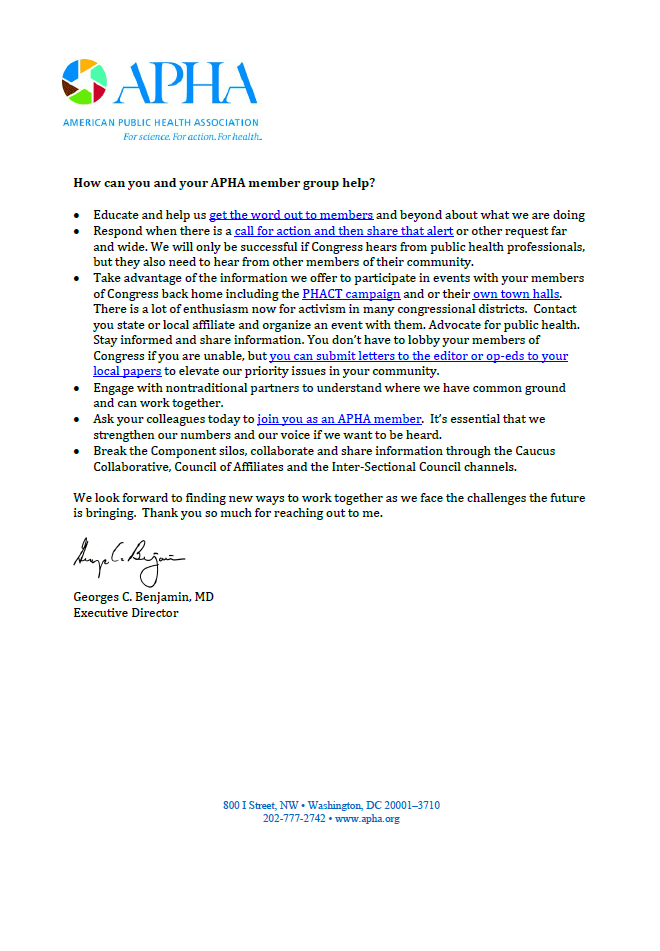
Dr. Georges Benjamin responds to APHA members and Section Leaders

Read Dr. Georges Benjamin’s response to our open letter and learn how you can be involved in public health advocacy efforts:

page 1
Page 1
page 2
Page 2