
h/t Amanda Makulec
Video: “It’s a Girl” Documentary Trailer
h/t Amanda Makulec

h/t Amanda Makulec
ASPH has recently released a draft of its Global Health Competency Model, a set of competencies recommended for graduates of master’s level programs in global health. They are based on the organization’s MPH core competencies and are divided in to seven “domains,” or categories. According to the draft,
…formal educational programs for global health professionals are highly fragmented in terms of the institutions offering such programs and quite varied in terms of the outcomes and qualifications expected of graduates. As the number of institutions offering formal training in global health grows, ASPH has taken leadership in developing a competency model based on the necessary roles and functions of the global public health system of the future. This approach recognizes that global health and public health represent a unified front with a long tradition of bringing scientifically-validated programs, policies, and services to bear upon the world’s most pressing health needs. A Lancet article in February 2010, in which ASPH global health leaders sought to emphasize the common framework of global health, international health, and public health, stated that “[g]lobal health and public health are indistinguishable,” further defining the scope of this initiative.
The document (pdf) can be viewed here. Below is a screen grab of the competencies.
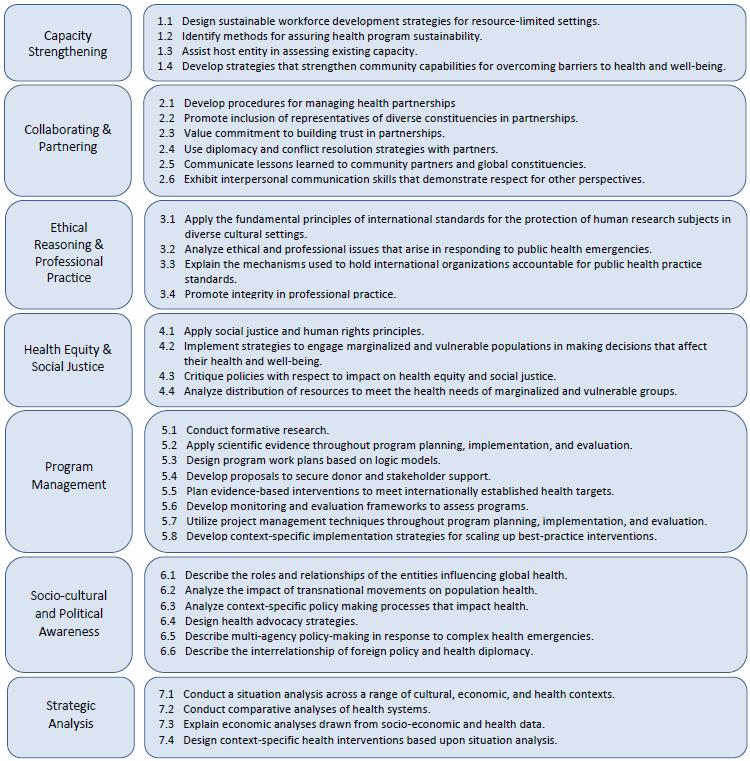
ASPH is calling for comments on the draft by Friday, September 23. Comments may be sent to ghcompetency@asph.org.
Evaluation Fellows Program
Office of the Associate Director for Program, Centers for Disease Control and Prevention (Atlanta, GA)
CDC-OADPG-2011-0032
Project Description:
CDC seeks applicants for the inaugural class of the CDC Evaluation Fellows Program. This is a new initiative within CDC and represents a major commitment by the Agency to program evaluation and program improvement. Fellows will be selected and will be housed in the newly-created Office of the Associate Director for Program and collaborate with the evaluation team under the leadership of CDC’s Chief Evaluation Officer. Fellows selected for this new initiative will be assigned out to CDC programs to help develop and implement program evaluations and evaluation studies. These host programs will be selected through a competitive process to ensure Fellows are being assigned to important and productive evaluation projects that will build the knowledge base of the program and enhance the professional development of the Fellow.
Fellows will conduct evaluations and help to build the evaluation skills and capacity of the staff in the program to which they are assigned. Fellows may be assigned to one program/project for the duration of their fellowship or may rotate to several programs, depending upon the duration of the project. Fellows will have a point of contact within the program as well as mentoring and support from AD Program staff. In addition, we have reserved some dedicated resources for training and professional development of Fellows.
The participant will receive a monthly stipend depending on education level and experience. The participant must show proof of health insurance. The appointment will be full-time at the CDC in the Atlanta, Georgia area. Participants do not become employees of CDC or the program administrator, and there are no fringe benefits paid.
Additional details regarding the ORISE Research Participation Program can be found at http://www.orau.gov/cdc
Qualifications:
The ideal candidate has a PhD in evaluation, social sciences, public health, or other relevant discipline plus some experience with applied evaluation projects. Master’s-level candidates with significant experience in applied evaluation projects are also welcome. Candidates must have received their degree within the past five years to qualify for this program.
Technical Questions:
The Research Participation Program for CDC is administered by the Oak Ridge Institute for Science and Education. To be considered, send a current resume to Tasha Powell via email at Tasha.Powell@orau.org or via fax at (865) 241-5219. Please reference Project # CDC-OADPG-2011-0032 in all communications.
SECTION NEWS
The following announcement is from Peter Freeman, chair of the section’s Advocacy and Policy Committee, regarding their first Advocacy Day to take place in conjunction with this year’s Annual Meeting in Washington,DC.
To all International Health Section Members:
The Advocacy/Policy Committee would like to invite you to participate in our first Advocacy Day, led in partnership with the Global Health Council. The day, scheduled for Thursday, November 3rd, 2011, will be an opportunity for us to voice support for a continued focus on international health to our elected officials. With the intense Congressional pressure to cut the budget, our voices can make a real difference. As a participant during this exciting day, you will be provided with training materials on effective advocacy techniques to ensure your message is clearly heard. Even if you do not have advocacy experience, you need not hesitate to sign up because you will be teamed with others. Please consider joining your fellow International Health Section members on Thursday, November 3rd, 2011 on Capitol Hill to advocate for a healthy globe.
Interested parties should contact Peter Freeman, Advocacy/Policy Committee Chair, at pffreeman@gmail.com or 773.318.4842 with their name, phone number and e-mail address. A registration link for the Advocacy Day will be sent out to the section by mid-September; please be on the lookout for it.
August 20 was World Mosquito Day.
On August 22, the Gates Foundation celebrated its 12-year anniversary (well, sort of).
POLITICS AND POLICY
PROGRAMS
RESEARCH
DISEASES AND DISASTERS
INFOGRAPHICS AND OTHER INTERESTING VISUALS
Thanks to Tom Murphy and Mark Leon Goldberg, Tom Paulson, and Isobel Hoskins.
SECTION NEWS
The following announcement, from Eric Williams, calls for any IH section members interested in assisting efforts to address federal global health and HIV/AIDS funding. Please see the text of the announcement below. Eric can be contacted by e-mail at ericwms@gmail.com.
Dear Colleagues,
I’m writing to request assistance in a “grasstops” effort to address federal global health and HIV/AIDS funding. As you are likely well aware, there have been serious threats and concerns regarding global health funding over the last several years. There is a real need to mobilize influential members of our community in an effort to ensure that Congress does not backtrack on our global health commitments.
I am doing some consulting work with amfar and they want to identify experts, donors, high-profile individuals and/or organizations in select states who can reach out to key Senate leadership. We need these individuals/organizations to show and voice their support for continued and sustained commitments for global health.
States of focus include Nevada (Sen. Harry Reid), Iowa (Sen. Tom Harkin), and Washington (Sen. Patty Murray). We believe these senators are in key positions to influence appropriations decisions and sure up support for global health.
The aim of this effort is to:
- identify grasstop individuals/organizations and
- plan, coordinate, and carry out outreach efforts to Senate leadership in a variety of ways, including state-level meetings, Hill visits, op-eds, sign-on letters, and so forth.
If you are interested or able to provide assistance in helping to identify and/or reach out to the above stakeholders, I would be very interested in speaking. If there is strong support for this I would be happy to facilitate a conference call to discuss in full.
August 19 was World Humanitarian Day.
POLITICS AND POLICY
PROGRAMS
RESEARCH
DISEASES AND DISASTERS
INFOGRAPHICS AND OTHER INTERESTING VISUALS
Thanks to Tom Murphy and Mark Leon Goldberg, Larry Johnson (filling in for Tom Paulson), Isobel Hoskins, and Jeff Meer.


