Call for Papers: AJPH Special Edition on Climate Change and Health

This announcement is posted on behalf of Rose Schneider, the IH Section’s Climate Change and Health Working Group Chair.


The American Journal of Public Health (AJPH) intends to publish a supplement issue on the topic of Climate Change and Health: Research, Translation, Policy, and Practice. Climate change is widely considered the greatest challenge to the public’s health. This issue will showcase scientific research that evaluates the degree to which climate change is a present-day and future threat to population health and health equity and highlight emerging and innovative evidence, strategies, solutions, and policies to address the health and equity consequences of climate change. Original research articles, briefs, systematic reviews, commentaries, editorials, as well as analytic, photographic, and historic essays on the health and equity impacts of climate change are invited. Papers that highlight translational practices as well as evaluation or policies that demonstrate advancement of health and equity are encouraged. Topics of interest include, but are not limited to, best-practice models, co-impacts of climate change and other policies, economic evaluation, climate literacy and communication, and gaps in research, policy, and practice implications related to climate change adaptation, community resilience, and mitigation.

Potential authors should visit the AJPH website (www.ajph.org) to review the Instructions for Authors and specific guidelines for the various types of manuscripts. All manuscripts will undergo standard peer review by the AJPH editors and peer referees as defined by AJPH policy. Manuscripts must be submitted April 1, 2017, via the online submission system at http://editorialmanager.com/ajph.

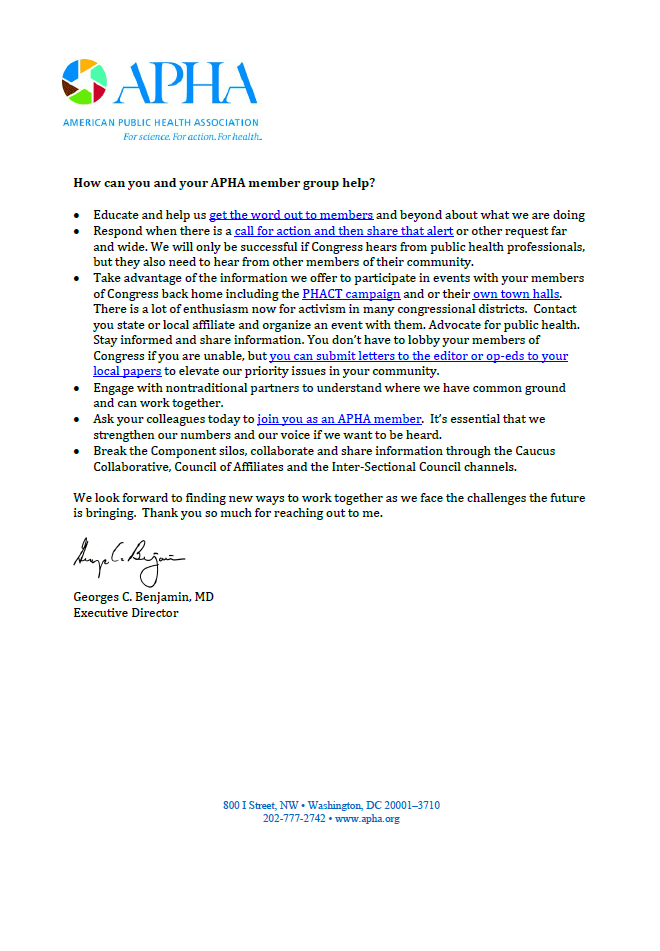
Dr. Georges Benjamin responds to APHA members and Section Leaders

Read Dr. Georges Benjamin’s response to our open letter and learn how you can be involved in public health advocacy efforts:

page 1
Page 1
page 2
Page 2

Five important business lessons I learned from developing country public health professionals

This is a guest blog post by Dr. Sharon Rudy, IH Section member and director of the Global Health Fellows Program II. It is the first in a three-part series the IH Blog will feature this week, Global health career insights: Lessons on the job market, how to crack it, and what to do once you’re in.


You might say I stumbled into my dream job. Although I was an exchange student in college, I never meant to end up in an international career (and certainly not advising about careers!).

I spent my senior year in The Netherlands where I thought I was really roughing it – little did I know what lay ahead. In fact, I can remember praying that I NOT be called to the “Mission fields” overseas. I felt a bit guilty about it, but I just never wanted to be uncomfortable.

After a few years of working in low-level administrative jobs in hotels, law firms, retail, and a yacht brokerage, I was so ready for graduate school to open all the doors. With a new Masters and Ed.S degree in Counseling, I just needed to work and wasn’t looking for an international setting. However, I unknowingly clinched the deal when an interviewer from an international exchange program asked me what I had learned from living abroad. I said, “What it means to be an American.” That was, evidently, a brilliant answer.

I got the job and spent the first 15 years of my professional life working in international exchange with a deep focus in cross-cultural adaptation, à la the Peace Corps. My Ph.D. dissertation was on how Americans adjust to cultural change and I’ve always felt strongly that in all the jobs I’ve had, good relationships are just as critical as technical expertise. In fact, as the Director of USAID’s flagship global health fellowship program, when I’ve had to fire an underperforming fellow, it has rarely been about technical skill. More often, problems come from their inability to connect with their team, their clients, or their colleagues.
It’s strange to me that when I started working in international development almost 30 years ago, everyone just assumed you were culturally competent and were happy to throw you into an environment that requires the highest levels of cross-cultural know-how. GHFP-II’s research, conducted with almost 50 global health employers, underscores the wide gap between the in-demand skills needed to succeed in global health and those being taught in the classroom. One skill cluster is the ability to thrive in a multi-cultural environment, take in new information, and adapt to your circumstances.

Here are five key lessons I learned from the patient, long-suffering developing country public professionals, including USAID Foreign Service Nationals (FSNs), who took pity upon me and showed me the ropes:

1. When you begin work as a technical adviser, your two immediate overriding objectives should be to establish trust and to demonstrate that you can add value. Seek first to understand by practicing active listening. Their country interests override anything else so try to identify what those interests are. Don’t be afraid to show initiative in learning the full truth. Initially, they may only be telling you what they think you want to hear.

2. Practice humility. A lack of humility destroys trust. Don’t assume you know more than your host counterpart. You will never know all the answers, so it is the attitude of empathetic awareness that allows mistakes to be forgiven. It’s not about you proving yourself with a barrage of data and other-country stories. Don’t try to establish the relationship by showing off your expertise and knowledge, especially by going quickly to the solution. This will result in a quiet “sigh” from your colleagues that you might not even notice in your hurry to fix things. Trust me, you aren’t the first American who has come their way, ready to fix everything, and you probably won’t be the last. Instead, find a way to balance the power and privilege that is reflected in your being an American, with access to American institutions and American resources, with an acute awareness and a learner’s heart.

3. Be their champion. Although complete “country ownership” rarely happens, it has to be an authentic, high priority for you. This means you are coming into the relationship with a focus on a post-“you” environment. Remember, it’s their country, not yours. Decisions will stick only if they truly own them. In communication about your work, promote the real picture of your host country – it usually differs from international media stories. Be generous about helping your local counterparts make connections with the international community and make available all your “secret” resources and technical knowledge. This is a joint venture with peers, so start it with a sense of mutual respect and a culture of sharing. Value local talent and make the best use of it to make your work more meaningful and sustainable.

4. Respect the culture. Make efforts to understand local norms, culture, and traditions. Seek to understand how people approach key issues in their daily life. No culture is a monolithic construct, but rather an intricate web of narratives. For example, in most cultures, family importance can’t be overstated, so don’t blow off dinner with your new colleagues so you can send emails. Even though USAID is an American agency, and local public health professionals, including the FSNs, have adapted to that reality, the most important things are happening outside the compound. Cultural competence is never a “checklist” and, admittedly, you can never learn everything about the culture, history, and politics of the country you are involved in, but honest efforts will be noted and appreciated.

5. Solutions must be contextualized within existing systems and structures. Don’t assume you have the answer even if you easily see all the things that are wrong. Seek to cause change in slow, measured steps to avoid negative or unintended consequences. Don’t offer solutions without understanding host country systems. Remember, not everything local needs to change – there are best practices already in place in your host country. And don’t assume that modern technology will magically fix everything – context and environment matter.

So, thank you to my developing country public health professional colleagues for being too dignified to criticize, for your patience with us as we come and go in your country, and for your generosity of spirit and forgiveness of my many mistakes over the years! I have learned so much from you, and continue to, even to this day.


These are valuable insights for professionals who are currently in global health practice. However, breaking into the technical advisor role is becoming increasingly challenging for recent graduates and aspiring global health professionals. Please stay tuned for the second part of our series, “Five sobering job search lessons I learned from analyzing the global health job market.”

Professional Certificate Program: Health & Humanitarian Supply Chain Management (May 15-20)

Georgia Tech’s Center for Health and Humanitarian Services (CHHS) is offering an upcoming Professional Certificate Program in Health & Humanitarian Supply Chain Management, to be held May 15-20th, 2017 at GA Tech’s Global Learning Center. 

2017 courses include:

  • Pre-planning Strategy for Health and Humanitarian Organizations MAY 15-16
  • Tactical Decision Making in Public Health and Humanitarian Response MAY 17-18
  • Systems Operations in Health and Humanitarian Response MAY 19-20

Program overview:

The certificate program is designed for practitioners in private industry, non-governmental organizations (NGOs), government, military, and others who are active participants or interested in health and humanitarian operations, including both disaster response and long-term development. The goal of the program is to enhance the knowledge and experience of participants on logistics and supply-chain topics related to a broad range of activities including preparation, response, and recovery from natural and man-made disasters as well as ongoing humanitarian crises due to war, famine, infectious diseases, and chronic health problems. Click here for a summary of the May 2016 certificate program with reviews from past participants or watch the course webinar for further details about the topics covered.

Courses include many interactive components, such as case studies, simulations and games, which help professionals to link the challenges and decision-making tradeoffs they face in everyday practice with the systematic approaches, tools, and techniques presented in the course. Upon completion of the requirements for the three courses, participants will receive an official certificate from Georgia Tech in Health & Humanitarian Supply Chain Management.

Attendees who complete the course series will be able to:

  • Provide immediate impact to their organization through knowledge gained from applied and real-world case studies Interact with others from NGOs, businesses, and/or government entities, enhancing collaboration, cooperation, and communication
  • Build a critical knowledge base to apply analytical models to aid in supply chain management decisions such as forecasting, inventory management, and distribution
  • Develop strategies for the management and allocation of scarce resources accounting for specific product characteristics and supply chain network structure
  • Deliver best-practices for improving system outcomes of humanitarian relief efforts through coordination and collaboration among strategic partners
  • Ultimately transform the humanitarian sector with increased capacity to participate in planning and strategic decision-making for effective supply chain management

Scholarships and Sponsors:

The HHS Center is fortunate to provide a limited number of scholarships for applicants from NGOs and developing countries only, which were made possible through the generosity of The UPS Foundation, Andrea L. Laliberte, and Richard E. and Charlene O. Zalesky. To apply for a scholarship for the 2017 program,  apply online here (CHHS is accepting scholarship applications beyond the 2/17 deadline, although priority will be assigned in the order they were received). If you would like to apply after the deadline, availability is not guaranteed, but you may email msmithgall@isye.gatech.edu to inquire.

To register:

Click Pre-Planning Strategy course and then add each of the other two courses in the certificate program (found on webpage at left side)to your virtual cart before payment. Please email msmithgall@isye.gatech.edu with any questions about registration. The full program is $6,000 ($2,000 per course) whereas each individual course fee is $2400 if taken separately outside of the 6-day certificate program. The program is offered once a year in May.  To sign up for all three courses and receive the discounted $6,000 rate for the full certificate program, please use this code at check-out: SCL-HHS.

Climate Justice Changes Health: Live Webinar on February 27th

The following message is from APHA’s environmental health team.


Climate Justice Changes Health

APHA has declared 2017 as the Year of Climate Change and Health. This very special kick-off webinar is being hosted by APHA, the Public Health Institute Center for Climate Change and Health, Island Press and Security & Sustainability Forum. During the webinar, you’ll hear from speakers who are engaged in the fight for climate justice and healthy communities, to explore how climate justice is the best strategy to address both climate change and health inequities here in the U.S. and around the world.

Date: February 27th, 2017, 1:00 PM – 2:30 PM EST

Moderators: 
Linda Rudolph, MD, MPH
Director, Center for Climate Change and Health, Public Health Institute

Surili Patel, MS
Senior Program Manager, Environmental Health APHA

Speakers: 
Jacqui Patterson, MSW, MPH
Director, Environmental and Climate Justice Program, NAACP

Patricia Cochran
Executive Director, Alaska Native Science Center

Renzo Guinto, MD
Healthy Energy Initiative, Health Care Without Harm, SE Asia

Lisa Hoyos
Director, Climate Parents

Amy Vanderwarker
Co-Director, California Environmental Justice Alliance

Please Register here!


Stay involved! Follow the conversation on social media using the hashtags #APHAwebinar and #ClimateChangesHealth. For more information on how climate change impacts health, please visit www.apha.org/climate.

Questions? Contact environment@apha.org.