
Scaling Up Climate Services: Lessons from East Africa, Adaptation Community Meeting, July 20

Effectively scaling up climate services requires solid investment in observations, usable climate data, the development of demand–driven products, and the tools to use processed data. One-off climate service pilots are important to test new ideas, but a more strategic approach is needed to reach scale.

USAID/Kenya and East Africa’s Planning for Resilience in East Africa through Policy, Adaptation, Research and Economic Development (PREPARED) Project brought together key partners including national meteorological and hydrological services (NHMS), the IGAD Climate Prediction and Applications Center (ICPAC), FEWS NET/USGS, and Tetra Tech to develop demand-driven tools to develop and improve East African climate services.

This month’s Adaptation Community Meeting will highlight the experience working with these partners, which has included the development of improved climate data sets and products with national meteorological services while also establishing user interface processes in multiple sectors and with multiple applications to maximize uptake and use.

Registration deadline: Jul 20, 2017
Date: Jul 20, 2017 4:00PM to 5:30PM EDT

Speaker

John Parker is a water resources management specialist, currently serving as Deputy Director of USAID’s Sustainable Water Partnership. Previous roles have included Senior Technical Advisor of USAID/East Africa’s PREPARED Program, Team Leader for a Climate Change Vulnerability Assessment in Honduras, and Deputy Director for a regional USAID watershed management program in Central America. He has led research on water resources management, climate change adaptation and food security, and has published in leading journals, including World Development, Food Security, and Water International. He is a graduate of Tufts University’s interdisciplinary Water Program and holds dual graduate degrees from the Fletcher School of Law and Diplomacy and Friedman School of Nutrition Science and Policy.

Location

Chemonics International, Inc.
1717 H St. NW, Washington, DC 20006

Detailed directions are available at: http://www.chemonics.com/Pages/Contact-Us.aspx

To join remotely:
Online webinar – https://register.gotowebinar.com/register/1307385679763801858
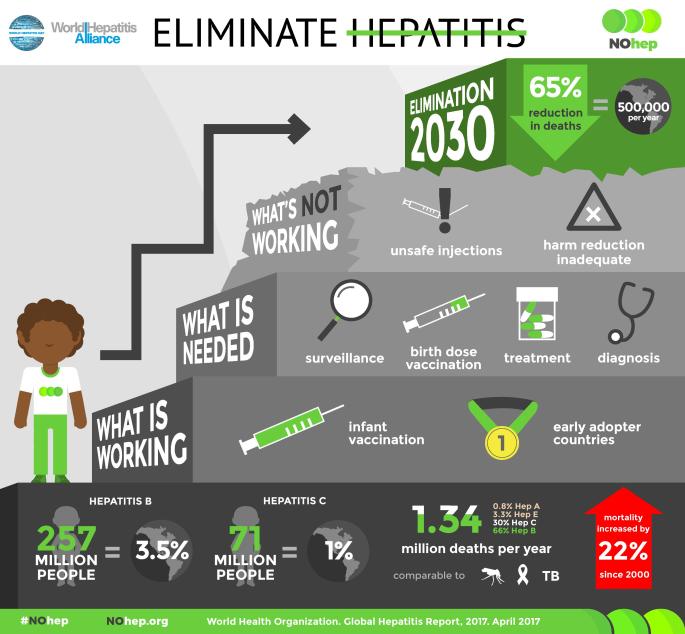
13 Years to Eliminate Morbidity and Mortality due to Viral Hepatitis- Global Partners Believe It Can Be Done!

The liver processes nutrients, helps to fight against infection, and aids in cleaning the blood in our bodies. Inflammation of the liver is generally known as hepatitis. Although hepatitis can be caused by autoimmune disorders, occur as a result of excessive alcohol consumption, or become induced after a toxin is introduced into the liver, the hepatitis of most concern has a viral origin. While there are 5 main viruses (Hepatitis A-E), Hepatitis C Virus (HCV) and Hepatitis B Virus (HBV) are responsible for the majority of morbidity and mortality cases associated with viral hepatitis infections globally- this is comparable to HIV/AIDS and TB, killing 1.34 million people a year. Hepatitis can either be acute (i.e. a short-term illness within 6 months of infection) or chronic. 75-80% of individuals infected with HCV will develop a chronic infection. The likelihood of HBV becoming chronic largely depends on the age at which infection occurs. According to the Centers for Disease Control and Prevention (CDC), 90% of infants, 25-50% of children between 1-5 years of age, and 6-10% of individuals over 5 years of age will develop chronic HBV. Although the majority of individuals are diagnosed at a young age, younger age groups are less likely to show symptoms.

Currently, there are 240 million people living with chronic HBV and 130-150 million people with chronic HCV around the world.

Risk factors for HBV and HCV include:

According to the World Health Organization (WHO), there are differences in global burden of disease trends for HCV and HBV:

  • HCV: Affects all regions although there are significant differences between and within countries. The WHO Eastern Mediterranean Region and the European Region have the highest reported prevalence of HCV.
  • HBV: Mostly affects the WHO African Region and the Western Pacific Region

The number of cases of hepatitis that are diagnosed increases every year as well as deaths, which have increased by 50% over the past 20 years. Even worse, most people with hepatitis are asymptomatic in the acute stage and the beginning of the chronic stage- those with symptoms may have fever, jaundice, loss of appetite, grey stools, dark urine, and abdominal pain.  Although a vaccine is only available to protect against HBV, effective treatment options exist for both chronic HBV and HCV. This is an important reality since therapy and proper case management can reduce the risk of complications such as cirrhosis, liver cancer, and premature death that are caused by chronic hepatitis infection. Access strategies supported by the WHO in 13 countries have helped more middle-income countries receive necessary medications such as Directing Acting Antirals (DAA). These drugs have a cure rate of over 95% within a 3-month timeframe, for HCV, and less side effects than other drugs- but 80% of HCV cases still have difficulties accessing the treatment and case management they need because it can be expensive. The WHO released the report, “Global Report on Access to Hepatitis C Treatment: Focus on Overcoming Barriers,” which discussed the importance of political mobilization, advocacy, and pricing negotiations on increasing access to necessary medications in low-middle income countries. Local, more cost-effective medications have even been manufactured in a few countries. In order to address the 80% of people still in need of help, in May 2016, at the World Health Assembly, 194 countries adopted the Global Health Sector Strategy on Viral Hepatitis with the goal of eliminating hepatitis by 2030. DAAs were also added to the List of Essential Medicines.

Information from the global strategy is incorporated into World Hepatitis Day activities. World Hepatitis Day occurs on July 28th every year and is focused on raising awareness about the global burden of viral hepatitis as well as the prevention and treatment options that exist. Watch these short videos to learn more about the WHO’s global strategy and the theme for this year!

Internship Opportunity with the Environmental Change and Security Program at the Wilson Center

The Wilson Center’s Environmental Change and Security Program is looking for the Fall 2017 class of interns, who will be based at the Wilson Center in Washington, DC. The application closes this Sunday, July 16th.

Since 1994, the Environmental Change and Security Program (ECSP) has actively pursued the connections between the environment, health, population, development, conflict, and security. ECSP brings together scholars, policymakers, media, and practitioners through events, research, publications, multimedia content, and an award-winning blog, New Security Beat.

The Environmental Change and Security Program is seeking interns to:

– Write for their award-winning blog, New Security Beat
– Network with leading experts in the environment, development, and security
– Work closely with the friendly, dynamic “Green Team” at the Wilson Center

Assignments may include:

– Researching and writing stories for New Security Beat and ECSP’s website
– Assisting with events and conferences
– Researching environment, security, development, global health, and demography topics
– Assisting the preparation of publications and/or outreach materials
– Performing administrative assignments in support of ECSP activities

Requirements

Potential interns should be students, prospective students (within the next year), and/or recent graduates (within the last year) with an interest in, coursework related to, and/or experience working on environmental and human security.

In addition, applicants should:

– Possess strong research, writing, and/or administrative skills
– Be detail-oriented
– Be able to work both independently and as part of a group

ECSP currently offers unpaid internships. They are looking for candidates who are willing to devote at least 21 hours per week, up to a maximum of 35 hours per week. Interns work seven hour days.

For the full description, list of qualifications, and instructions on how to apply, please see the Wilson Center website:
https://www.wilsoncenter.org/opportunity/internships-the-environmental-change-and-security-program

Five minutes of your time could impact Senate health care funding decisions

Posted on behalf of Paul Freeman, IH Section Action Board Representative.


We urge you to ring your local Senator to encourage them NOT to vote in favor of the Better Care Reconciliation Act (BCRA) currently being considered by the Senate. If only a few more Senators oppose the Act it will not pass.

The evidence is that senators are influenced by phone calls and letters from their local voting constituents. Cumulatively, individual approaches can influence them as much as those from large organizations that they may see as not affecting local voting.

To reach your senators, ring the Capitol switchboard at 202-224-3121. You should mention your postcode and your residence there and you will be put through to the appropriate senator’s office.  All you need to do then is again mention: who you are, your residence in their electorate, your health expertise and calmly and civilly your health concerns in as short as a few minutes.

A few key talking points against this Act:

  • According to the June 26 analysis by the nonpartisan Congressional Budget Office, the Better Care Reconciliation Act would result in 22 million Americans, including children, losing health insurance coverage by 2026.
  • The Act would greatly cut funding through the Prevention and Public Health Fund. 
  • It is critical to maintain this funding which makes up more than 12 percent of the budget at the Centers for Disease Control and Prevention. The Better Care Reconciliation Act would eliminate the prevention fund placing our nation’s health security at risk especially from new infectious disease outbreaks either man made by terrorists or occurring naturally.  The financial costs of epidemics can far out weight those in preventing them.
  • Ongoing international cooperation, epidemic surveillance and timely vaccine development and modernization of systems is needed in an ongoing manner to prevent and rapidly respond to such epidemics as the recent Zika, and Ebola outbreaks. Unchecked infectious epidemics can reach the magnitude of the Spanish flu which killed over 50 million people in 1918. Similar could well occur again if we are unprepared.
  • The Better Care Reconciliation Act would allow states to opt-out of requiring health plans to cover the 10 essential health benefits such as maternity care, mental health and substance abuse disorder services and prescription drug coverage.
  • This provision would likely lead to significantly higher out-of-pocket costs for consumers who can only afford plans that may not cover the services they will need. 
  • The BCRA would phase out the ACA’s Medicaid expansion, cut federal contributions to Medicaid by $722 billion over 10 years, and starting in 2025, would cut the federal contribution to Medicaid even deeper than the House-passed bill.

Learn more on APHA’s Health Reform page here or visit APHA’s Take Action! website.

Call for applications for 2018 Public Health Fellow in Government

APHA has put out a call for applications for the 2018 Public Health Fellowship in Government. APHA is looking for candidates with strong public health credentials who wish to spend one year in Washington, D.C., working in a Congressional office (either the House or the Senate). The fellow will have the opportunity to see first hand how public policy impacts public health and to offer their public health expertise to policymakers. Fellows will have the option of serving on the personal staff of a member of Congress or a congressional committee, working on legislative and policy issues such as creating healthy communities, improving health equity, addressing environmental health concerns, population health or the social determinants of health.

Training for the fellowship will begin in January 2018 so you must be able to move to the Washington, D.C., area. The fellowship is open to all APHA members who are public health professionals including state and local health department staff, medical, nurse or public health practitioners, nongovernmental agency staff and teachers/researchers/academics who have a demonstrated interest and ability in policy. Federal employees are not eligible for this fellowship. All candidates must have a master’s degree or a doctorate (or equivalent) in public health or related discipline. In addition, all candidates must be U.S. citizens or a permanent residents. All candidates must have five years or more of professional experience in a public health setting. Internships, graduate assistantships and residencies do not count toward the five year requirement.

Fellows receive a stipend of $70,000 for the year, and an additional $10,000 is available for travel and other related costs (including moving costs and the costs of attending the APHA Annual Meeting).

Applications, additional information and brief articles from the previous fellows are available at https://www.apha.org/fellowship. The application, including a CV and three letters of recommendation, is due to APHA by August 14, 2017. For more information, contact aphafellowship@apha.org or call 202-777-2510.