Global Nutrition-A report Card

The 2016 Global Nutrition Report, a report that assess progress towards global nutrition targets as set by the World Health Assembly,  was released in June. This annual report is the result of a comprehensive review of state of nutrition by an independent, collaborative initiative that involves a diverse set of partners.

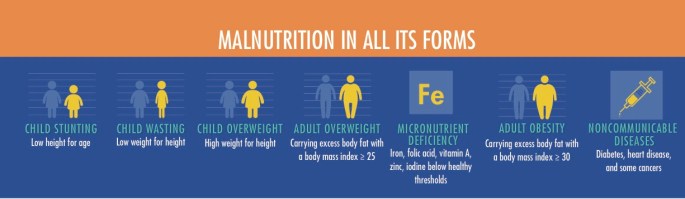
According to the latest report a staggering one in three of us suffers from malnutrition. Malnutrition is defined as “lack of proper nutrition, caused by not having enough to eat, not eating enough of the right things, or being unable to use the food that one does eat.” The one in three number reflects a spectrum of malnutrition ranging from childhood stunting and wasting to adult overweight and obesity. Malnutrition is the number one driver of global disease burden and its occurrence tends to have a cascading effect.

Malnutrition 1Image Source: Global Nutrition Report 2016, p 21.

In the last five years or so, there has been traction and investment into ending malnutrition. The global nutrition targets for 2025 set by the World Health Assembly include:

  • Achieve a 40 percent reduction in the number of children under 5 who are stunted
  • Reduce and maintain wasting in children under 5 at less than 5 percent
  • Experience no increase in overweight in children under 5 years
  • Experience no increase in obesity and diabetes (in adults and adolescents)
  • Achieve a 50 percent reduction of anemia in women of reproductive age
  • Achieve a 30 percent reduction in low birth weight
  • Increase the rate of exclusive breastfeeding in the first 6 months up to at least 50 percent
  • Achieve a 30 percent reduction in average population salt intake

According to the report there is significant variations between countries in the status of meeting the global targets. Many countries have made great progress and are on track to reducing under-5 stunting wasting, and overweight, and exclusive breastfeeding of infants younger than 6 months old. Of particular importance are data that show that under-5 stunting is decreasing in most regions except in Africa and the number of children under-5 who are overweight is increasing in Asia. Despite this success, the report points out that nearly all countries are off course with respect to global targets related to reducing anemia in women and adult overweight and obesity.

The calls to action issued by the authors of this report include:

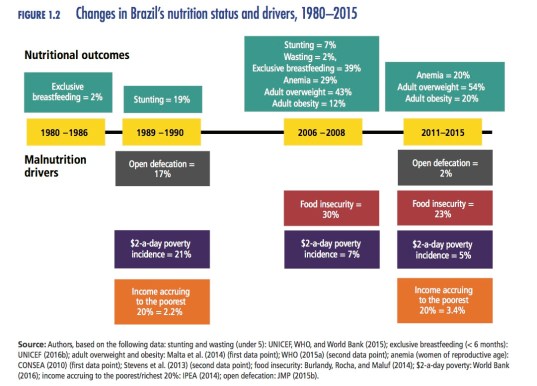
  1. Governments making a commitment to end all forms of malnutrition; dramatic reductions in malnutrition in Brazil, Ghana, Peru and Maharashtra (Indian state) were due to political choices that were made.

Malnutrition 2
Image Source: Global Nutrition Report 2016, p 33.

  1. Invest more, allocate better”: Current spending is not enough to tackle malnutrition. According to the report  government spending and funding from donors are low and remain stagnated.
  1. Collect right data: Countries must strive to fill national and subnational data gaps to understand their unique nutrition contexts that would help them act on it by maximizing investment.
  1. Support evidence-based solutions and identify new solutions: Countries could learn from successes and use proven policies and interventions to tackle malnutrition.
  1. Address all forms of malnutrition: Curbing the rise of dual burden of undernutrition and obesity (and other nutrition-related NCDs) in many low and middle income countries would require policies, strategies and interventions that can take on the double-duty of tackling all forms of malnutrition.

Given the large numbers of refugees and internally displaced people, the report does discuss the vulnerability of this group to food insecurity and malnutrition. The authors also call for better assessment of nutritional status in emergency settings, incorporating nutrition-sensitive interventions and improved accountability of nutrition actions in emergency contexts.

The report does not discuss malnutrition among the elderly or the complete lack of data that would be helpful in understanding the magnitude of this problem. What the report is also missing or perhaps not within its scope, is the importance of maintenance of agro-biodiversity in combating malnutrition. The loss of biodiversity and its impact on providing better nutrition for today and tomorrow is something that cannot be ignored.

You can read the report in its entirety here and let us know what you think!

At least one Congressman is being reasonable about Syrian refugees

In response to an online petition, Dr. Amy Hagopian, our Section’s Nominations Committee Chair, received the below thoughtful reply from her Congressman, Adam Smith (D-WA). The petition asked that U.S. welcome refugees from Syria, despite opposition from xenophobic governors around the country. Here’s a link to a petition YOU can sign!


Dear Amy,

Thank you for contacting me with your concerns regarding the situation in Syria. I appreciate hearing your thoughts on this important issue.

The civil war in Syria is a highly complex struggle between Bashar al-Assad’s authoritarian regime and the fragmented groups that oppose it. As the conflict in Syria has become more violent and protracted, radical elements that directly and seriously threaten our and our allies’ security have become more powerful. It has also become an enormous humanitarian catastrophe. Since the unrest and violence began in 2011, the number of Syrians seeking refuge in neighboring countries or Europe has increased above 4 million. The United Nations Refugee Agency reports that 12.2 million people inside Syria have been affected by the conflict, with nearly 7.6 million displaced internally.

The tragic terrorist attacks in Paris have complicated the situation even further. Our number one priority must be protecting the United States and the American people from terrorist attacks. In the strongest possible terms, I condemn the cowardly attacks in Paris and send my deepest sympathies to the victims. I also welcome the French government’s increased efforts to combat terrorists in Syria. It is important that as we fight terrorism, we must stay true to the values enshrined in our Constitution, remember that we are a nation of immigrants, and not let terrorist groups define or change who we are.

Amidst the conflict, radical groups – like Jabhat al Nusra and the Islamic State of Iraq and Syria (ISIS) – have established safe havens and where, they have attracted substantial financial resources. The strongest and most violent group, ISIS, has continued a campaign of terror and has launched violent and deadly attacks in Northern and Western Iraq. ISIS victories over the Iraqi armed forces have made them a real and dangerous threat to the government in Baghdad and the region. Additionally, the civil war in Syria has attracted a large number of foreign fighters, including from Europe, many of whom are fighting with forces affiliated with ISIS or al Qaeda. As we have seen, these foreign fighters may eventually return to their home countries or go to others where their new combat skills and increased radicalization can be used to subvert other governments.

The civil war in Syria has devolved into a protracted conflict that is dangerously destabilizing. The increasing flows of refugees to neighboring countries place a real strain on already over-burdened public services. Sectarian tensions are on the rise and can lead to further displacement of refugees as host communities become increasingly frustrated with the length of their stay. The humanitarian crisis is quickly shifting from being a consequence of the Syrian conflict to being a potential driver of conflict itself, threatening regional stability. Additionally, the increased activity of Hezbollah, the Iranian-allied militia within Lebanon, and its involvement in the Syrian conflict has escalated tensions between Lebanon and Israel, presenting a great security risk.

The United States has not turned a blind eye to the hurt and suffering of the Syrian people and has been the largest contributor of humanitarian assistance to the crisis, providing over $4.1 billion between Fiscal Years 2012 and 2015. These funds have been used to provide critical, lifesaving services for internally displaced populations within Syria and refugees in neighboring countries, including Jordan, Iraq, Lebanon, Turkey, and Egypt. Channeled through United Nations (UN) agencies and non-governmental organizations, U.S. emergency assistance provides Syrian families with food, medical care and supplies, shelter, and funding for water, sanitation, and hygiene projects.

Due to the worsening refugee situation and immediate need for increased assistance, on July 31, 2015, the U.S. Agency of International Development (USAID) announced an additional $65 million in emergency food assistance. These funds are for the UN World Food Program (WFP), which serves approximately 4 million people inside Syria and 1.6 million refugees in neighboring countries every month.

To help address the refugee crisis, I have taken a number of steps. I supported increased funding for refugee-related program in Fiscal Year 2016 so that resettlement agencies have the resources necessary to help these refugees. I believe that helping our partners in the region and European allies cope with this stressful and destabilizing situation is in our national interest and ultimately helps keep this crisis from devolving into further chaos. I also joined a letter to Secretary of State John Kerry and Secretary of Homeland Security Johnson asking them to increase the number of people eligible to apply for refugee status. I have also called for the Department of State and Homeland Security (DHS) to improve coordination of the lengthy security check process for those applying for asylum, as well as informing families when some but not all of their members have been cleared. Finally, I have joined other members in advocating for the U.S. to increase the number of refugees we are admitting through our resettlement program from 70,000 to 85,000 per year.

To date, of the millions of law-abiding Syrian refugees, less than 1,800 have been resettled in the United States. Applicants for refugee status are held to the highest level of security screening through which we evaluate travelers or immigrants to the United States. If as a result of the security process, U.S. security agencies cannot verify details of a potential refugee’s story to that agency’s satisfaction, that individual cannot enter the United States. I will continue to pursue ways to make sure our vetting process is effective, without unduly burdening bona fide refugees fleeing the terrible situation in Syria and Iraq.

To be very clear, the United States thoroughly vets all refugees. Refugees are subjected to an in-depth interagency vetting process that includes health checks, verifications of biometric information to confirm identity, and multiple layers of biographical and background checks. Moreover, applicants get interviewed in-person. Members of the interagency team includes the FBI’s Terrorist Screening Center, the State Department, DHS, the National Counterterrorism Center, and the Department of Defense. The background check process takes between 18-24 months, happens before an application is approved; and occurs long before a refugee would be able to enter the United States.

The American SAFE Act of 2015, H.R. 4038, which was brought to the House floor for a vote by House Republicans on November 19, 2015, would effectively shut down resettlement of refugees from the Syria and Iraq region. It is wrong to deny asylum to refugees on the basis of inaccurate assumptions, fear, and prejudice, and that is why I voted against it. We must continue to stand strong as an international community and remember that refugees are fleeing terrible conditions and persecution. As we move forward, let us unite to use the tools at our disposal – diplomatic, military, intelligence, and development – to defeat extremism and the terrorism it breeds.

I have also heard several concerns regarding U.S. military involvement in Syria. I am acutely aware of the great cost we incur in both blood and treasure when we ask our men and women in uniform to secure our interests abroad. I share your concerns about becoming militarily involved in another costly conflict in the Middle East. Any consideration of the use of U.S. military force is not one to be taken lightly – especially considering our experiences in Iraq and Afghanistan and the limited ability to affect certain outcomes in those countries. Ultimately, this is a fight between the Syrian people about who will control the future of their country.

The best way to protect ourselves and our allies in the region from the chaos in Syria is by building the Syrian moderate opposition’s capacity so they can stand their ground and fight this war. There is no easy way to identify those elements in the opposition that we can work with, although we have some developed some local allies, such as the Iraqi and Syrian Kurds and some local Sunni allies and are working to identify additional such forces that we can support. By helping those who are fighting ISIL, the U.S. can ensure moderate elements have a chance at playing a role in the creation of an inclusive transitional government, if a peace deal were to be reached in the future.

Due to the extremely concerning developments in Syria and Iraq, the President has taken a number of actions. First, the United States has conducted literally thousands of airstrikes intended to degrade ISIS in Syria and Iraq, reduce their ability to raise money, and to support the local allies we have identified. We are also currently retraining and equipping a number of brigades in the Iraqi Army and Congress has provided over $1 billion for this process. The President also decided that training and equipping moderate elements of the opposition was necessary in Syria. On June 26, 2014, he requested $500 million as part of a supplement to the budget request known as “overseas contingency operations.” These funds would be used to train and equip vetted elements of the Syrian armed opposition to help then fight against the Assad regime. As you may know, this training program did not meet expectations nor objectives and the training portion has been suspended. Since that time, however, the approach has transitioned to equipping moderate elements in hopes of empowering them in this fluid situation, and the President has announced that fewer than 50 U.S. Special Forces will be deployed to Syria to help accomplish this goal. I will continue to monitor developments in the region, understanding that there are always risks involved in conflict and I do not take them lightly.

Moreover, I support the Obama Administration’s diplomatic efforts to find a political solution to the situation in Syria that respects the rights of people. While those efforts have not yet produced any sort of agreement that would lead to an end of the war in Syria, I believe that it is helpful to have the major international countries that are involved in the conflict in Syria discussing possible ways to bring about a political transition and end to the civil war. Hopefully, such a course forward would also address the underlying causes of the refugee crisis. Until a solution can be found, we must continue to help those seeking refuge. We cannot let what happened in Paris cloud our judgement, drive policy or destroy the fabric of what America stands for. We need to be strong and smart to fight terrorism. If we turn our backs on refugees, then we risk making ISIS stronger.

Again, thank you for contacting me with your concerns regarding these important issues.. Rest assured that I will closely follow the continuing developments as they arise. Should you have any additional questions or concerns, please do not hesitate to contact me again.

Sincerely,

Adam Smith
Member of Congress

NYT on the relationship between health and climate change: unraveling the science is “tricky” but the risks are real

Note: This was cross-posted to my own blog.


Last week, the New York Times published a nuanced and thoughtful piece on the complicated scientific relationship between climate change and health outcomes. It lays out several health effects that advocates frequently bring up – vector-borne diseases, natural disasters, and temperature extremes – and examines the strength of the research behind each association.

The article’s tone is cautious, and it acknowledges early on that public health initiatives based on climate risk are politically fraught and, in some cases, the science is not as robust as some would like.

A White House report listed deepening risks. Asthma will worsen, heat-related deaths will rise, and the number and traveling range of insects carrying diseases once confined to the tropics will increase.

But the bullet points convey a certainty that many scientists say does not yet exist. Scientists agree that evidence is growing that warmer weather is having an effect on health, but they say it is only one part of an immensely complex set of forces that are influencing health.

“There’s a lot of evidence showing that extreme weather can hurt people, but what we don’t know is whether those effects are getting worse,” said Patrick L. Kinney, director of the Columbia University Climate and Health Program, adding that scientists don’t have the long-term data needed to pinpoint how climate change is affecting health.

Mary H. Hayden, a scientist at the National Center for Atmospheric Research in Boulder, Colo., who studies climate and health, said of dengue fever, a tropical disease carried by mosquitoes: “I don’t think we can dismiss the role of climate. But can we say there is a direct causal link? No, we can’t. It’s more complex than that.”

The central point of the article is that the science examining climate and its effects on health is (as most scientists will cheerfully admit) quite complicated, and the data that the scientific community has on the subject is incomplete and patchy for many countries and geographic regions. The upside to this, however, is that we now have much more data than we used to, in no small part thanks to increased political will and a greater sense of urgency.

Evidence is accumulating, however. In 2000, the first National Climate Assessment, a government document weaving together the best evidence on climate change, had just 21 pages on health. The most recent assessment included a special section on health that filled more than 400 pages.

Two peer-reviewed British journals — Philosophical Transactions B and The Lancet — have dedicated many pages to the topic this year. Europeans, unburdened by the level of political controversy over climate change in the United States, often give more conclusive interpretations of the science.

“We are in a far more certain place now,” said Nick Watts of the University College London Institute for Global Health and a co-author of the Lancet analysis. “We feel very comfortable talking about direct effects of climate change on health.”

One thing that the article pointed out was that the effects of climate health – particularly with regard to temperature extremes – is that they disproportionately affect the poor because they are more vulnerable to the elements. This is one thing that we focused on in the health chapter of Climate Risk and Resilience in China (which I co-authored) and why I like the idea of working to reduce climate-related risks to the most vulnerable populations, as that may be a less politically controversial option. No one can argue that many lives are at risk from a heat wave when so many have no access to AC.

Rose Schneider, the IH Section’s Climate Change Working Group Chair, agreed on that point of the article. “It makes sense to be ‘skeptical’ and it is true that especially in developing countries most is written about ‘projections’ of the effects on health, but it is true that the toll is much worse, especially on the poor, if from nothing else than major climate events like floods, windstorms, crop damage from drought, and sea rise. I liked the last line of the article; I’m not waiting.”

As Dr. Kinney noted, “if we wait for the health evidence to be ironclad, it may well be too late.”

How will a trade agreement – the TPP — impact global health?

Guest post by Mary Anne Mercer, Senior MCH Advisor for Health Alliance International and the IH Section’s liaison with the Trade and Health Forum. Mary Anne spoke at a recent activist rally in Seattle on January 31st about public health concerns related to the TPP.

Only six months ago, when the TPP, or the Trans-Pacific Partnership, was brought up in discussions, even well-informed activists generally gave blank stares.  TP what?  But in recent weeks it’s been the subject of increasing news coverage, along with exposure to the so-called fast track authority bill that would grant President Obama authority to sign the agreement without prior Congressional review.  Although extensive negotiations on the TPP have been going on in secret over the past several years, as information about the TPP becomes better known, activist groups around the world have organized to oppose it. Just what is the TPP, and why do we care about it?

The Trans-Pacific Partnership is a “trade” deal (but encompassing many other areas of corporate rights) among 12 countries of the Pacific Rim, including the United States. Official discussions are held behind closed doors without public information or input, and without input from our elected representatives in Congress, so little is known about the specific terms of the agreement.  However, WikiLeaks has published two chapters over the past few months detailing regulations concerning intellectual property and the environment. We have good reason to expect that the TPP will ratchet up terms that are prominent in existing trade agreements that have been signed between individual countries. So although only the negotiating committees, which include about 600 diplomats and corporate representatives, know the exact terms of the deal, we have substantial cause for concern.

National and international groups concerned about global health have voiced opposition to many terms of the agreement, believing that they would affect the health and quality of life of people around the world if enacted.  Some of the main health-related concerns about the TPP include:

  • Restrictions on individual countries’ abilities to pass and enforce laws protecting public health. Through a mechanism known as Investor-State Dispute resolution, corporations would be entitled to sue sovereign governments for passing laws that ‘restrict trade’ – even public health measures such as restricting tobacco advertising on cigarette packaging, which the Australian and other governments are now facing.
  • Intellectual property laws that would set up barriers to accessing generic medicines and other health commodities (including AIDS drugs), thus dramatically increasing their costs. By extending the already lengthy duration of patents and other corporate protections, Big Pharma will have an even stronger hold on the economic gains to be made from health problems around the world.
  • Detrimental effects on equity, including the distribution of income and other resources.  There is good evidence 20 years after NAFTA that poverty and inequality have increased in Mexico and wages in the US have stagnated.  The promises of NAFTA have not been kept.

But the TPP is far from a done deal.  Many progressive groups, including a number of labor, environmental and community organizations, as well as APHA’s Trade and Health Forum, are working to oppose the TPP and the Fast Track bill.

Sen. Harry Reid, Majority Leader in the U.S. Senate, recently indicated that he is not interested in having the Senate vote on legislation granting Fast Track Authority this year. There is no question that Reid’s decision is a result of mobilization of voters across the country. We need to continue to educate and inform as many people as possible about the content of the TPP and the negative impact it would have on jobs, the environment, and on public health in the US and globally.

New CSIS Book Out: Global Health Policy in the Obama Second Term (videos)

The following is a series of videos (one on each chapter) on a new book recently released by the Center for Strategic and International Studies. Basically, the book looks at the global health accomplishments and challenges in Obama’s first term and makes recommendations for his second term. Based on the interview with Dr. Morrison, who wrote the introduction, it sounds like the book has a pro-administration tone, but it is sure to be an interesting read nonetheless. Following are the videos for each chapter (except for chapter 4, which for some reason is “private”).


Introduction


In the new volume, Global Health Policy in the Obama Second Term, Dr. J. Stephen Morrison discusses major themes from his introductory chapter of Global Health Policy in the Second Obama Term.

Chapter 1: Global Health Diplomacy


Dr. J. Stephen Morrison discusses the evolution of U.S. global health diplomacy over the course of the first Obama term, as well as his recommendations for Secretary of State Kerry.

Chapter 2: HIV/AIDS


In the new volume, Global Health Policy in the Obama Second Term, Dr. Sharon Stash discusses the evolution of U.S. bilateral and multilateral efforts to reduce the worldwide spread of HIV/AIDS, as well as her recommendations for how to proceed toward an “AIDS-free generation” during the second Obama term.

Chapter 3: Malaria


In the new volume, Global Health Policy in the Obama Second Term, Dr. David Bowen discusses the progress, challenges, and his recommendations for continuing to successfully control malaria.

Chapter 5: Women’s Global Health


In the new volume, Global Health Policy in the Obama Second Term, Janet Fleischman discusses the achievements of the first Obama term in regards to advancing women’s global health, and the challenges and opportunities the administration may confront during its the second term.

Chapter 6: Multilateral Partners


In Chapter 6 of the new volume, Global Health Policy in the Second Obama Term, Todd Summers discusses the importance of the multilateral partners for realizing U.S. global health objectives.

Chapter 7: Global Health Security


In Chapter 7 of the new volume, Global Health Policy in the Second Obama Term, Julie Fischer discusses the emergence of the field of global health security and provides recommendations for how the second Obama administration can better align the objectives of the global health and security communities.