Global Health News, Week of August 28-September 3

Global Fund round 11 is now open for proposals.

GREAT LEARNING OPPORTUNITY

A seven-part webinar series, called the “Outstanding Presentations Workshop,” began this Wednesday and is available for free to all who register. Each one-hour seminar will be streamed live over the next few weeks on Wednesday and will be recorded for later viewing.  Take advantage of this wonderful opportunity to improve your presentations and spare your audiences death by PowerPoint. More information is available here, and the schedule can be accessed here.

POLITICS AND POLICY

  • In Uganda, the landmark legal case of Jennifer Anguko, a mother who died while she was in labor for 12 hours in a government hospital, will begin in early September.
  • Critics of the World Health Organization say it needs to redefine and reposition itself within the increasingly complex and convoluted field of global health. These experts suggest that the world will not suffer if the WHO cuts certain programs while narrowing its focus.
  • In the United States, the American College of Obstetricians and Gynecologists are promoting the use of IUDs as the “most effective form of reversible contraception available and safe for most women.”
  • The Global Fund may cut its contributions to China by half.
  • USAID Admin Dr. Raj Shah announced that $23 million in new aid will be directed towards the Horn of Africa crisis.
  • Anonymity is no longer a right of people seeking HIV/AIDS tests in China, and the change has lead to a significant drop in the number of tests being performed.
  • The Asian Development Bank has called for Asia-Pacific countries to collaborate on combating HIV/AIDS at the International Congress on AIDS in Asia and the Pacific.
  • Tension between the United States and Pakistan will not prevent USAID from continuing to support health, energy and education systems says the USAID Pakistan Chief.
  • The epidemics of diabetes, heart disease and cancers that have stricken the populaces of wealthy countries are spreading to the developing world, yet the United Nations lacks an agreement, let alone an overall goal, on how to limit the preventable illnesses and deaths arising from these so-called non-communicable diseases. The British Medical Journal reports many developed countries, including the U.S. and Canada, are resisting specific targets for reduction in fats, sugars and salt in processed foods.

PROGRAMS

  • Overall, more newborn children are surviving, but slower progress in cutting death rates among babies in the first weeks of life is putting the global goal of reducing child deaths by two-thirds in jeopardy.
  • One expert says as the question of aid effectiveness has moved to the centre of development debates. If donors want to make their aid more effective, then they need to engage strategically with the private sector.
  • In the Washington Post, Michael Gerson makes the “pro-life” case for increased support for contraception and family planning worldwide.
  • UNICEF and international NGOs are working to raise awareness and encourage West African communities to invest in the construction of more pit latrines. Pit latrines, say advocates, can drastically reduce the spread of diarrhea, cholera and worms.

RESEARCH

  • A study published in Lancet finds that the workers who took part in the efforts to rescue people from the World Trade Center on 9/11 are at a high risk of suffering physical and mental illness.
  • A study by the Elizabeth Glaser Paediatric AIDS Foundation in Uganda and Zambia found high rates of syphilis and HIV co-infection among pregnant women, but showed that “integrating rapid syphilis screening and HIV testing for pregnant women was feasible, cost-effective, and helped to prevent transmission of syphilis and HIV from mother-to-child.”
  • A genetically engineered virus may be the key to combating cancer, says a group of scientists.
  • Believed to only help children under four, researchers have determined that the rotavirus vaccine also reduces deaths in children between the age of five and fourteen.
  • Researchers who have tracked Haitian cell phone SIM cards relative to the cholera outbreak are optimistic that their findings will lead to future use of the same technology for other outbreaks.
  • Scientists may have found a critical weakness in Plasmodium falciparum, the parasite that causes malaria. Researchers say the discovery provides a promising target for new malaria therapies.
  • Engineers at Michigan State University are developing a low-cost mobile phone application that can detect certain types of cancer.
  • Danish scientists say mosquito populations are dropping in many parts of Africa, even in parts where there are no human efforts such as insecticide spraying or bed net distributions underway.
  • A study published in the British Medical Journal reports a 24% reduction in deaths in children who received vitamin A.
  • A new approach to malaria vaccines grows the parasite inside mosquitoes and extracts vaccine components from the salivary gland.

DISEASES AND DISASTERS

  • A study published in Nature says that the last three waves of cholera can all be traced back to the Bay of Bengal.
  • Despite a massive humanitarian effort after the 2010 earthquake, females in Haiti remain neglected, rights activists say, lacking access to care as they give birth to babies in squalid conditions, often as a result of sex in trade for food or other necessities.
  • UN FAO warns that the bird flu is on the rise in Bangladesh, China, Egypt, India, Indonesia and Vietnam.
  • Reports from the Libyan capital Tripoli say a humanitarian crisis appears to be emerging following the ouster of long-time ruler Muammar Qaddafi. There is a shortage of medicine, fuel, food, water, and power supplies, and growing piles of uncollected garbage.
  • Polio has been reported in China and Kenya.

Thanks to Tom Murphy and Mark Leon Goldberg, Tom Paulson, Isobel Hoskins, and UN Wire.
Community Health Workers: What needs to be done to help these vital workers to be most effective and sustainable? (CBPHC Workshop)

Updated September 10: Below, please find the announcement for the Community-Based Primary Health Care Working Group’s annual workshop. The CBPHC-WG holds this workshop each year on Saturday before APHA’s annual meeting in October/November.


Community Health Workers: What needs to be done to help these vital workers to be most effective and sustainable?

Community-Based Primary Health Care (CBPHC) Working Group
13th Annual Pre-APHA Annual Conference Workshop
Washington DC Convention Center Room WCC 204A
Saturday, October 29, 8:30 a.m. to 5 p.m.

Currently there is an emphasis on mobilizing community health workers as part of strengthening health services in developing countries in an attempt to help them better meet their health Millennium Development Goals. However, the mobilization of CHWs is not a new approach in itself. Anyone who has worked in developing countries for several years can relate stories about projects that included CHWs that did not motivate CHWs to practice well enough for long enough to produce sustained outcomes. What can we do now so that we can maximize the possibility of success of current projects in this regard?

This workshop is being facilitated through the collaboration of John Snow Incorporated and the CBPHC Working group. Through presentations from current experts from MCHIP and other experienced health practitioners, we will deal with the focal question of this workshop and grapple with current solutions. Workshop presentations will cover key interventions underway through the USAID Health Care Improvement Project, recommendations coming from the Earth Institute One Million Community Health Workers Technical Advisory Committee, recent findings concerning worker motivation and experience from a good cross section of JSI and NGO field practitioners.

Key presenters include Steve Hodgins, Serge Raharison, Ram Shestra and Leban Tsuma from MCHIP; Mary Carnell from JSI; Mary Anne Mercer from University of Washington; and Dory Storms and Henry Perry from Johns Hopkins University. The CORE group and NGOs are well represented through presentations by experienced experts such as Karen LeBan, Judy Lewis, Tom
Davis, Damaris Batista, Laura Altobelli and Connie Gates. Discussion and dialogue both in small and large group sessions specifically designed to stimulate input from participants will be a key part of our program. So please join us for a day of interesting, informative and enlivening discussion. REGISTER EARLY to not miss out.

To register contact: Sandy Hoar, Assistant Clinical Professor of Healthcare Sciences and Global Health, George Washington University (npaseh@gwumc.edu). Please put “CBPHC” in your e-mail heading. The only fee is $25 ($20 for students), payable at the door. To facilitate planning, please
register ASAP (the deadline is October 22nd)
and indicate if you will
be joining us for dinner afterwards at your own expense. For further
information contact: Sandy Hoar or Paul Freeman (freeman.p.a@att.net), Chairman of the IH Section’s CBPHC-WG.

How much education does it take to learn to wash people’s feet?

By Barbara Waldorf RN, MPH (candidate)
Boston University School of Public Health
Recently, in a health policy class at BUSPH, I listened to Dr. Jim O’Connell describe how, as a hot-shot young doctor fresh from being the chief resident at MGH, he was told that to start his new job at the Pine Street Inn, he would be washing the feet of the homeless clients at the nursing clinic. The struggle with his (and the medical profession’s) ego was palpable. To his credit and the benefit of thousands of homeless people over the next 20 years, he chose, in that moment, to not know, to trust the nurses and to learn a in new way.

Ruth Stark, in her training manual for working abroad, speaks of the critical importance of learning to listen when in a another country or culture. Her advice to everyone who ventures beyond their boundaries, who wishes to have an impact in a different cultural context, is to spend significant time asking questions rather than assuming prior knowledge, and to cultivate humility.

There is no doubt that facts and figures, economic theory and the scientific process are important. These can be taught. Graduate education in public health gives us the tools for financial analysis, the application of management principles and the rigor of epidemiology and biostatistics. These are the building blocks of the profession.

Yet, without the more intangible skills of listening, humility, curiosity about the unknown and a profound respect for the deep threads of humanity that bind us together, we will not be able to make the right decisions. Paradoxically, the depth of respect for, and willingness to learn from, other people’s wisdom and knowledge is based in the confidence and knowledge of one’s own culture, experience and education. Without grounding in self-respect, how can we access that which needs to be given? In order to become an advocate for real change and have the discernment to make important decisions, we need to know ourselves.

I washed the feet of homeless women at the Pine Street Inn the same year as Jim O’Connell. As a student nurse at UMass/Boston, it was my community health placement. I was young, suburban, and middle class with noe xperience of inner city, drug addicted, alcoholic or mentally ill homeless folks. I was scared and felt I had nothing to give. But as I sat with them, day after day, soaking their feet, listening, being with them as a human being, something happened.

Something was touched that opened my eyes, both inner and outer, to a very different way of being. It changed me in a fundamental way and shifted both the trajectory and context of my professional life. I owe the homeless women who allowed me to wash their feet for an education I have utilized all my life. It has taken me throughout the world, and allowed me to be with people I could not speak with; to work in situations I did not understand and to take risks and move into arenas I did not know.

That thread has led me to now pursue a Masters degree in public health, where new vistas are opening up. Understanding how economic theory explains the provision of care, finding a new perspective on health care systems and gaining the building blocks to decide when and where to intervene in complex emergencies. Something has come together here, which is the place where my education from the university meets my education from the women of Pine Street, from the Tibetan refugees I cared for in the mountains of Nepal and from my schizophrenic clients in Boston.

To answer the question, it takes a lot of education to wash people’s feet, to be present for them, to be a true advocate and to understand when to speak and when to listen.

Barbara Waldorf is an RN and working on her MPH at Boston University School of Public Health with a concentration in International Health. Having lived and worked in Asia, Europe and Australia, her current interest is in the emerging field of Global Health nursing and learning from other nurses who are active in this field.

ASPH Calls for Comments on its Draft Global Health Competencies

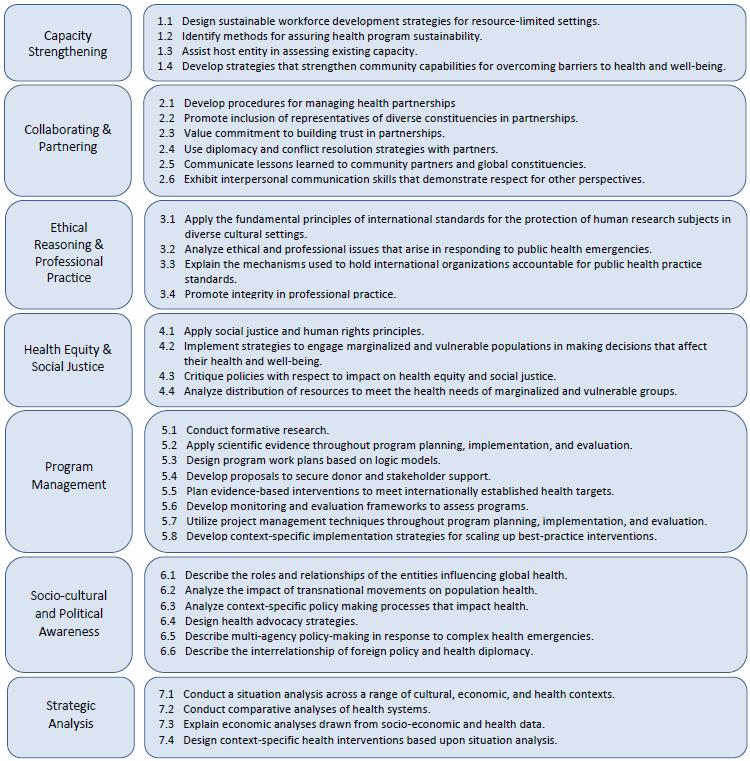
ASPH has recently released a draft of its Global Health Competency Model, a set of competencies recommended for graduates of master’s level programs in global health.  They are based on the organization’s MPH core competencies and are divided in to seven “domains,” or categories.  According to the draft,

…formal educational programs for global health professionals are highly fragmented in terms of the institutions offering such programs and quite varied in terms of the outcomes and qualifications expected of graduates. As the number of institutions offering formal training in global health grows, ASPH has taken leadership in developing a competency model based on the necessary roles and functions of the global public health system of the future. This approach recognizes that global health and public health represent a unified front with a long tradition of bringing scientifically-validated programs, policies, and services to bear upon the world’s most pressing health needs. A Lancet article in February 2010, in which ASPH global health leaders sought to emphasize the common framework of global health, international health, and public health, stated that “[g]lobal health and public health are indistinguishable,” further defining the scope of this initiative.

The document (pdf) can be viewed here.  Below is a screen grab of the competencies.

ASPH is calling for comments on the draft by Friday, September 23.  Comments may be sent to ghcompetency@asph.org.